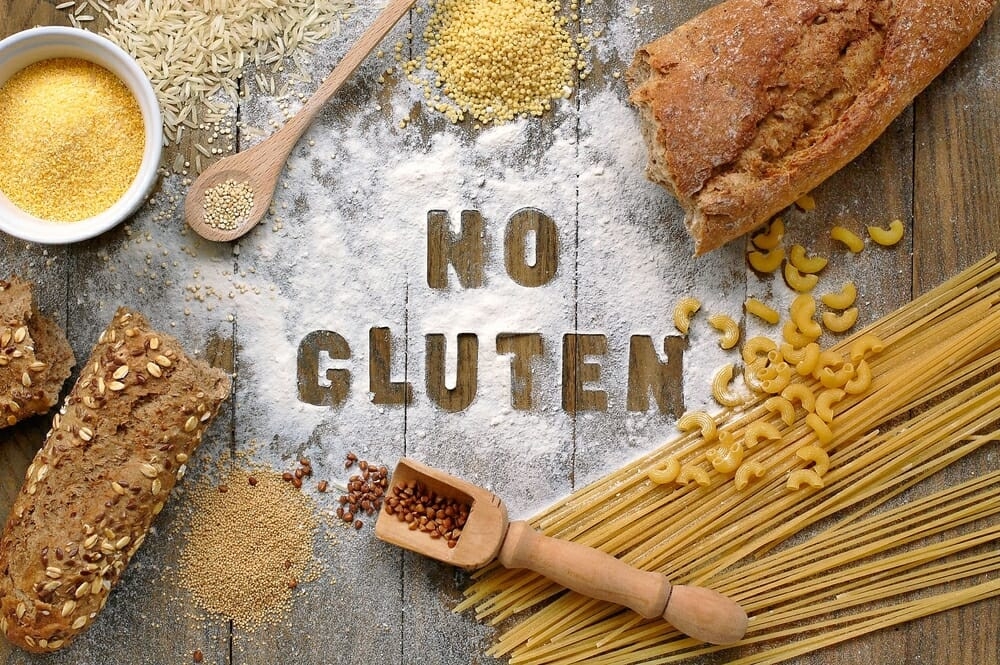
Complying with gluten-free labeling laws or certifications is essential. From raw materials and ingredients to transport, production, storage and the final product, the challenge is to make a wholesome, nutritious product that meets consumer expectations and prevents gluten contamination at every step of the production chain.
1. Understanding celiac disease and gluten sensitivity
- Celiac disease is an autoimmune disorder in which the individual develops an intolerance to gluten, present in wheat, rye and barley. The global prevalence of celiac disease is around 0.7% – 1.4% ( Clin. Gastroenterol Hepatol. June 2018; 16 (6): 823-836 ) . For consumers with celiac disease, avoiding gluten is the only option.
- The number of consumers on gluten-free diets is significantly higher (for example 25% in the United States) and growing. The gluten-free product market is booming with a CAGR of 8% – 9% (2024 – 2032). Regardless of the target customer group, gluten-free labeling laws apply in many countries. Both in Europe ( Regulation (EU) 828/2014 ) and the United States (the US FDA final rule), products may be labeled "gluten-free" if they do not exceed 20 mg/kg of gluten.
2. The challenges of gluten-free food production
Making sure products labeled gluten-free really are gluten-free can be a challenge. These challenges must be addressed in the production process to
- Sourcing gluten-free raw materials.
- Contamination in raw materials.
- Incomplete information from suppliers (analytical data).
- Cross-contamination during production.
- Inadequate cleaning of production lines.
- Errors from incorrect labeling and packaging.
- Changes to ingredients or recipes.
- Tracking gluten levels
3. Integrated solutions for gluten testing
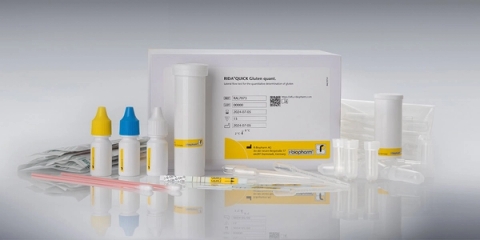
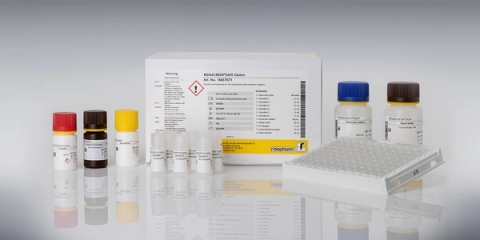
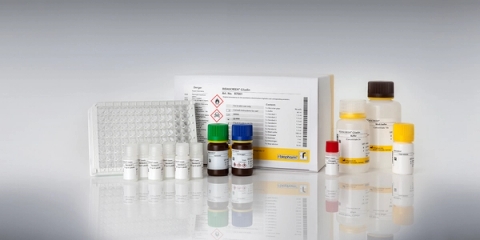
- We introduce an integrated solution for testing gluten across the entire food production chain. Our gluten test kits track gluten concentration at every step of the gluten-free food production chain and in all test environments. From the AOAC Official Method of Analysis, the RIDASCREEN® Gliadin test, gluten test strips such as the RIDA®QUICK Gliadin test and RIDASCREEN® Gliadin competitive for hydrolyzed food to the PCR-based SureFood® ALLERGEN Gluten
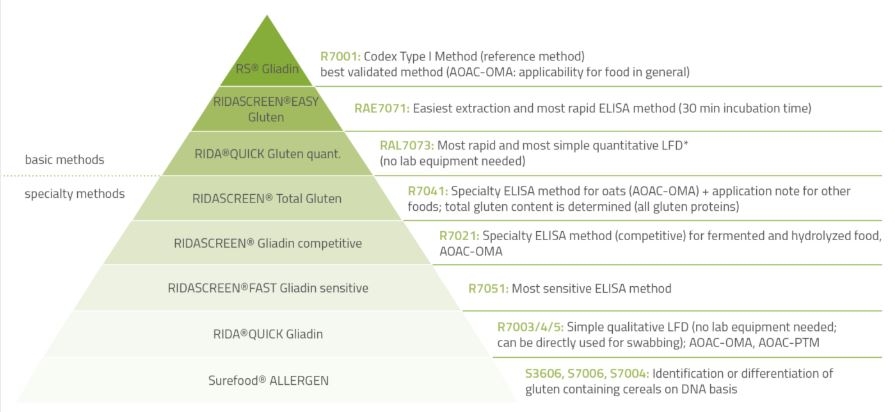
- We have added 2 completely new gluten testing methods to our portfolio. Learn more and download these brochures about our latest gluten test kits for integrated gluten management
4. Testing gluten throughout the food production chain
4.1. Raw material sources
Gluten-free crops can be contaminated with gluten-containing grains before harvest or after harvest, during transport or storage. A rapid, easy-to-use test, ideally quantitative such as the RIDA®QUICK Gluten quant is the best way to get a quick answer on the spot. Alternatively, raw materials can be tested in the in-house laboratory with the RIDASCREEN®EASY Gluten , our new rapid ELISA test for detecting gluten. If the source of contamination is unclear, our PCR testing range can help trace the source of contamination.
4.2. Transport, storage and processing
During transport, storage or processing, cross-contamination can occur if vehicles, bins, containers or production lines are used for both RIDA®QUICK Gluten quant to monitor surfaces for traces of gluten. With the RIDA® SMART APP Allergen, data can be uploaded to the RIDA® Universe cloud-based data management system for data analysis, trend analysis and fast decision-making.
4.3. Product control and quality assurance:
As mentioned in the law, a product labeled gluten-free must not contain more than 20 mg/kg gluten. Therefore, the final product can be tested by the manufacturer or by third-party laboratories for quality control purposes but also for legal compliance or compliance with certifications by official laboratories. RIDASCREEN® Gliadin combined with the Cocktail (patented) is a Codex Alimentarius Type I method (CODEX STAN 234-1999) and an AOAC Official Method of Analysis (O
5. Three analytical platforms for gluten testing
- Quantitative and qualitative rapid-tests (LFD) : These fast, user-friendly tests provide quantitative assessment of the presence of gluten, delivering reliable results in a few minutes. LFDs are ideal for on-site testing throughout the different stages of food production. With the RIDA® SMART BOX or a chosen smartphone, results can be interpreted quantitatively with the RIDA® SMART APP Allergen . A qualitative lateral-flow test is also available. You can assess the result visually or read and record it with the RIDA SMART APP Allergen.
- Enzyme-linked immunoassay (ELISA) : Famous for high sensitivity and specificity, ELISA remains the gold standard in gluten detection. The method allows precise quantification of gluten proteins in c
- Polymerase chain reaction (PCR) : PCR-based techniques identify gluten-containing grains at the genetic level, providing exceptional specificity and the ability to distinguish between different gluten sources (wheat, barley and rye). This method is particularly useful for validating gluten-free claims and ensuring product integrity.
6. RIDA® Universe: cloud-based data management
A unique feature is the integration of RIDA® Universe, a cloud-based digital data management system, into gluten testing with the RIDA® SMART APP Allergen . The system enables real-time data collection, analysis and sharing, strengthening traceability and compliance across the entire food production chain.
7. Supporting gluten-free production
- We support gluten-free production with the knowledge and tools needed to implement effective gluten management strategies. Our digital solutions streamline the gluten testing process, improve data accuracy and support proactive food safety management
If you would like to learn about the Gluten test kits we supply, do not hesitate to leave a message or contact us for product support suited to your requirements!