
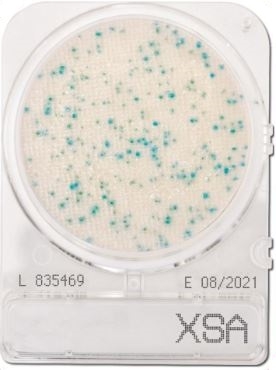
 FeaturedShimadzuCompact Dry Staphylococcus Aureus plates | Compact Dry X-SA Staphylococcus Aureus | Shimadzu
Code: 54057 · +1 order codes
Shimadzu
Compact Dry VP Vibrio Parahaemolyticus plate | Compact Dry VP Vibrio Parahaemolyticus | Shimadzu
Manufacturer: Shimadzu Diagnostics (Nissui)
Origin: Japan
Product code: 06749
Packaging: 4 plates/pack, 240 plates/carton

– Vibrio parahaemolyticus is a gram-negative, rod-shaped bacterium characterised by a curve, and it is usually motile. Vibrio cholerae, Vibrio parahaemolyticus and Vibrio vulnificus are the three pathogenic Vibrio species known from the many cases recorded.
– Vibrio is commonly found in seawater because it can tolerate high salt concentrations.
– Food contaminated with Vibrio bacteria can lead to negative health consequences, the most common symptom being diarrhoea and, in the worst case, death.
– It is therefore regarded as one of the controlled parameters for seafood and seafood-based products.
– For this reason, a procedure for testing and detecting Vibrio parahaemolyticus is recommended; and the Compact Dry VP Vibrio Parahaemolyticus plate offers convenience to the user thanks to the advantage of requiring no preparation of complex culture media, instruments or consumables.
– All the technology used for this Compact Dry Vibrio Parahaemolyticus plate is pre-poured medium. And the user only needs to extract the sample, pipette it onto the plate and incubate it.
– Simple procedure, easy to use, with no need to prepare complex equipment or consumables.
– The sample diffuses by itself, so no spreading tool is needed.
– Easy to use and no time lost training operators.
– The Compact Dry plate is easy to store thanks to the packaging of 4 plates per pack.
– Results are quite accurate, easy to interpret, and available after 20 to 24 hours.
– No dilution required.
3.1. Preparing the Compact Dry plate
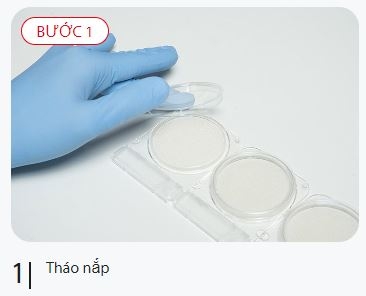
– Open the aluminium pouch
– Take out a set of 4 plates, or take the 1 – 3 plates you need, and keep the pouch sealed to prevent loss of quality due to light and moisture.
– Write the relevant information in the notes section.
3.2. Sample preparation
– Prepare the diluent: weigh 7.650g NaCl, 0.724g Na2HPO4 and 0.210g KH2PO4 in 1L distilled water, adjust the pH to 7.4 with 1N NaOH. Sterilise by autoclaving for 15 minutes at 121ºC.
– Prepare the sample dilutions:
+ Analyse 50 g of each sample. Add 450 ml of diluent. Homogenise in a stomacher for 1 minute to obtain a 1:10 dilution
+ Transfer 1 ml of the 1:10 dilution into 9 ml of diluent. Mix well to obtain a 1:100 dilution
3.3. Inoculation
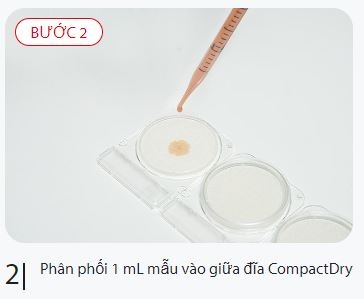
– Use a pipette to draw up 1 ml of sample
– Open the lid of the plate
– Inoculate 1 ml of sample into the centre of the plate
– Close the lid
3.4. Incubation
– Turn the closed plate over and place it in the incubator. Incubate for 20 – 24 hours at 35°C.
3.5. Reading the results
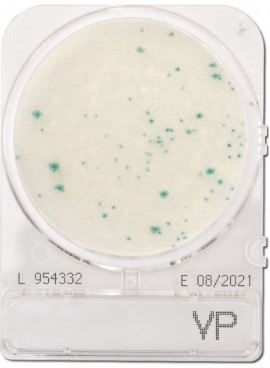
– Count the colonies that appear on the medium from the underside of the plate.
- Select plates with 10-150 colonies.
- The colonies are blue/blue-green
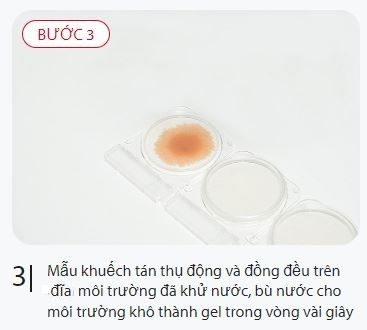
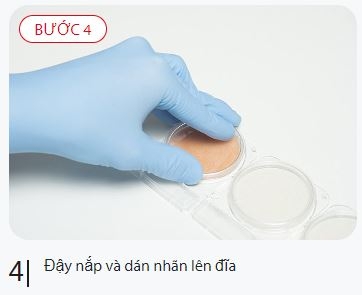
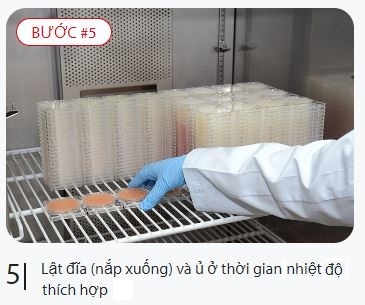
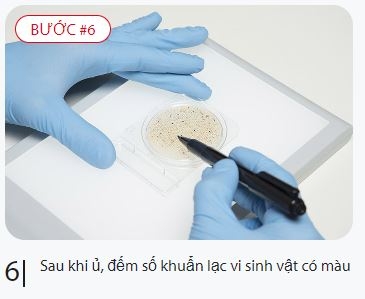
- A plate with more than 300 CFU may cause the whole colony area to turn blue. In this case the sample has to be diluted.
- After the results have been read, the plate is sterilised by autoclaving (121 °C/ 30 minutes) before disposal.
 FeaturedShimadzuCompact Dry Staphylococcus Aureus plates | Compact Dry X-SA Staphylococcus Aureus | Shimadzu
Code: 54057 · +1 order codes
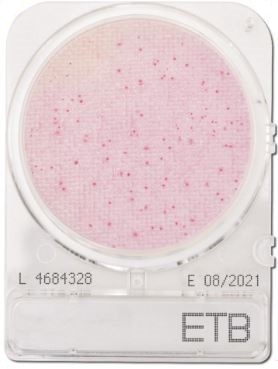 FeaturedShimadzuCompact Dry Enterobacteriaceae plates | Compact Dry ETB Enterobacteriaceae | Shimadzu
Code: 54055 · +1 order codes
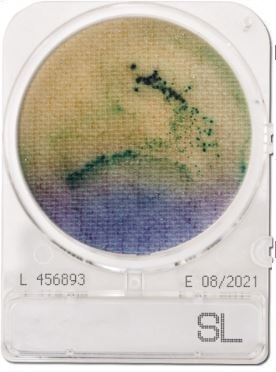 FeaturedShimadzuCompact Dry Salmonella plate | Compact Dry SL Salmonella | Shimadzu
Code: 54058 · +1 order codes
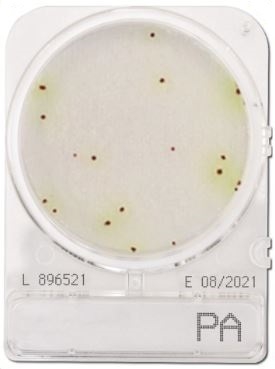 FeaturedShimadzuCompact Dry Pseudomonas Aeruginosa plate | Compact Dry Pseudomonas Aeruginosa | Shimadzu
Code: 54062 · +1 order codes