
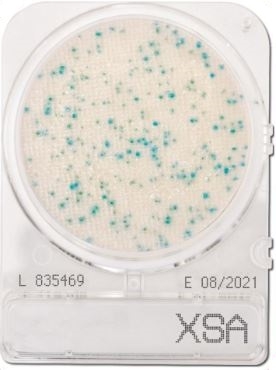
 FeaturedShimadzuCompact Dry Staphylococcus Aureus plates | Compact Dry X-SA Staphylococcus Aureus | Shimadzu
Code: 54057 · +1 order codes
Shimadzu
Compact Dry Bacillus Cereus plates | Compact Dry X-BC Bacillus Cereus | Shimadzu
Manufacturer: Shimadzu Diagnostics (Nissui)
Origin: Japan
Product code 54068
Packaging: 4 plates/pack, 1400 plates/carton

– Bacillus Cereus is a gram-positive, aerobic, spore-forming bacterium that usually thrives in soil, vegetables, raw food products and in food processing.– Bacillus Cereus spores can survive adverse conditions and germinate if conditions improve, a characteristic that makes their complete elimination difficult.– Studies show that when the bacterial population of the bacillus reaches more than 10^6 cells/g, toxins are produced; it can be an enterotoxin causing vomiting or diarrhoea due to acute nausea and vomiting; or abdominal pain and diarrhoea.– Bacillus Cereus is regarded as one of the parameters that need to be tested in meat and cooked vegetables, rice and fried foods, vanilla sauces, custard, soups, and raw sprouts.
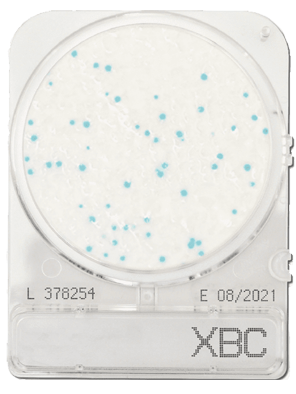
- For this reason, the Bacillus Cereus X-BC testing procedure is recommended; and the Compact Dry Bacillus Cereus plate offers convenience to the user thanks to the advantage that no complex preparation of culture media, equipment or consumables is required.
- All the technology used for this Compact Dry Bacillus Cereus plate is a pre-poured medium. The user only needs to extract the sample, pipette it onto the plate and take it to incubation.
– The Compact Dry Bacillus Cereus plate is manufactured by the renowned Japanese company Shimadzu Diagnostics (Nissui) with the advantage that all culture media chemicals are freeze-dried and coated onto one piece of fabric.
– Simple, easy-to-use procedure, with no need to prepare consumables or complex equipment.
– Easy to use, and no time lost training users.
– The compact dry plate is easy to store thanks to its packaging of 4 plates per pack.
– Results are quite accurate, easy to analyse, and available after 24 hours.
– Colonies can be isolated for biochemical testing.
- Prepare a suitable dilution buffer: MRD diluent, Phosphate Buffered Saline, saline or another suitable diluent.
– Aseptically weigh 10.0 g of sample or use a pipette to take 10.0 ml (for samples that are a solution) into a suitable sterile container (for example a sterile sample bag, a dilution bottle or a Whirl Park bag).
– Add 90.0 ml of diluent to reach a 1:10 dilution and homogenise the sample.
+ Adjust the pH if necessary.
+ The diluent usually recommended is Butterfield's phosphate buffer; maximum recovery diluent and other suitable diluents depending on BAM.
– If necessary, the sample can be diluted further.
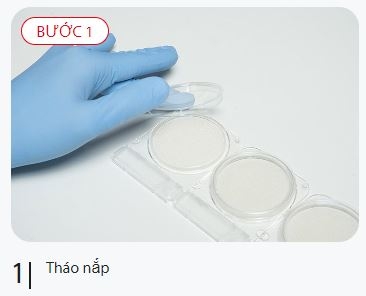
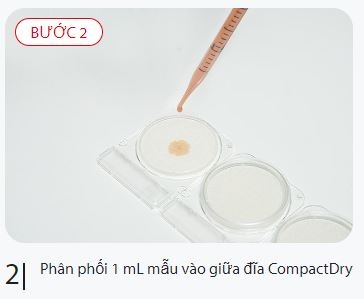
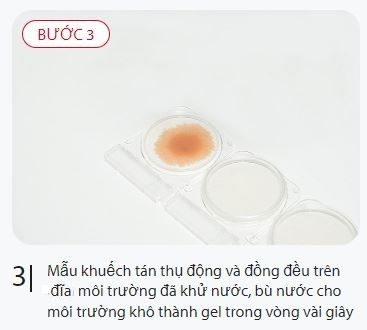
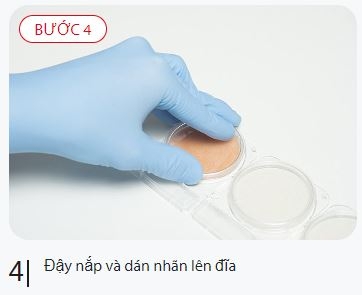
– Open the lid of the Compact Dry plate. Take 1.0 ml of the diluted sample with a micropipette and place it in the middle of the Compact Dry plate. Close the lid of the plate.
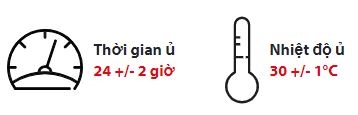
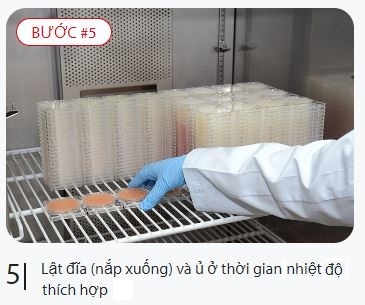
– Invert and incubate the compact dry plate under the specific incubation conditions (As recommended by the manufacturer: 35 ± 2°C for 24 ± 2 hours, per the Microval standard: 30°C for 48 hours, per the NordVal standard: 35 ± 1°C for 48 ± 2 hours).
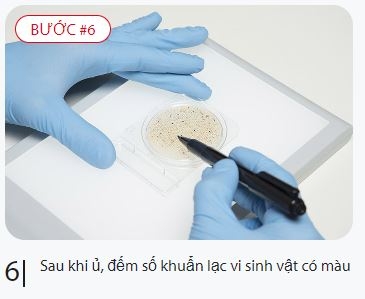
- Select plates with 10-150 colonies.
- Blue / light blue colonies for B. cereus, if blue / light blue colonies appear, confirmation on sheep blood agar must be carried out in accordance with ISO 7932.
- A plate with more than 300 CFU colonies can cause the entire colony area to develop a red colour. In this case the sample must be diluted.
- If more than 104 cfu of bacteria are inoculated onto the plate, no separate colonies are formed and the whole medium becomes stained.
- Although bacteria other than B. cereus can also grow and form white colonies on this plate, only blue / light blue colonies should be counted.
- After the results are read, the plate is autoclaved (121 °C / 30 minutes) before disposal.
 FeaturedShimadzuCompact Dry Staphylococcus Aureus plates | Compact Dry X-SA Staphylococcus Aureus | Shimadzu
Code: 54057 · +1 order codes
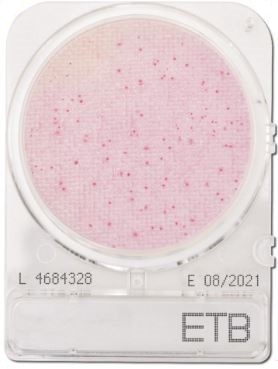 FeaturedShimadzuCompact Dry Enterobacteriaceae plates | Compact Dry ETB Enterobacteriaceae | Shimadzu
Code: 54055 · +1 order codes
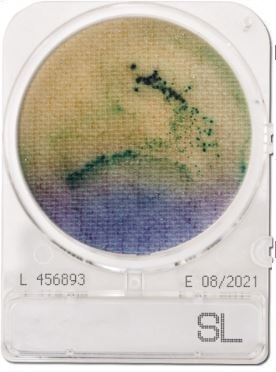 FeaturedShimadzuCompact Dry Salmonella plate | Compact Dry SL Salmonella | Shimadzu
Code: 54058 · +1 order codes
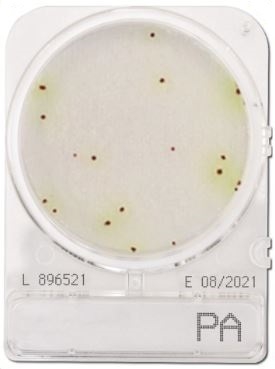 FeaturedShimadzuCompact Dry Pseudomonas Aeruginosa plate | Compact Dry Pseudomonas Aeruginosa | Shimadzu
Code: 54062 · +1 order codes