
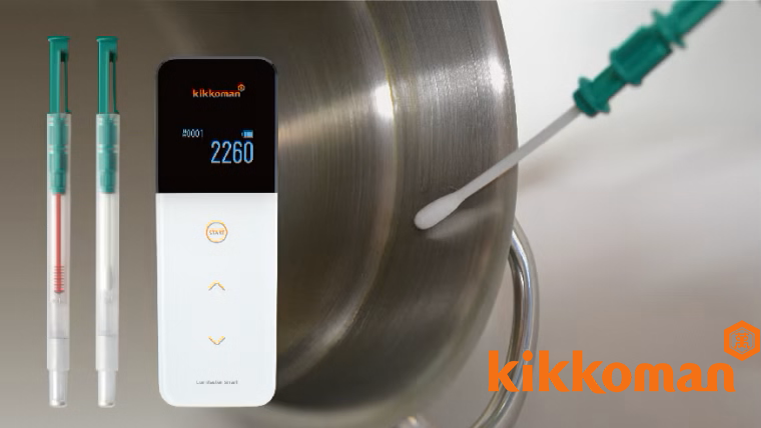
In the field of hygiene control and food safety, the ATP meter is increasingly becoming an indispensable tool for rapidly assessing how clean equipment surfaces, people's hands and the production environment are. Among the devices currently on the market, the Kikkoman Lumitester Smart stands out for its breakthrough improvements in technology, accuracy and convenience.
1. What is ATP and why measure it
- ATP (Adenosine Triphosphate) is the energy molecule present in every living cell. Detecting and quantifying ATP on a surface after cleaning helps assess cleaning effectiveness — if ATP remains, biological residue (bacteria, food, body fluids...) remains too.
- ATP is one molecule used as an energy source in every living organism. It also exists in various organic materials, and in microorganisms such as bacteria, food (for example meat, fish and vegetables), and body fluids (for example human sweat, saliva, etc.). The presence of ATP is equivalent to living cells being present. Detecting a large amount of ATP indicates the presence of food residue usually caused by ineffective cleaning. It can lead to a growing risk of bacterial proliferation in food production facilities. There is a risk of infectious agents in healthcare facilities, and of dirt remaining on surfaces from ineffective cleaning.
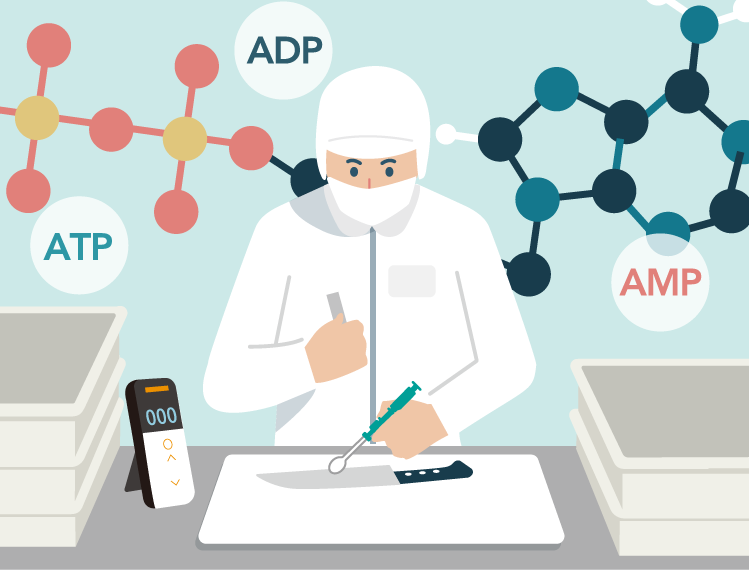
- It is also known that a relatively large amount of ADP and AMP is contained in living food cells such as meat, fish and dairy products, and in processed foods such as smoked meat and sausage.
- The ATP meter uses bioluminescence technology — the reaction between the luciferase enzyme and ATP — to measure the emitted light intensity and thereby estimate the amount of ATP remaining.
* Why measure ATP
- ATP is converted into AMP through the reaction with luciferase. The reaction releases energy accompanied by bioluminescence. The amount of bioluminescence — the light created — is proportional to the amount of ATP present. This means the amount of ATP can be assessed and quantified using an instrument that measures the light emitted by the reaction.
- The presence of a large amount of dirt (and so a large amount of ATP) on a swabbed surface leads to strong bioluminescence with a high measured value displayed on the Lumitester device. The bioluminescence is quantified in Relative Light Units (RLU).
- The new-generation ATP test (Kikkoman A3) uses unique enzymatic reactions in proprietary A3 chemistry. The measuring method uses the reagent in the Lucipac swab to convert ADP and AMP into ATP. This makes it possible to measure the total ATP + ADP + AMP. For that reason the measurement is significantly more sensitive than traditional ATP measurement.
2. Introducing the ATP Lumitester Smart
Lumitester Smart is the newest generation of ATP meter from Kikkoman Biochemifa (Japan) — a long-standing, globally trusted brand in biotechnology and food safety.
* Standout features of Lumitester Smart
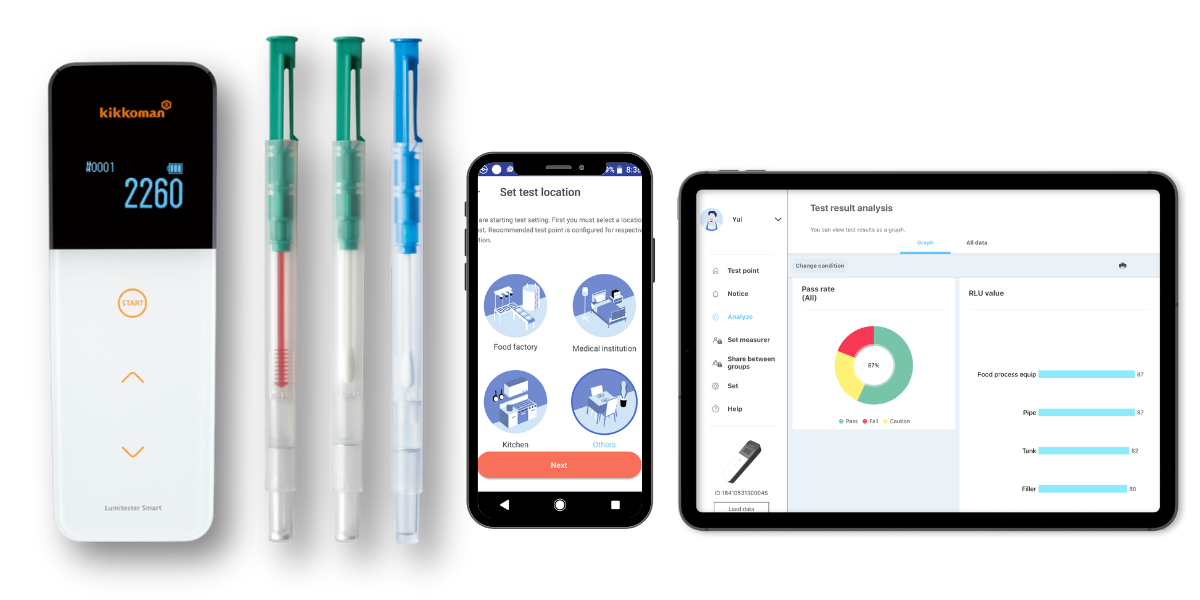
- Compact, wireless design: the Lumitester Smart is small, easy to hold, with no cables needed to connect to a computer or screen.
- Through the Lumitester app (available on iOS and Android), users receive the results right on the phone, manage data, create reports and track hygiene trends over time.
- Superior measurement performance: the device works with the LuciPac A3 swab — capable of detecting ATP, ADP and AMP at once, giving results more sensitive and accurate than swabs that measure only ATP.
- Fast, accurate results: extremely fast readout times save businesses time during testing.
- RLU quantitative assessment system: allows users to set clean/dirty judging thresholds according to the specific characteristics of their environment.
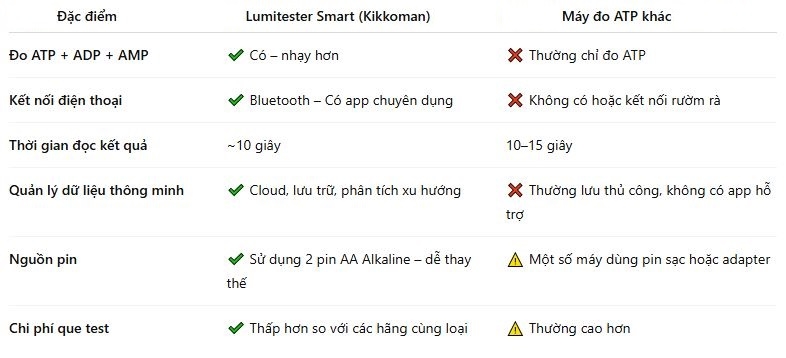
3. Comparing the Lumitester Smart with other same-type ATP meters on the market
4. Applying the ATP meter across industries
The ATP Lumitester Smart is the ideal tool for rapid on-site cleanliness checks (on-site hygiene monitoring). Below are the typical application fields:
🔹 The food and beverage industry
- Testing after equipment cleaning: measuring ATP on surfaces of machinery, conveyors, cutting blades, containers… after cleaning to assess cleaning effectiveness.
- Monitoring worker hand hygiene: directly testing the hands or gloves of production staff, especially in packing areas and raw-material handling.
- Tracking the periodic risk spots: places that are hard to clean or carry a high cross-contamination risk such as filling nozzles, handles and container lids...
👉 Benefits: minimizes the risk of microbial contamination, assures HACCP, ISO 22000, BRC and FSSC 22000 standards.
🔹 Restaurants — industrial kitchens — food service
- Testing preparation tools: knives, cutting boards, stainless trays, fryers, food trays…
- Monitoring customer-serving areas: counters, door handles, POS machines, food trays...
- Training and controlling hygiene staff: used as a tool to train and evaluate the cleaning performance of employees.
👉 Benefits: raises service quality, builds customer trust, limits food poisoning.
🔹 Hospitals — medical facilities — clinics
- Monitoring operating-room, clinic and isolation-area surfaces: hospital beds, infusion stands, door handles, buttons...
- Testing medical staff: making sure the hand hygiene procedure is followed correctly in infection control.
- Assessing the disinfection process for medical devices: rapid testing of ultrasound machines, surgical lamps, examination tools...
🔹 The pharmaceutical — cosmetics industry
- Monitoring cleanroom areas: making sure no biological residue remains after cleaning.
- Assessing the effectiveness of the production equipment cleaning process: filling machines, mixing tanks, conveyors, bottle caps, packaging...
- Controlling staff personal hygiene before entering cleanrooms.
👉 Benefits: complies with the strict requirements of GMP, ISO 22716 and PIC/S.
🔹 Education — hotels — public buildings
- Testing school industrial kitchens, public areas, elevators, stair handrails,...
- Applied in campaigns raising personal hygiene awareness and disease prevention.
👉 Benefits: raises the hygiene standards of living and study environments, especially after the COVID-19 pandemic.
The Kikkoman ATP Lumitester Smart is the perfect combination of advanced biotechnology, modern design and smart management, helping businesses control hygiene quickly, accurately and conveniently. With many superior improvements, it is one of the leading choices for organizations wanting to raise hygiene and safety standards in production and services.
See our other articles related to the ATP meter topic at: