
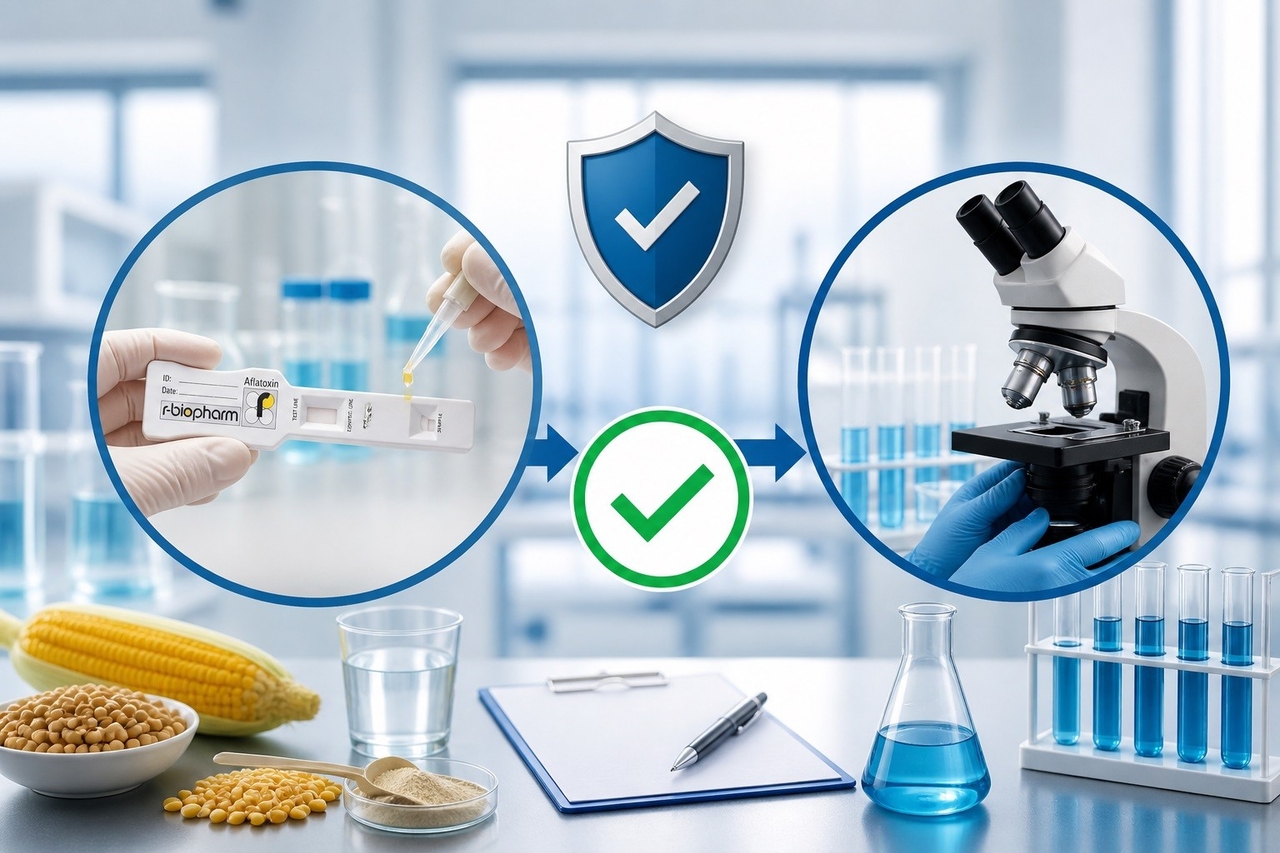
So why should businesses use rapid tests before sending samples to the lab? The article below will help you understand the benefits and practical applications.
1. Rapid tests screen samples on the spot
One of the biggest advantages of rapid tests is how quickly they return results (just 5–30 minutes).
👉 This lets a business:
- Detect early samples suspected of microbial or toxin contamination
- Screen before sending samples for official laboratory testing
- Avoid sending "failing" samples that waste testing costs
2. Significantly cuts testing costs
The cost of sending samples to a laboratory (HPLC, LC-MS/MS, PCR...) is often quite high.
👉 When using rapid tests:
- Only "at-risk" samples are sent for in-depth analysis
- The number of samples requiring formal testing goes down
- The quality control budget is optimized
This is the solution many businesses apply to cut testing costs by up to 30–50%
3. Faster production and shipping decisions
In production, time = money.
- Rapid tests help to:
- Check incoming materials as soon as they enter the warehouse
- Assess intermediate products quickly
- Make shipping decisions faster
👉 Especially important for:
- The dairy industry (Aflatoxin M1 testing)
- The coffee and cereal industries (Ochratoxin, Aflatoxin testing)
- Animal feed
4. Reduces the risk of returns or product recalls
A batch contaminated with mycotoxins or microorganisms above the allowed threshold can cause:
- Export consignments being rejected
- Damage to brand reputation
- Major financial losses
👉 Rapid tests act as the "first line of defense" that lets a business:
- Detect risks early
- Act proactively before sending samples for official testing
5. Supports continuous quality control (QA/QC)
Rapid tests are well suited to:
- Tracking microbial/mycotoxin contamination trends
- Testing many samples every day on a schedule
- Raising testing frequency without too much extra cost
They are an indispensable tool within HACCP, ISO 22000, and GMP systems.
6. Easy to use — no complex laboratory needed
Most current mycotoxin rapid tests and microbiological rapid tests:
- Require no complex equipment
- Require no advanced technique
- Can be used directly in the factory
👉 QC staff can perform them fully after basic training.
7. Combining rapid tests and the laboratory — the optimal approach
A smart business does not choose "rapid tests or the laboratory" but combines both:
- Rapid tests: screening – fast checking – cost saving
- The laboratory (HPLC, PCR, LC-MS/MS): accurate confirmation – supports legal documentation
👉 This is the most effective quality control model today.
Conclusion
Using rapid tests before sending samples to the lab not only helps a business:
- Save costs
- Speed up testing
- Reduce risk
but also comprehensively strengthens its quality control system.
👉 In an era of rising competition and standards, rapid tests are the "smart checkpoint" every business should adopt.