
1. When to enrich?
– Low microbial density in the sample: When you expect or know that the amount of microorganisms in the sample is very small and may not be enough to be detected directly on Compact Dry plates. This often occurs with drinking water samples, treated water, or high-hygiene products.
– Testing for the presence of microorganisms: In situations where it is necessary to determine whether microorganisms are present or not, even at very low density (for example: testing for E. coli or Salmonella in food or water).
– Testing for pathogenic microorganisms: For samples requiring detection of pathogenic microorganisms, an enrichment stage is usually required to ensure that these bacteria can grow and be easily identified.
* How to do it
1. Choose the appropriate Compact Dry plate:
Make sure you have chosen the right Compact Dry plate type for the microorganism to be enriched (for example: Compact Dry TC for total bacteria, Compact Dry EC for E. coli and Coliforms, Compact Dry YM for yeast and mold).
2. Prepare the microbiological sample
– If the sample has a low microbial density, use the pre-enrichment method (enrichment) in a liquid nutrient medium before inoculating onto Compact Dry plates.
– Dilute the sample if necessary, but ensure the sample volume contains enough microorganisms to be detected on the plate.
3. Incubate the sample under suitable temperature and time conditions
– Place the Compact Dry plate in an incubator at a temperature suitable for the type of microorganism being tested (usually 35°C to 37°C for bacteria, 25-30°C for yeast and mold).
– Incubation time is usually 24-48 hours, depending on the requirements of each type of microorganism. Check the plate manufacturer's documentation for the optimal time.
4. Create humidity conditions during incubation
Place the Compact Dry plate in a zip bag or a high-humidity container to prevent the plate from drying out. This is especially important when incubating microorganisms for longer periods.
5. Ensure a stable environment, do not move the plate during incubation
Avoid moving the Compact Dry plate while microorganisms are growing to avoid affecting the distribution of colonies.
6. Observe and record results
– After the incubation period, observe and count the number of colonies on the Compact Dry plate. To ensure accurate results, record the colour, shape, and number of colonies if necessary.
* Note: This enrichment method is often used when the initial amount of microorganisms is too small, requiring a nutrient medium or specific incubation conditions to enrich before inoculating the sample directly onto Compact Dry plates.
2. When should the sample be diluted?
– High microbial density in the sample: When you expect or know that the sample has a very high microbial density, such as in fresh food (meat, fish), fermented products, or untreated wastewater samples. Direct inoculation can lead to too many colonies on the plate, making accurate counting difficult.
– Ensure the colony count is within the countable range: To ensure accurate and easy counting, the number of colonies on the plate should be within the countable range, usually 30 to 300 colonies.
– Assessing microbiological quality: When the exact microorganism concentration needs to be determined, especially in shelf-life or product quality evaluation tests.
* How to do it
1. Prepare the sample and dilution solution
– Use physiological saline (NaCl 0,85%) or another suitable dilution solution.
– Ensure all tools such as pipettes, test tubes and other equipment are sterile.
2. Perform sample dilution
– The first step is to prepare the stock sample solution (if the sample has a high concentration).
– Dilute the sample at the required ratio, for example: 1:10, 1:100, 1:1000, depending on the sample concentration and the sensitivity required.
– Take an initial sample volume (for example: 1 ml) and add it to 9 ml of dilution solution to obtain a 1:10 dilution.
– Continue diluting from the already diluted sample step by step, for example, take 1 ml from the 1:10 solution and add it to 9 ml of dilution solution to obtain a 1:100 dilution, and so on.
3. Take a sample to inoculate onto the Compact Dry plate
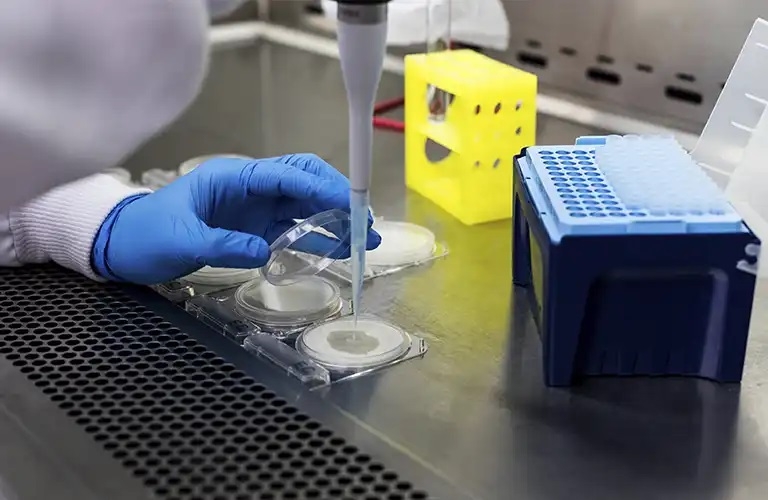
– From the diluted solution, pipette 1 ml and drop it directly onto the centre of the Compact Dry plate.
– Wait about 10-15 seconds for the sample to spread evenly over the plate surface.
4. Incubate and read the results
– After inoculating the sample onto the plate, incubate the plate at a suitable temperature and time (usually 35°C for 24-48 hours, depending on the type of microorganism).
– Read the results by counting the number of colonies growing on the plate.
* Note: Choosing the appropriate dilution level is very important to ensure that the number of colonies on the plate falls within the countable range (usually 30-300 colonies).