
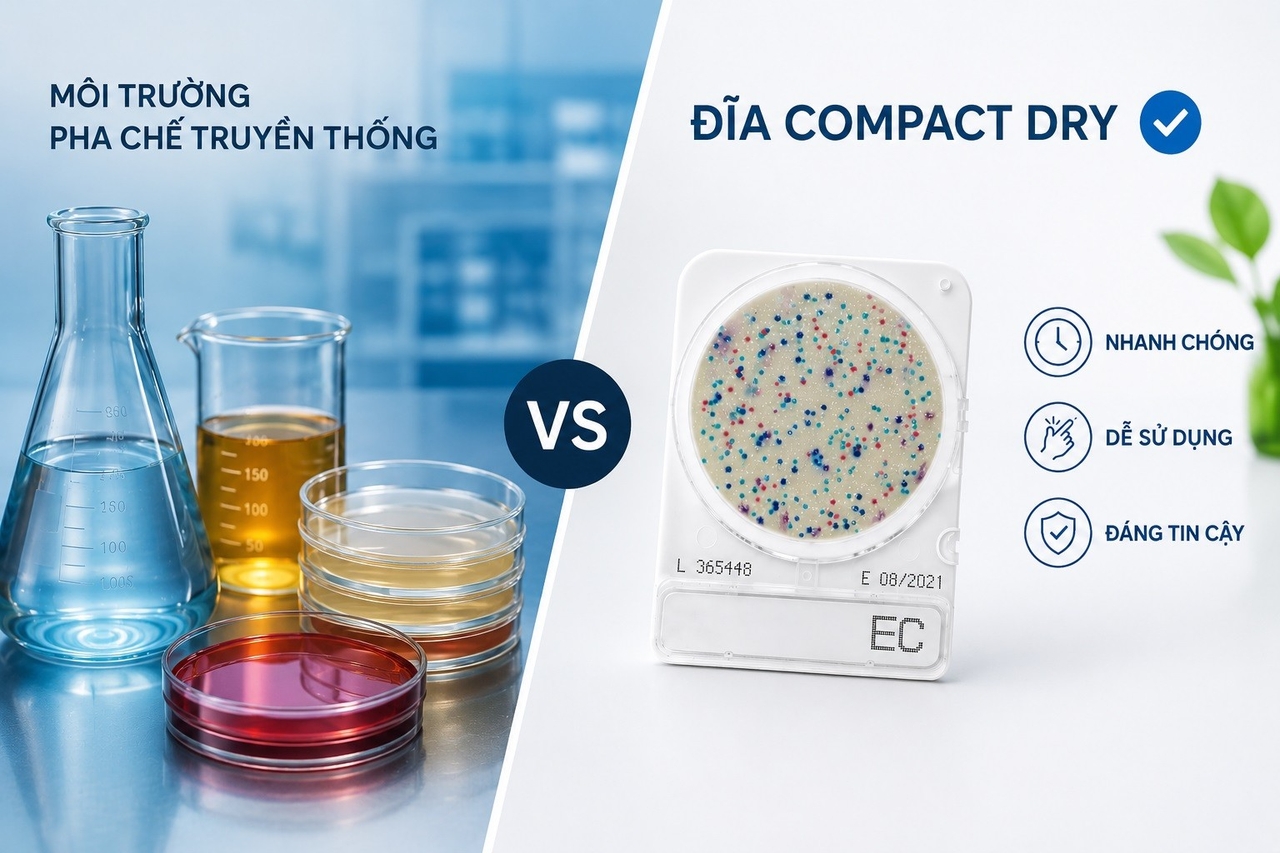
- For many years, traditionally prepared agar medium was the common choice. However, the arrival of the Compact Dry plate has brought a faster, more convenient and more economical microbiological testing solution.
- So when should a business choose Compact Dry instead of traditionally prepared media? Let's find out in the article below.
- Compact Dry is a dry microbiological culture medium developed by Shimadzu (Japan). The product is designed as a compact plate, pre-loaded with culture medium and a color indicator.
- The user only needs to drop the sample onto the plate surface; the medium absorbs the sample automatically, forms a gel and is ready for incubation.
* Standout advantages of Compact Dry
- No media preparation needed.
- No autoclaving needed.
- No agar pouring.
- Saves laboratory space.
- Reduces the risk of cross-contamination.
- Results easy to read through distinctive colors.
1. When the laboratory wants to save preparation time
With the traditional method, technicians must perform many steps:
- Weighing out chemicals.
- Preparing the medium.
- Adjusting pH.
- Autoclaving.
- Pouring plates.
- Waiting for the agar to set.
This process can take from a few hours to an entire working day. Meanwhile, with the Compact Dry plate, the technician only needs to:
- Prepare the sample.
- Drop the sample onto the plate.
- Place it in the incubator.
The entire medium preparation stage is almost eliminated.
Compact Dry is the ideal choice for QC departments that need fast results and handle many samples each day.
2. When the business wants to reduce microbiological testing costs
Many businesses only count the cost of culture media and overlook hidden costs such as:
- Electricity for the autoclave.
- Water usage.
- Preparation labor.
- Glassware.
- Equipment maintenance costs.
- The cost of disposing of leftover medium.
Using Compact Dry cuts these costs significantly. Especially for businesses in:
- Food.
- Beverages.
- Bottled water.
- Animal feed.
Reduced handling time saves hundreds of working hours each year.
3. When the laboratory does not have an autoclave
Some small and medium businesses or in-factory QC rooms do not invest fully in microbiology equipment. In this case, traditional medium preparation is difficult because it requires:
- An autoclave.
- An agar pouring cabinet.
- A medium storage system.
Compact Dry requires none of the above equipment. This is a suitable solution for:
- Food factories.
- Water bottling plants.
- Raw material testing rooms.
- In-house QC rooms.
4. When the risk of human error needs to be reduced
Traditional media can suffer deviations from:
- Weighing chemicals incorrectly.
- Mixing the wrong concentration.
- Pouring agar unevenly.
- Contamination during preparation.
Compact Dry is manufactured in advance under strict standards, so it helps:
- Ensure uniformity.
- Improve result repeatability.
- Reduce dependence on technician skill.
This is especially important for businesses applying:
- ISO 17025.
- HACCP.
- ISO 22000.
- FSSC 22000.
5. When laboratory space needs optimizing
Traditional microbiology rooms usually need space for:
- Chemical storage.
- The medium preparation area.
- The autoclave.
- The agar plate storage cabinet.
Compact Dry is compact, simple to store and does not require a separate preparation area. This helps:
- Increase working space.
- Reduce infrastructure investment.
- Optimize QC room space.
6. When on-site microbiological testing is needed
Many businesses need to perform microbiological testing at:
- Factories.
- Farms.
- Processing areas.
- Water sampling points.
Carrying traditional agar medium is quite inconvenient. Compact Dry can be transported easily and used directly on site, which helps:
- Increase flexibility.
- Shorten the time from sampling to analysis.
- Limit deviations from sample transport.
7. When many microbiological parameters need to be controlled
Compact Dry currently comes in several product lines serving different parameters:
- Compact Dry TC — Total aerobic microorganisms.
- Compact Dry EC — E. coli and Coliform.
- Compact Dry CF — Coliform.
- Compact Dry YMR — Yeast & mold
- Compact Dry SL — Salmonella.
- Compact Dry X-SA — Staphylococcus aureus.
- Compact Dry ETB — Enterobacteriaceae.
- Compact Dry LS - Listeria spp.
- Compact Dry VP - Vibrio parahaemolyticus
- Compact Dry LM - Listeria monocytogenes
- Compact Dry BC - Bacillus cereus
- Compact Dry PA - Pseudomonas aeruginosa
- Compact Dry ETC - Enterococcus
- Compact Dry TCR — Total aerobic microorganisms (rapid incubation).
Businesses can run multiple tests without storing many different kinds of prepared media.
When should traditional media still be used?
Although Compact Dry has many advantages, traditional media remain suitable in some cases:
- In-depth research.
- Isolation and identification of microorganisms.
- Trials to develop new methods.
- Tests requiring special media.
Conclusion
- If the goals of the business are rapid microbiological testing, lower operating costs, less labor and more stable results, the Compact Dry plate is a choice worth considering over traditionally prepared media.
- Especially for QC departments in the food, drinking water, animal feed and pharmaceutical industries, Compact Dry simplifies the microbiological testing process while maintaining high reliability and accuracy.