
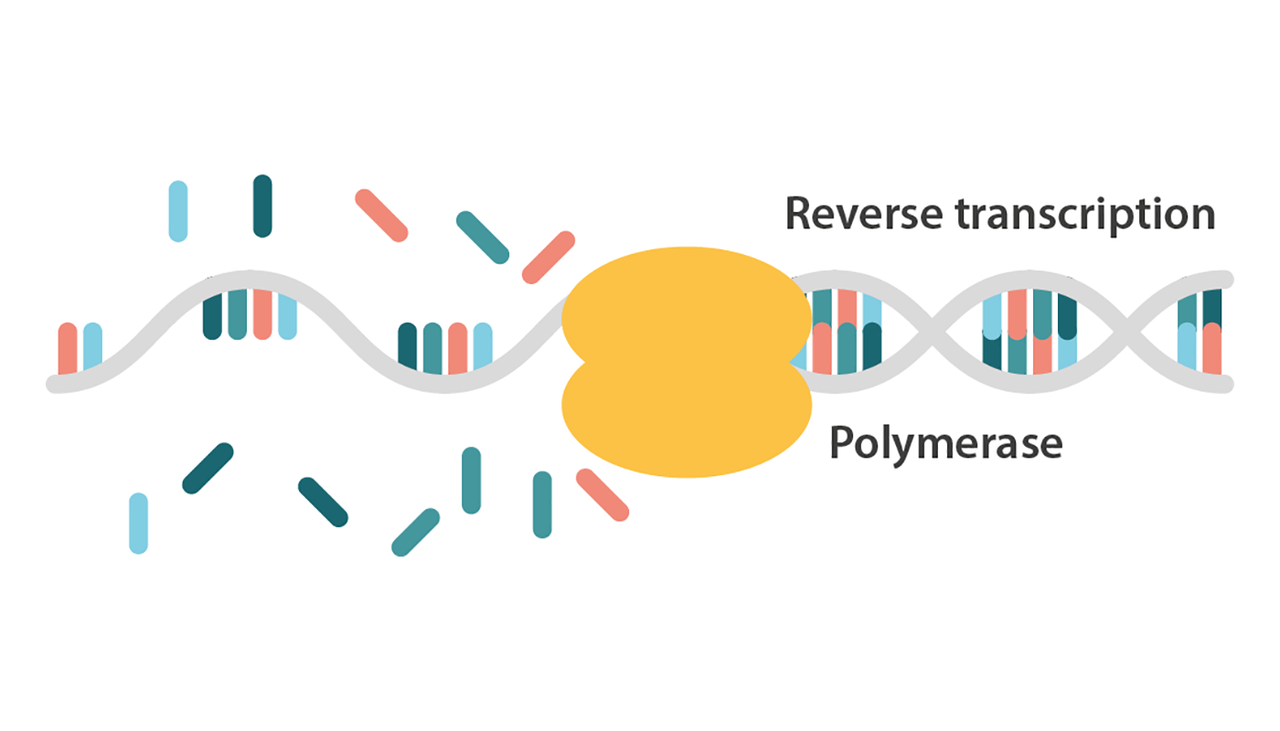
1. What is the PCR technique? (Polymerase chain reaction).
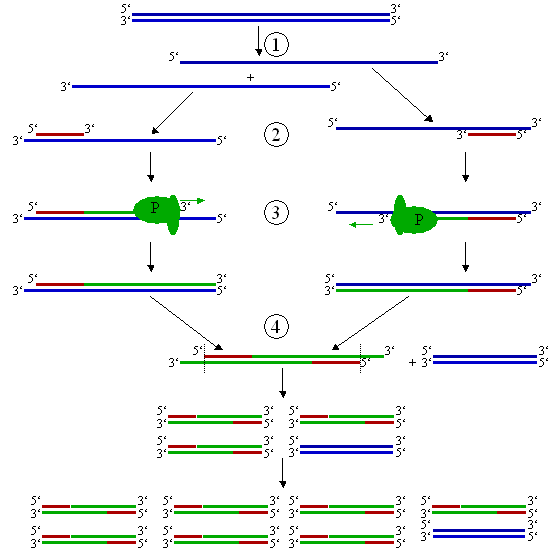
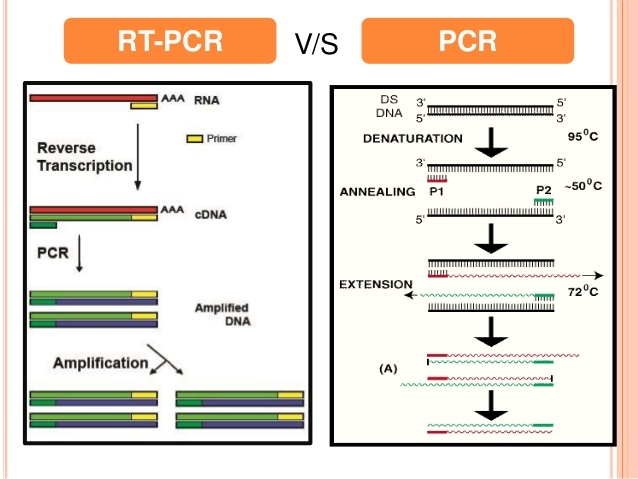
What is PCR? PCR is an abbreviation for Polymerase Chain Reaction, a technique used to amplify a DNA molecule, or a selected DNA fragment, in vitro, multiplying the original DNA to a desired quantity. The PCR process consists of 20 to 30 cycles, and each cycle includes 3 steps: denaturing the template DNA to separate the double strands, annealing the primer to the complementary sequence on the template DNA, and extending the primer to synthesize the complementary DNA fragment in the 5'-3' direction. When one cycle finishes, the next cycle begins with the denaturation step.
Step 1
Denaturation, by raising the temperature to 94–96 °C to break the hydrogen bonds joining the two template DNA strands, separating them into two single strands of template DNA.
Step 2
Once the two DNA strands have separated completely, the temperature is lowered for the primer annealing step. The primer attaches to the single-stranded DNA and the complementary strand is synthesized in the 5'-3' direction. The temperature of the annealing stage mainly depends on the primer being used, and is usually about 50 °C lower than the denaturation stage (45–60 °C). A temperature deviation at this stage causes the primer to bind incompletely to the template strand or bind arbitrarily, which produces unwanted point mutations.
Step 3
This step is called elongation. DNA polymerase attaches next to the primer and runs along the DNA strand, synthesizing the complementary fragment in the 5'-3' direction. The temperature of this step depends on the DNA polymerase. The time depends on both the DNA polymerase and the length of the DNA fragment to be amplified.
Within one hour, amplification can reach one million times. The amplified DNA can be detected by various methods, the most common of which is electrophoresis on an agarose gel stained with ethydium bromide. Today, to reach high accuracy in both qualitative and quantitative analysis at the same time while saving handling time, modern devices such as the Real-Time PCR machine can be used as a replacement.
You have surely now understood clearly what PCR is from the presentation above. Next, let's continue learning about the applications of the PCR technique in medicine.
2. Applications of the PCR technique in medicine and related fields.
From a very small amount of DNA such as a drop of blood, a strand of hair, or a cell, the PCR technique allows precise and ordered amplification of a large amount of target DNA for experimental purposes such as gene mapping, gene detection, point mutation detection, gene cloning, DNA sequencing, etc.
For these experimental purposes, PCR is now widely applied in medicine: diagnosis; cancer screening (detecting HPV in cervical cancer, finding the BRCA1-BRCA2 gene in breast cancer screening, detecting the APC gene in colon cancer, etc.); detecting sickle cells by finding the point mutation at position CvnI; research on the human lymphocyte antigen system (HLA); detecting bacteria (Chlamydia, Legionella, Mycoplasma, Treponema pallidum…), and viruses (hepatitis B, hepatitis C, HIV, Herpes, H5N1, SARS, etc.).
The PCR technique is also used to determine microbial toxins: using the primer pairs VT1-F, VT1-R, VT2-F, VT2-R, eae-F, and eae-R to detect the VT1, VT2, and eae genes of Verotoxigenic E.coli (VTEC), which can produce Verotoxin or Shiga-like toxin that damages the intestinal tract. The cholera toxin (CT) of the cholera bacterium plays the leading role in its pathogenic mechanism. PCR has been used to amplify the gene segment encoding CT (cholera toxin — the enterotoxin of the cholera bacterium), allowing a definite distinction to be made between the truly cholera-causing Vibrio cholerae and other Vibrio cholerae of the non-cholera-causing serogroups.
3. Detecting Covid-19 infection with the RT-PCR test.
First, we need to understand clearly the concept of the coronavirus that causes severe acute respiratory syndrome 2. Abbreviated SARS-CoV-2, this is a virus whose genome is a single-stranded RNA. After collecting the throat swab sample of a suspected person, the technician uses a reverse-transcribing enzyme called Reverse Transcriptase (RT) to convert the virus's RNA into cDNA and then carries out the PCR technique..
What is RT-PCR
What is RT-PCR? This is the Reverse Transcriptase-Polymerase Chain Reaction technique. RT-PCR is a molecular biology technique that allows a signal in the sample (if present) to be read in real time (realtime). The technique has 2 phases: (1) synthesizing cDNA from the viral RNA using a reverse-transcribing enzyme, and (2) amplifying the cDNA with the proper PCR technique.
If the sample contains the virus's RNA, after a certain number of amplification cycles the signal in the sample will exceed the background signal and be recorded by the Realtime PCR device. This is called the CT (Cycle threshold) of the sample. The CT value indicates the number of cycles at which the SARS-CoV-2 virus was detected. The standard number of cycles is set up in advance, and the signal is recorded throughout the Realtime PCR device's operation during the test.
The meaning of CT in the Sars-Cov2 test result
Viral load, expressed through the CT index: when first infected, the CT is high because the viral load is low. The CT then decreases (the viral load rises sharply). After that, the CT rises again (the viral load falls). When treated, the patient is discharged when the CT index is >=30. That means the person's viral load is very low, and it is hard to infect people around them. When the CT index continues rising above 33, the person is considered no longer able to infect. However, the speed of virus shedding differs from patient to patient, so the time during which the viral load is expressed through the CT also differs.
The RT-PCR test can detect the SARS-CoV-2 virus in the late stage of the incubation period (1–2 days before the first symptom appears) and in the full-blown stage of the disease. As a result, the RT-PCR test is considered the gold standard for diagnosing Covid-19 infection.
We hope the knowledge above helps you gain a complete understanding of what PCR is and also what RT-PCR is. You will also understand the meaning of "CT" in the Sar-Cov-2 virus test result.
Pacificlab is glad to be able to bring you ever more knowledge about microbiological testing in general and PCR in particular. Learn more about the PCR and PCR-related services we supply at:
https://pacificlab.vn/vi/shops/group/real-time-pcr/
Reference source: XÉT NGHIỆM PCR TRONG CHẨN ĐOÁN Y KHOA