

1. Why is food safety hygiene monitoring necessary?
- ATP, ADP, and AMP act as indicators of dirt. ATP is an indicator of cleanliness in food processing and medical settings.
- ATP is a molecule used as an energy source in every living organism. It also exists in various organic matter, as well as in microorganisms such as bacteria, food (for example: meat, fish, and vegetables), and body fluids (for example, human sweat, saliva, etc.). The presence of ATP means living cells are present. ATP is the energy source that allows the enzyme to convert Luciferin into Light. Unit: RLU (relative light units).
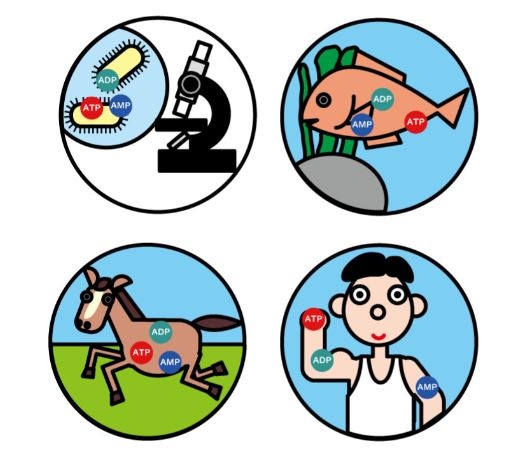
- Detecting a large amount of ATP indicates the presence of food residue, usually caused by ineffective cleaning. It can lead to an increased risk of bacterial proliferation in food production facilities. There may be risks of infectious agents in medical facilities, and of leftover dirt on surfaces due to ineffective cleaning.
- It is also known that a relatively large amount of ADP and AMP is contained in the living cells of foods such as meat, fish, and dairy products, and in processed foods such as smoked meat and sausages.
- The amount of AMP and ADP contained in some food residues after cleaning is much greater than the amount of ATP, so these stains will not be detected if only the ATP in the sample is measured. With Kikkoman's highly sensitive detection technology, the measurement detects not only ATP but also the amounts of ADP and AMP in the sample.
2. Mechanism and principle of the ATP meter
- Kikkoman has developed a technique for simultaneously detecting ATP+AMP+ADP, based on its soy sauce brewing technology. Kikkoman's Lumitester Smart ATP meter not only helps solve the problem of food safety hygiene monitoring, but also helps customers control sources of contamination from organic residues in the production process.
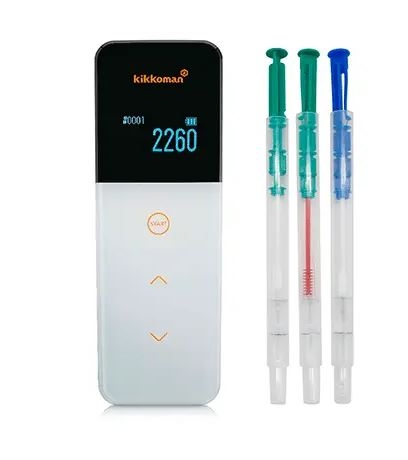
- Kikkoman owns the proprietary technology of the ATP conversion method, which allows not only ATP to be detected but also AMP and ADP.
- The enzymatic reaction that normally occurs in the light-emitting organ of the firefly is used in Kikkoman's ATP test
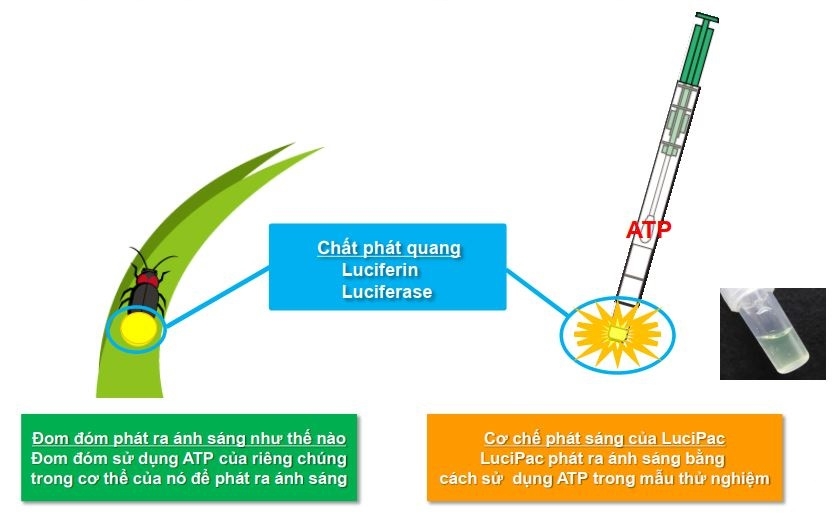
- ATP conversion cycle method: The A3 swab uses the proprietary "ATP conversion cycle method" technology owned by Kikkoman, with extremely high sensitivity achieved by detecting ATP together with ADP and AMP. The Lumitester Smart ATP meter can detect all 3 forms, while other devices of the same type on the market measure only ATP without measuring ADP+AMP.
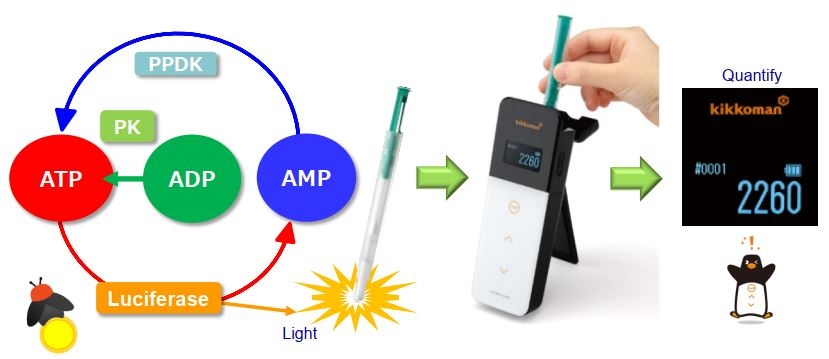
- ATP is converted into AMP through a reaction with luciferase. The reaction results in the release of energy accompanied by bioluminescence. The amount of luminescence — the light produced — is proportional to the amount of ATP present. This means the amount of ATP can be assessed and quantified by using a device that measures the light produced by the reaction.
- The presence of a large amount of dirt (that is, a large amount of ATP) on a swabbed surface leads to strong luminescence with a high measured value displayed on the Lumitester Smart device. The luminescence is quantified in Relative Light Units (RLU).
- The new-generation ATP test (Kikkoman A3) uses unique enzymatic reactions in chemistry. The measurement method uses the reagent in the Lucipac swab to convert ADP and AMP into ATP, thereby allowing the total amount of ATP + ADP + AMP to be measured. This is why the measurement is significantly more sensitive than traditional ATP measurement.
3. Why should you use Kikkoman's Lumitester Smart ATP meter?
- Kikkoman's surface hygiene testing ATP device (also called an ATP meter) is manufactured in Japan, and Kikkoman currently holds the proprietary technology for surface hygiene testing that can measure all 3 forms: ATP, AMP, and ADP.
- Other devices of the same type currently on the market do not have this technology; they measure only the ATP form and not AMP and ADP. Therefore the displayed results may give false negatives. This is because organic residues will remain on the surface uncontrolled (as we know, ATP is an unstable substance that readily degrades into ADP and AMP).
- The compact design suits field visits; it can be carried anywhere, whenever needed.
- The swab has 3 functions for sampling: one type for surface sampling, one type for sampling water (RO water, CIP water, etc.), and one for testing wastewater in cooling towers.

* Applications of ATP meters across sectors
- Food: hygiene and food safety monitoring management at factories helps prevent contamination; also kitchens and retail stores, and education.
- Healthcare: infection prevention and control, endoscope hygiene checks, environmental hygiene, and hand hygiene.
- Cleaning: cleaning services, industrial hygiene, room-attendant monitoring, hotel room checks, and Legionella prevention.

Pacific Science & Technology Equipment Co., Ltd. is the exclusive distributor of Kikkoman products in Vietnam. Please contact us for consultation and the best quotation.
You can refer to our Kikkoman Lumitester Smart ATP meter at the following link:
https://pacificlab.vn/vi/shops/group/may-atp-kiem-tra-ve-sinh-be-mat/
https://pacificlab.vn/vi/news/blog-kien-thuc/tai-sao-nen-su-dung-may-do-atp-lumitester-smart-cua-kikkoman-289.html