1. What are Enterococci
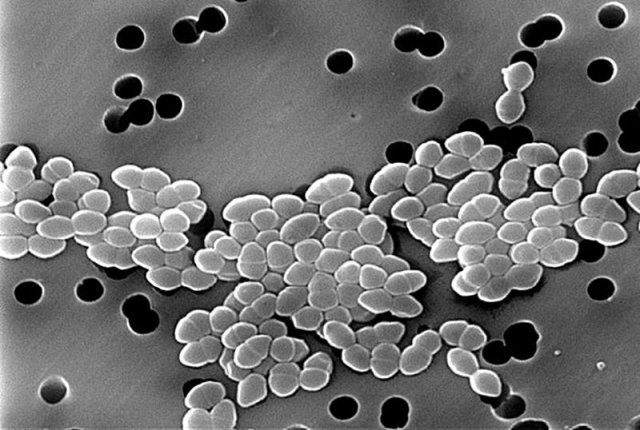
What are Enterococci? Enterococci are a group of gram-positive, spherical bacteria that usually live in pairs or short chains. Enterococci belong to the Streptococcaceae family, of which the most common species are Enterococcus faecalis and Enterococcus faecium.
- : accounts for about 80–90% of human Enterococci infections. Causes urinary tract infections, meningitis, and endocarditis.-
Enterococcus faecium: has a higher drug resistance capability, causing many hard-to-treat hospital infections, especially VRE infections (Vancomycin-Resistant Enterococci).- They commonly live in the human and animal intestine, so they are considered
an indicator microorganism of fecal contamination in the environment, especially in water and food.-
Their high survival capability in harsh conditions such as high temperature, salinity, and low pH makes Enterococci an ideal microbial parameter for assessing the long-term contamination of the environment.- Enterococci tolerate temperatures up to 60°C for 30 minutes, pH of 4.5–10.0, and salt concentrations up to 6.5%.
2. Why Enterococci must be tested in food and water
2.1.
An indicator of fecal contamination-
Enterococci are now recognized as the primary parameter for assessing fecal contamination in drinking water and coastal seawater by the World Health Organization (WHO) and many health organizations worldwide. The presence of Enterococci in water proves the water source may be contaminated with human or animal feces, carrying a high risk of intestinal disease.* Unlike Coliform bacteria or
E. coli, Enterococci:- Survive better in harsh environments such as seawater, highly saline water, or acidic conditions.
-
Are not easily killed by chlorine or common disinfectants, making them an ideal indicator of long-term or hard-to-treat contamination.- Are recognized by WHO, the EU, the EPA (USA), and many countries as a mandatory microbiological parameter in monitoring domestic water, bottled water, and water types such as swimming pools.
* Example:
if Enterococci are detected in domestic water, that can prove the pipes are leaking and the water is contaminated with feces. In seawater, if the Enterococci density exceeds 100 CFU/100 ml, the beach may be closed under EPA (USA) rules. 2.2.
Linked to food poisoning In food, Enterococci do not always cause disease directly, but they have high antibiotic resistance, causing opportunistic infections in immunocompromised people; nonetheless they are
an important hygiene indicator during processing, especially for:- Fresh meat and processed meat (sausages, cold cuts,....)
-
Seafood and shellfish (especially eaten raw)- Dairy products such as cheese, yogurt, and ice cream.
-
Fermented foods, raw vegetables, and pre-packed salads The presence of Enterococci in these foods shows:
-
The incoming raw material may be fecally contaminated.- Processing tools and the production environment are not being cleaned to standard.
-
Staff handling food are not ensuring clean hands or wearing protective clothing correctly.- Example: a study in Europe showed as many as 25% of retail fresh chicken samples contaminated with Enterococci, of which nearly 10% were Vancomycin-resistant strains — posing a risk of cross-infection to consumers or handlers.
2.3.
The risk of hospital infection and antibiotic resistance Some Enterococci strains, especially
E. faecalis and E. faecium, are capable of causing serious infections in hospitals such as:-
Urinary tract infection- Endocarditis
-
Bloodstream infection (sepsis)- What is worrying is that these strains can carry antibiotic resistance genes, especially resistance to
Vancomycin, creating VRE (Vancomycin-Resistant Enterococci).-
Detecting Enterococci in hospital wastewater, or in widely consumed food sources, is an early warning sign about the spread of drug-resistant bacteria into the community. 3. The method for testing Enterococci in water with Compact Dry plates
-
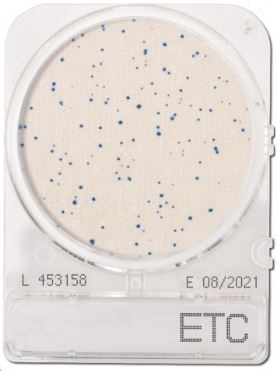
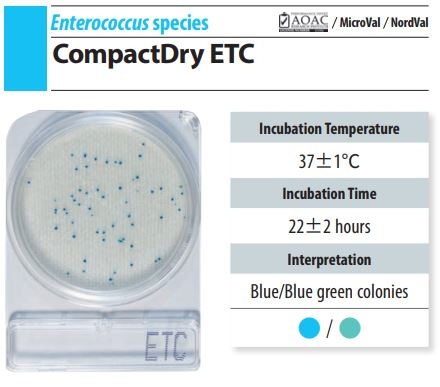
The Compact Dry ETC Enterococcus plate is a modern, convenient pre-poured freeze-dried medium plate developed by companies such as Shimadzu Diagnostics for rapid testing of Enterococci in water and food.*
Advantages of the method- No medium preparation needed: the plate comes with a special dry culture medium already integrated.
-
Easy to use: just drop the diluted water or food sample onto the plate.- After incubating at 36–37°C for 22 to 24 hours, the Enterococci colonies appear in a characteristic, easily recognizable color.
-
No complex equipment needed: suitable for both small-scale laboratories and on-site testing.*
Basic sampling steps
- Collect the water sample: to be tested (drinking water, wastewater, pool water, etc.).
- Drop 1 ml of the sample: directly onto the center of the Compact Dry ETC plate.
- Incubate at 36–37°C for 22 to 24 hours.
- Count the colonies with a characteristic color (usually blue).
- Calculate the result: compare against the drinking water or recreational water standard set by regulation (QCVN, WHO...).
4. Conclusion
What Enterococci are — they are an important indicator reflecting fecal contamination in water and food. Testing Enterococci strengthens early warning of health risks and ensures consumer safety. Using the Compact Dry ETC Enterococcus plate is an effective, fast, and reliable testing method, suitable for many kinds of sample and laboratory condition.
👉 See the product article Compact Dry Enterococcus plate | Compact Dry Enterococcus | Shimadzu