
- However, the reality shows that many businesses still rely entirely on microbiological testing while ignoring active control at the production site.
1. Traditional microbiological testing – accurate but slow
It cannot be denied that the microbial culture method gives high reliability. However, its limitations are becoming a burden in a high-speed production environment:
- Waiting time for results is 2–5 days, sometimes even longer than that.
- It only reflects the state of the sample at the time of sampling, not the即时 hygiene condition in the factory.
When the result is out of spec:
- The product has already been packed, shipped, and put on the market
- Or the business is forced to destroy the whole lot, causing heavy losses
👉 What is worrying is that the microbiological risk is only discovered after the consequences have already happened.
2. The risks of detecting microorganisms too late
Delays in detecting contamination not only cause cost losses but also bring many consequences:
- Increased risk of unsafe products
- Recalls and destruction costs arise
- It affects HACCP, ISO 22000, FSSC 22000, and GMP assessments
- Loss of reputation with customers and partners
In a context where the demands on food safety and production hygiene are increasingly strict, businesses cannot rely only on testing laboratories.
3. Why do businesses need rapid contamination control?
The current trend of modern factories is to move from reactive testing to active control. The purpose of active control is:
- Detect the risk of contamination right at the site
- Get results immediately to make decisions
- Reduce the total dependence on microbiological results that take days to wait for
This is exactly when rapid contamination control solutions and rapid microbiological testing prove their value.
4. What is rapid microbiological testing?
Rapid microbiological testing is a method for quickly assessing the total level of contamination (especially organic contamination from food residuals and microorganisms).
Gives results in only a few seconds to a few minutes
* It is performed directly on:
- Equipment surfaces
- Production lines
- Workers' hands
- Processing areas
- Early detection of contamination risks before the products are affected
Among these, the ATP method is considered the most popular and effective rapid contamination control solution.
5. The ATP method – the foundation of rapid contamination control
- ATP (Adenosine Triphosphate) is a compound present in all living cells, including bacteria, yeasts, molds, and organic residuals.
👉 The principle is very simple:
- Higher ATP → greater contamination level
- Low ATP → clean surface, low microbiological risk
Therefore, measuring ATP is a way to quickly assess hygiene efficiency and to control contamination quickly immediately after cleaning and disinfection.
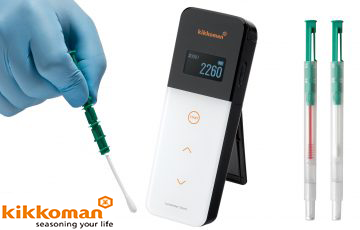
6. The ATP Lumitester Smart meter – a rapid contamination control solution for modern factories
- Among the ATP meters available today, the ATP Lumitester Smart meter is chosen by many businesses for its reliability and wide applicability.
🔹 The outstanding advantages of the Lumitester Smart
- Gives results in just 10 seconds
- Smart connectivity, easy data storage and retrieval
- High sensitivity, accurately reflecting the hygiene condition
- Easy to use, suitable for: QA/QC, cleaning staff, production supervisors
With the Lumitester Smart, businesses can do rapid microbiological testing right on the production line, instead of waiting for the laboratory result.
7. Practical applications of rapid microbiological ATP testing
✅ Controlling hygiene before – during – after production
- Assessing the efficiency of CIP/SIP
- Checking equipment surfaces after cleaning
- Checking workers' hands before entering the production area
✅ Early warning of contamination risks
- Detecting unhygienic points
- Closing in on them and taking timely action
- Reducing the risk of microbiological samples failing
✅ Supporting HACCP and ISO systems
- It is evidence of hygiene control
- Increasing proactivity in hazard assessment
- Raising reliability during audits
8. Rapid microbiological testing does not replace but complements traditional testing
One important point to emphasize
👉 Rapid microbiological ATP testing does not replace microbiological testing but plays the role of a strategic complement.

* Combining both helps businesses:
- Actively prevent contamination
- Reduce the failure rate of samples
- Optimize cost and time
9. The economic benefits of investing in rapid contamination control
Many businesses after applying rapid contamination control with the ATP Lumitester Smart meter have reported:
- A lower rate of microbiological samples failing
- Lower product destruction costs
- Time saved from production interruptions
- A more professional image of the factory
👉 The initial investment cost is far smaller than the cost of handling a microbiological incident.
10. Conclusion: do not let the microbiological risk be discovered when it is already too late
- In modern production, waiting too long for microbiological results means accepting the risk. Businesses need to equip themselves with a fast, active, and comprehensive control system.
🔑 Rapid contamination control and rapid microbiological testing with the ATP Lumitester Smart meter are exactly the solution that helps:
- Early detection.
- Timely action.
- Protecting product quality and brand reputation.