

1. Types of vitamins that need to be analysed
- Vitamins are essential for our health: our body needs them for metabolism, energy production, for the immune system and for cell formation. Vitamin deficiency can cause deficiency symptoms such as circulatory disorders, metabolic disorders, anaemia or muscle wasting. 13 vitamins are considered essential for humans:
- Vitamin A
- Vitamin B1
- Vitamin B2
- Vitamin B3
- Pantothenic acid
- Vitamin B6
- Vitamin B7 (Biotin)
- Folic acid
- Vitamin B12
- Vitamin C (ascorbic acid)
- Vitamin D
- Vitamin E
- Vitamin K
Because the human body cannot produce vitamins itself (except vitamin D and niacin), they must be consumed with food. Therefore, a balanced diet is necessary. Of course this includes fruits and vegetables, but also fish, meat, grains, nuts and dairy products. In addition, some foods are fortified with vitamins artificially. Supplements supplied as tablets or powders can also contribute to optimal vitamin supply.
2. Purpose of vitamin analysis in food
- Food quality control: ensure the product contains the declared vitamin content.
- Product research and development: assess the stability of vitamins during processing and storage.
- Compliance with legal regulations: Meet the food standards of organisations such as FDA, EFSA, CODEX.
- Assessing nutritional value: Helps identify which foods are rich in vitamins, supporting the development of a sensible diet.
3. Common vitamin analysis methods
3.1. High-performance liquid chromatography (HPLC - High-Performance Liquid Chromatography)
- Application: determination of most types of vitamins in food.
- Principle: separation of vitamins based on differences in their polarity when passing through the chromatography column.
- Advantages: high accuracy, suitable for many types of food.
- Disadvantages: requires complex equipment, high cost.
3.2. Gas chromatography method (GC - Gas Chromatography)
- Application: Analysis of fat-soluble vitamins such as vitamins A, D, E, K.
- Principle: The sample is vaporised and separated in the gas phase before being detected by the detector.
- Advantages: High sensitivity, suitable for trace analysis.
- Disadvantages: Complex sample preparation required.
3.3. UV-Vis absorption spectrophotometry method
- Application: analysis of vitamin C, vitamin B2, vitamin A.
- Principle: measuring the absorption of light at the characteristic wavelength of each vitamin.
- Advantages: fast, simple, low cost.
- Disadvantages: lower accuracy than HPLC.
3.5. Electrochemical method
- Application: determination of vitamin C and some B vitamins.
- Principle: measuring the current produced when the vitamin reacts with an electrode.
- Advantages: simple, fast.
- Disadvantages: accuracy is not yet high.
3.6. ELISA method
- Especially juices, infant food and dairy products are often advertised as being vitamin-fortified and therefore contribute to a healthy diet. There are many different methods that allow you to check whether a product really contains the amount of vitamins stated on the label.
- For example, the immunoaffinity column (IAC) is a method commonly used in vitamin analysis. These columns are used to purify the sample before liquid chromatography using HPLC (high performance liquid chromatography) or LC/MS. However, a simpler and more affordable method is the ELISA test. This antibody-based immunoassay is the technique we use for vitamin testing
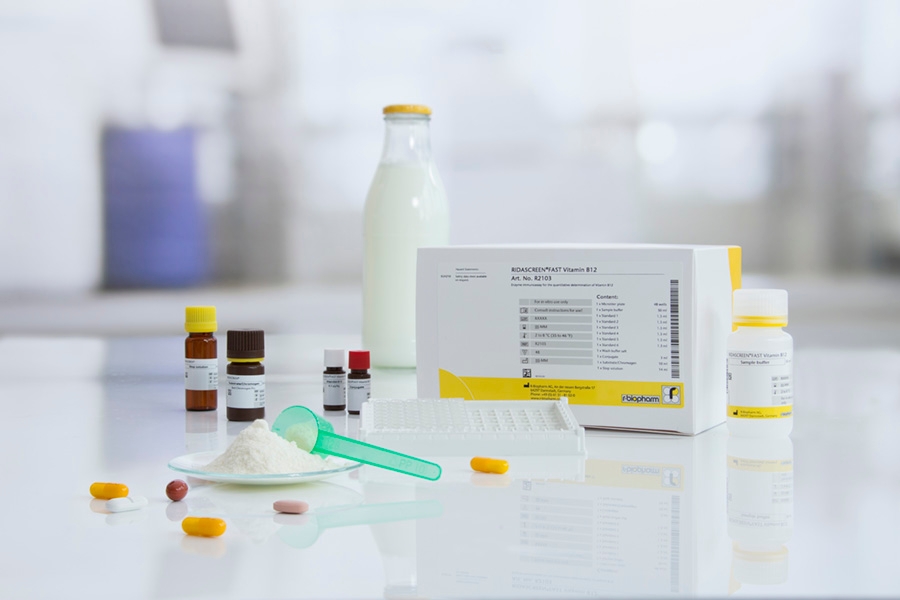
- RIDASCREEN®FAST Vitamin B12 new and RIDASCREEN®FAST Folsäure/Folic Acid are significantly faster and easier to use than traditional methods. This unique method needs less than one hour to detect vitamins in food. Milk and fruit juice can even be applied directly to the microplate without sample preparation. It is especially convenient that both test kits use the same sample buffer and sample preparation procedure: In this way, you can test vitamin B12 and folic acid with just one weighing of the sample and one quick sample preparation.
3.7. Microbiological method
- Application: determination of vitamin B12 and folic acid content.
- Principle: based on the growth of bacteria sensitive to the vitamin being analysed.
- Advantages: high sensitivity for vitamins with biological activity.
- Disadvantages: time-consuming, requires high technical skills.
* Below is a summary table of the different vitamin analysis methods:
| RIDASCREEN®FAST | VitaFast® |
| ||
| Method | ELISA test | Microbiological test | Immunoaffinity column | |
| Time | Incubation time: 25 minutes | Incubation time: 44-48 hours (Pantothenic acid: 24 hours) | 2-3 hours, plus HPLC or LC/MS analysis | |
| Benefits | - Easy to use - No hazardous chemicals required | - High accuracy - Some tests are AOAC-RI certified | - High recovery - Low coefficient of variation | |
| Available for | Vitamin B12 Folsäure (Folic Acid) | Vitamin B12 Folsäure (Folic Acid) Biotin Vitamin B1 Vitamin B2 Vitamin B3 (Niacin) Vitamin B6 Vitamin C Pantothenic Acid (Inositol ) | Vitamin B12 Folsäure (Folic Acid) Biotin |
4. Factors affecting vitamin analysis results
- Sample preparation: Grinding and extraction processes can cause loss or degradation of vitamins.
- Sample storage: Vitamins are sensitive to temperature, light and oxygen, so they must be stored properly.
- Analytical method: Choosing a suitable method helps ensure the accuracy and reliability of the results.
5. Applications of vitamin analysis in food
- Checking fortified food products, milk and beverages.
- Assessing the nutritional value of vegetables and meat/fish.
- Monitoring the food processing to ensure vitamins are not degraded.
- Vitamin analysis plays an important role in the food industry, helping to ensure nutritional value and product quality.