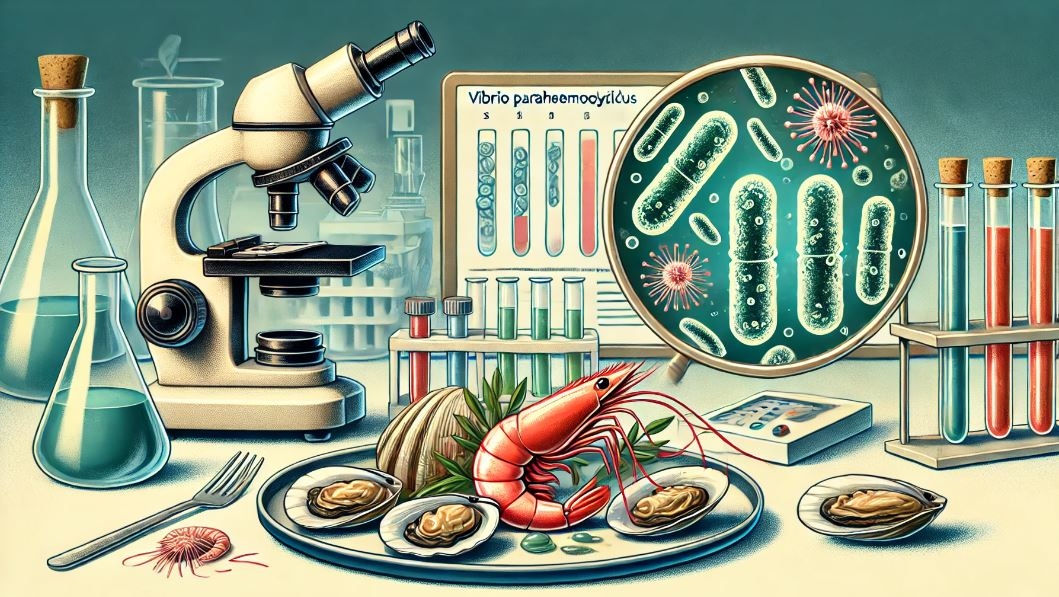
This vibrio bacterium causes gastrointestinal infections, most often from eating raw or undercooked seafood contaminated with the bacteria.
1. Characteristics of the bacterium Vibrio parahaemolyticus
- Habitat: vibrio Lives mainly in saltwater and brackish water environments.
- Growth temperature: Grows strongly at temperatures from 15°C to 35°C, and can cause infection when contaminated food is eaten raw or not cooked thoroughly.
- Pathogenicity: Causes diarrhea, abdominal pain, nausea, vomiting, and fever after eating contaminated seafood.
2. Origin and transmission
- High-risk foods: seafood, especially kinds eaten raw or not cooked thoroughly.
- Contamination during handling: Seafood can be contaminated with Vibrio parahaemolyticus during catching, transport, and processing if hygiene rules are not followed.
3. Methods for testing Vibrio parahaemolyticus in food
To detect and quantify Vibrio parahaemolyticus in food, testing methods range from traditional culture to rapid modern techniques.
3.1. Traditional bacterial culture method
- Step 1: The food sample is processed and homogenized (minced or diluted).
- Step 2: The sample is plated onto selective media such as Thiosulfate Citrate Bile Salts Sucrose Agar (TCBS Agar). Vibrio parahaemolyticus forms green colonies on this medium because it does not ferment sucrose.
- Step 3: The sample is incubated at 37°C for about 18-24 hours.
- Step 4: Colonies are observed and counted, then biochemical tests are carried out to confirm the exact identification.
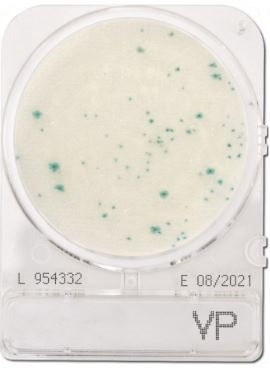
3.2. The pre-poured dry rehydratable culture medium plate method (Compact Dry VP Vibrio parahaemolyticus)
Compact Dry VP can isolate Vibrio strains. For the pathogen Vibrio parahaemolyticus, see the product detail page here.
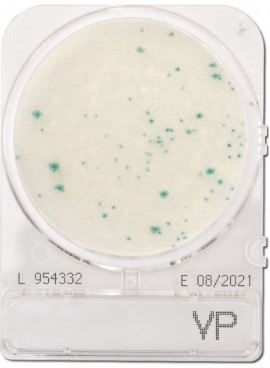
- The back of the Compact Dry Vibrio parahaemolyticus plate has a built-in counting chamber divided into grid squares; convenient for observing and reading results.
- Storage temperature 1-30 degrees C; suitable for refrigerator temperatures in Vietnam, so a dedicated storage cabinet is not needed.
– Incubation temperature 32 – 35 degrees C; equivalent to outdoor temperature in Vietnam, so no incubator is needed.
- The plate is sealed so the sterile medium is protected from the environment, so no laboratory is needed.
One extremely important advantage is that the handling is VERY SIMPLE
– Step 1: Open the lid
– Step 2: drop 1 ml of pond water into the middle of the plate
– Step 3: close the lid.
– Step 4: put the plate in an aluminum bag and leave it at the outdoor temperature of 32-35 degrees; read the result after 24 hours.
With these simple steps, shrimp farmers can perform the test right at the shrimp pond, and the result is as dependable as in a standard laboratory.
3.3. Vibrio identification by PCR (Polymerase Chain Reaction)
- The PCR method is a sensitive, fast method to detect the presence of Vibrio parahaemolyticus from a food or environmental sample.
- This is a modern method, able to detect precisely and faster than the culture method.
3.4. The MPN method (Most Probable Number)
- This method uses multiple tubes containing selective liquid media to estimate the number of bacteria in the sample.
- Based on the number of tubes that test positive after incubation, the result is calculated from a statistical probability table.
4. How to prevent Vibrio parahaemolyticus in food
- Cook seafood thoroughly: This is the simplest and most effective way to kill the bacteria. Seafood should be cooked above 63°C at the center of the food.
- Store food properly: Seafood should be kept cold (below 5°C) to limit bacterial growth.
- Handle and process food hygienically: When preparing seafood, make sure hands, utensils, and surfaces are kept separate and clean to avoid cross-contamination.
- Avoid raw seafood: People with weak immune systems, pregnant women, and small children should avoid raw or undercooked seafood.
5. Symptoms of Vibrio parahaemolyticus infection
- When infected with this bacterium, symptoms usually appear 4-96 hours after eating contaminated food.
- Diarrhea: Can be bloody.
- Abdominal pain and cramps.
- Nausea and vomiting.
- Mild fever.
- The illness is usually self-limiting within 2-3 days, but in some cases, especially in people with weak immune systems, it can become more severe and need treatment.
6. What to do when infected with Vibrio parahaemolyticus
- In most cases the illness clears up on its own without specific treatment; however, it is important to drink enough fluids to replace the water and electrolytes lost through diarrhea.
- In severe cases, especially in people with underlying conditions or weak immunity, medical treatment may be needed and the person should go to a medical facility.
- Controlling the bacterium Vibrio parahaemolyticus in food is essential to prevent the source of infection and to protect consumer health.
- The bacterium Vibrio parahaemolyticus not only causes illness in people who eat contaminated seafood, but is also a harmful agent that threatens the economic results of shrimp farming. Customers can read more about the damage the Vibrio parahaemolyticus bacterium causes at the link