
- The article below gives a detailed guide to using R-Biopharm IAC columns, helping laboratories optimize performance and ensure results meet international standards.
1. R-Biopharm Mycotoxin IAC columns
- R-Biopharm IAC columns are sample clean-up columns using highly specific antibodies, designed specifically for individual mycotoxins such as:
- Aflatoxin
- Ochratoxin A
- DON (Deoxynivalenol)
- Zearalenone
* Key advantages:
- Extremely high selectivity → less matrix interference
- Fully compatible with HPLC / LC-MS/MS
- Recognized under AOAC and ISO standards
- Simple procedure, easy to implement
👉 This is an indispensable step in mycotoxin analysis for EU and US exports.
2. Preparing samples before using R-Biopharm immunoaffinity (IAC) columns
To make the most of how to use IAC columns, sample preparation must be done with correct technique:
✔️ Applicable matrix types:
- Cereals (maize, wheat, rice…)
- Animal feed
- Food raw materials
✔️ Preparation steps:
- Step 1: Grind the sample → ensures homogeneity and improves extraction efficiency
- Step 2: Weigh the sample → usually 5–25 g depending on the R-Biopharm method
- Step 3: Extract the sample. Common solvent: methanol : water (70:30) or as directed by the kit. Shake or vortex to boost extraction
- Step 4: Filter the sample. Use filter paper or a membrane filter. Ensure the solution is clear, with no residue.
3. Procedure for using R-Biopharm immunoaffinity (IAC) columns
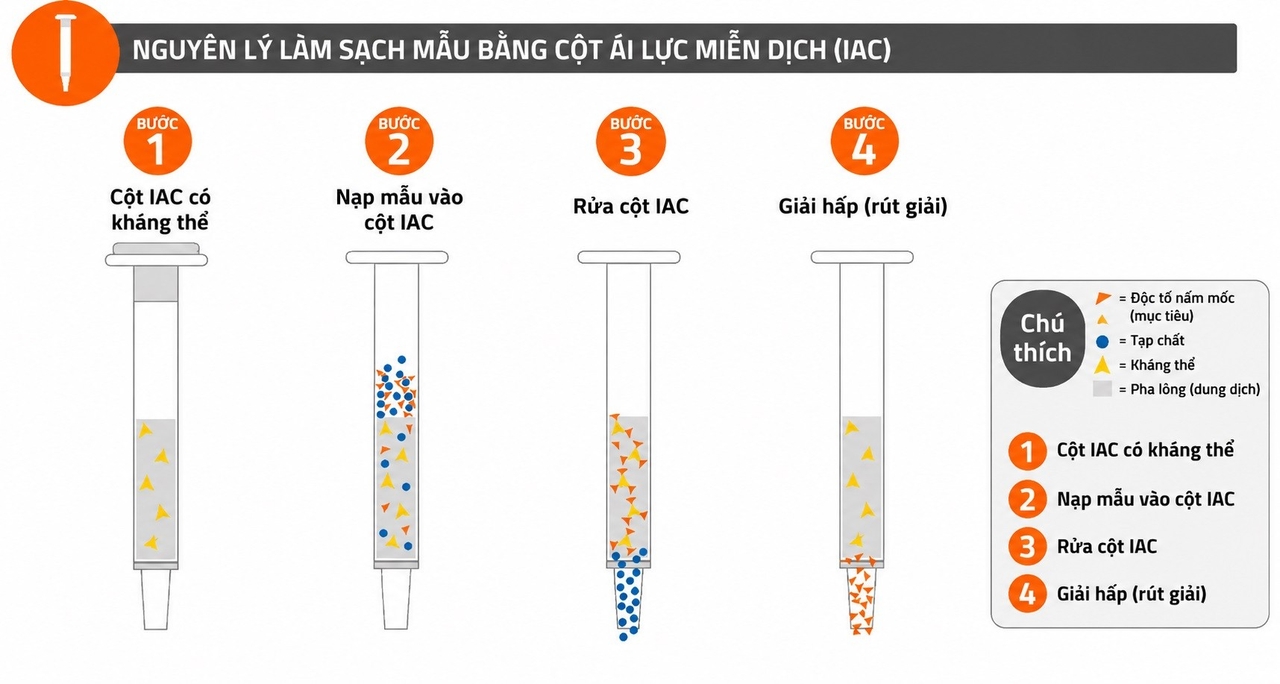
The standard workflow for using R-Biopharm IAC columns consists of these steps:
* Step 1: Loading
- Take the filtered extract
- Load it onto the column at a flow rate of 1–2 drops per second
- The mycotoxin is retained through antibody binding
* Step 2: Washing
- Use distilled water or the buffer specified by R-Biopharm
- Remove non-specific impurities
* Step 3: Elution
- Use pure methanol
- Collect the eluate containing the purified mycotoxin
* Step 4: Analysis
- The cleaned sample goes to: HPLC (with a fluorescence detector) or LC-MS/MS.
👉 This is the step that determines the accuracy of the entire mycotoxin analysis workflow.
4. Important notes when using R-Biopharm immunoaffinity (IAC) columns
To maximize the performance of the R-Biopharm IAC column, pay attention to:
⚠️ Control the flow rate
- Too fast → reduced binding efficiency
- Too slow → longer analysis time
⚠️ Avoid air bubbles in the column
- They reduce antibody contact efficiency
- They cause result deviations
⚠️ Never let the column dry out
It destroys the biological activity of the antibodies
⚠️ Follow the manufacturer's solvents exactly
- R-Biopharm has specific guidance for each toxin type
- Wrong solvent → compromised recovery
⚠️ Store to standard
- Temperature: 2–8°C
- Never freeze the column.
5. Why choose R-Biopharm Mycotoxin IAC columns
- High accuracy, suitable for export testing
- Widely used in ISO 17025-accredited laboratories
- Easy to use, saving sample-handling time
- Compatible with many modern analytical methods
👉 This is the ideal choice for businesses that need to raise the quality of mycotoxin testing in food and animal feed.
6. Conclusion
Mastering how to use R-Biopharm IAC columns helps businesses:
- Increase confidence in test results
- Meet international export standards
- Optimize analysis cost and time
If you are building or improving a mycotoxin analysis workflow, R-Biopharm IAC columns are an effective and sustainable solution.