
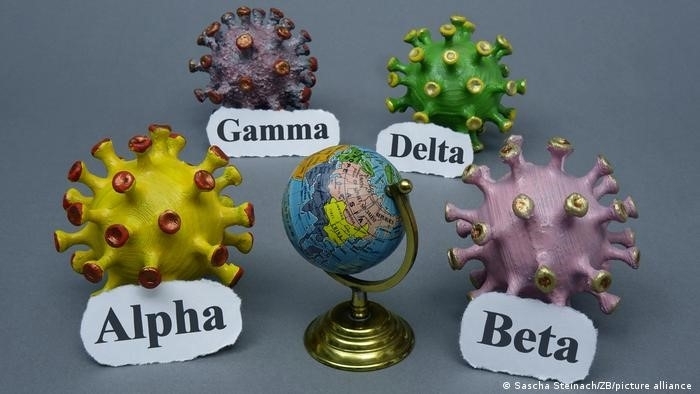
1. Tracking SARS-CoV-2 variants
1.1 Sars-Cov-2 variants
All viruses, including SARS-CoV-2, the virus causing COVID-19, can develop variants over time. Most changes have little or no impact on the characteristics of the virus. However, some changes may affect how easily the virus spreads, the severity of the associated disease, or the performance of vaccines, therapeutics, diagnostic tools or other public health and social measures.
WHO, in collaboration with partners, national authorities, organisations and researchers, has been monitoring and assessing the progress of SARS-CoV-2 since January 2020. Since late 2020, the emergence of variants that increase the risk to global public health has prompted the characterisation of the Variants of Interest (VOIs) and Variants of Concern (VOCs), to prioritise global surveillance and research, and ultimately to report on the response to the COVID-19 pandemic.
1.2 Global tracking of Sars-Cov-2 variants
WHO and the organization's international expert networks are monitoring changes to viruses so that, if significant amino acid mutations are identified, WHO will notify countries. This allows them to respond to the change and prevent the spread of the variant. Globally, systems have been put in place and are being strengthened to detect “signals” of Variants of Interest (VOIs) or Variants of Concern (VOCs) emerging.
Reducing transmission through disease control measures has been established and proven. Efforts to avoid the introduction of the virus into animal populations are also an important part of the global strategy to reduce the emergence of mutations that have a negative impact on public health.
The current strategies and measures recommended by WHO to continue working against virus variants identified since the start of the pandemic. Evidence from several countries where VOCs have spread strongly indicates that: public health and social measures (PHSM), including infection prevention and control (IPC), have been effective in reducing COVID-19 cases, hospitalisations and deaths. Local and national authorities are encouraged to continue strengthening existing PHSM and IPC measures. Authorities are also encouraged to strengthen genomic surveillance and sequencing capacity. A systematic approach should be applied to provide an early picture of the transmissibility of SARS-CoV-2 variants based on the local context and to detect unusual epidemiological events.
2. Naming the SARS-CoV-2 variants
Naming systems have been established to name and track the SARS-CoV-2 genetic lineages of:
- GISAID (GISAID is a global scientific initiative and the main data repository established in 2008 that provides open access to genomic data of the influenza virus and corona viruscausing the COVID-19 pandemic , headquartered in Germany)
- Nextstrain (a collaboration between researchers in Seattle, USA and Basel, Switzerland, providing a suite of open-source tools for visualising the genetics behind the spread of viral outbreaks)
- Pango is currently used and will be used by scientists and researchers.
To support public discussion on variants, WHO has convened a group of scientists from:
- WHO's Virus Evolution Working Group
- Reference laboratory network COVID-19 of WHO
- Representatives from GISAID, Nextstrain, Pango
- Additional experts in virology, microbial nomenclature and communications, from several countries and agencies
to consider pronounceable and non-stigmatising labels for VOI and VOC. At the current time, this WHO-convened expert group has recommended the use of Greek alphabet letters, i.e. Alpha, Beta, Gamma, Delta. This will be easier and more practical for non-scientific audiences to discuss.
3. SARS-CoV-2 variants definitions and actions taken
Due to the continuous evolution and mutation of the SARS-CoV-2 virus. As knowledge of the impact of variants develops, the working definitions need to be adjusted periodically. When necessary, variants that do not meet all the criteria set out in these definitions may be designated as VOIs / VOCs. Variants that pose a decreasing risk compared to other currently circulating variants may be reclassified in consultation with the WHO Advisory Group on Virus Evolution.
3.1 SARS-CoV-2 variants of concern (VOC)
A SARS-CoV-2 variant that meets the VOI definition (see below) and, through comparative assessment, has been demonstrated to be associated with one or more of the following changes to a degree that is significant to global public health:
- - Increased transmissibility or detrimental changes in epidemiology COVID-19
- - Increased virulence or change in clinical disease presentation
- - Reduced effectiveness of public health and social measures or of the diagnostic tools, vaccines or treatment methods available.
Current designations of variants of concern and actions required
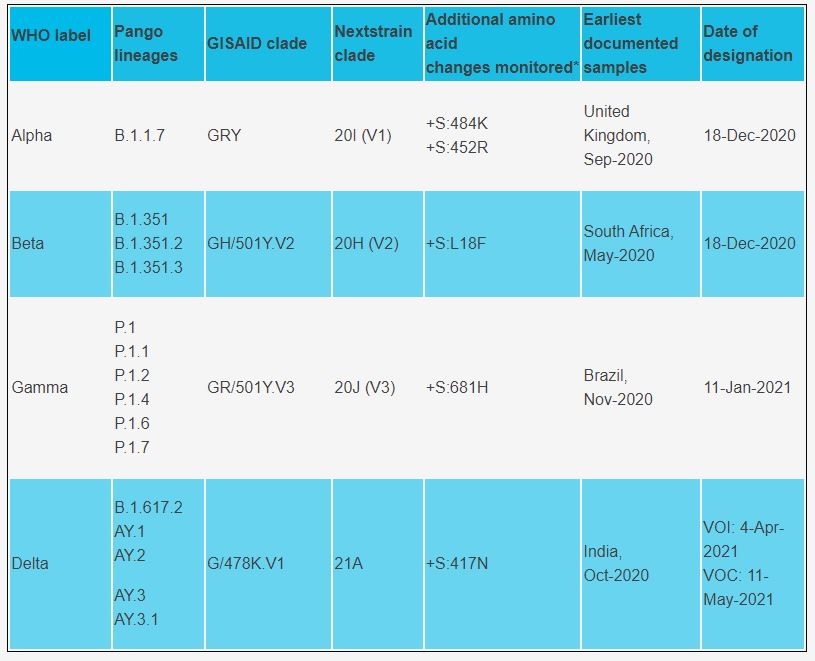
Key WHO actions for potential VOCs: |
-Comparative assessment of the characteristics of the variant and the public health risk by WHO and the Advisory Group on the evolution of the virus
- If determined necessary, coordinate additional laboratory investigations with Member States and partners.
- Communicate new designations and findings to Member States and the public through the established mechanisms.
Review WHO guidance through the established WHO mechanisms and update, if necessary.
Key actions by Member States, if a VOC is identified:
- Share complete genome sequences and related metadata to a publicly accessible database, such as GISAID.
- Report to WHO any initial cases / clusters related to VOC infection via the IHR mechanism.
- Where capacity exists and in collaboration with the international community, conduct field investigations and laboratory assessments to enhance understanding of the potential impacts of the VOC on the epidemiology of COVID-19, disease severity, the effectiveness of public health and social measures, diagnostic methods, immune response, neutralising antibodies or other relevant characteristics.
3.2 SARS-CoV-2 variants of interest (VOI)
A VOI is a SARS-CoV-2 variant with genetic alterations that are predicted or known to affect the characteristics of the virus, such as transmissibility, disease severity, immune evasion, or escape from diagnostic tools or therapeutic agents; and that cause a significant increase in community spread or multiple clusters COVID-19 in multiple countries, with an increasing relative incidence over time, in conjunction with increasing numbers of cases, or other clear epidemiological impacts indicating a new risk to global public health.
Some variants of interest (VOI) and actions required
Key actions by Member States, if a new potential VOI is identified:
-Notify WHO through the WHO Country or Regional Office reporting channels with supporting information about cases linked to VOI (person, place, time, clinical and other relevant characteristics).
-Share complete genome sequences and related metadata to a publicly accessible database, such as GISAID.
-Perform field investigations to improve understanding of the potential impacts of the VOI on the epidemiology of COVID-19, disease severity, the effectiveness of public health and social measures, or other relevant characteristics.
-Perform laboratory assessment according to capacity or contact WHO for support to perform laboratory assessment of the impact of the VOI on the relevant topics.
Key WHO actions for potential VOIs: | |
|---|---|
- Comparative assessment of the characteristics of the variant and public health risk by WHO. |
References:
https://www.who.int/en/activities/tracking-SARS-CoV-2-variants/