
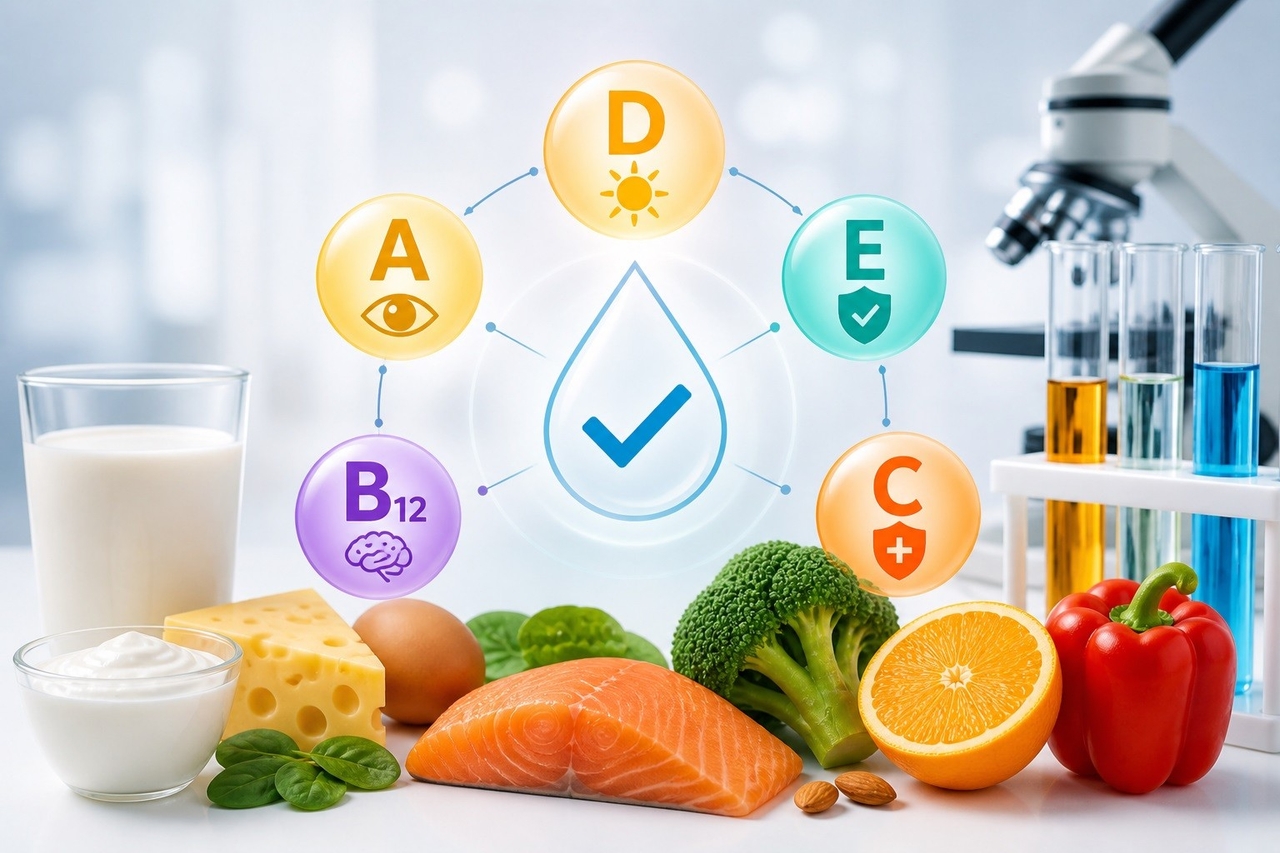
In the food industry, especially the dairy and supplement industry, vitamins are an important nutritional parameter that directly affect:
- Product value
- The ability to declare quality
- Export standards
However, many businesses still wonder:
- What vitamins in milk should be tested?
- Which vitamins must be tested?
This article will help you clearly understand the vitamins that need controlling and why they matter.
Classifying vitamins in food
Before going into detail, understand that vitamins fall into 2 main groups:
1. Fat-soluble vitamins
Including:
- Vitamin A
- Vitamin D
- Vitamin E
- Vitamin K
👉 Characteristics:
- They dissolve in fat
- They are more stable than water-soluble vitamins
- They easily accumulate in the body
2. Water-soluble vitamins
- Including: Vitamin C, Vitamin B1, B2, B6, B12…
* Characteristics:
- They are easily lost on heating
- They are not stored long in the body
- They are sensitive to the environment
The top vitamins that must be tested in the food & dairy industry
Below are the most important vitamins to test:
1. Vitamin A – The leading important parameter
* Role:
- Strengthening eyesight
- Supporting immunity
* Why test it?
- It is easily decomposed by light
- It is commonly added to milk
2. Vitamin D – Decisive for nutritional value
* Role:
- Calcium absorption
- Bone development
* Why test it?
- Low content but very important
- It directly affects dairy product quality
3. Vitamin E – Antioxidant
* Role:
- Protecting cells
- Antioxidant
* Why test it?
- It is easily affected by oxygen
- It relates to product stability
4. Vitamin B12 – Important in supplements
* Role:
- Supporting the nervous system
- Making red blood cells
* Why test it?
- Tiny amounts with a big impact
- It is commonly found in milk and functional foods
5. Vitamin C – The most easily lost
* Role:
- Boosting resistance
- Antioxidant
* Why test it?
- It is very easily lost on heating
- It often deviates from the declaration
Why must businesses test these vitamins?
1. Ensuring the label declaration is correct
- A vitamin deviation = a regulatory violation
- It can lead to product recalls
2. Product quality control
- Ensuring the nutritional content
- Raising brand reliability
3. Meeting export standards
- Markets: USA, EU, Japan
- Vitamin testing is a mandatory requirement
4. Optimizing production costs
- Avoid over-fortifying vitamins
- Reduce ingredient waste
Effective vitamin testing solutions
- Today businesses can apply: HPLC (high accuracy), rapid tests (economical – fast).
- The R-Biopharm vitamin test kits help: fast testing, easy to use, suited to internal QC
When should vitamins be tested?
Businesses should test when:
- Developing new products
- Performing routine checks
- Before declaring the product
- Exporting
Conclusion
- In the food & dairy industry, the most important vitamins to test are: Vitamin A – D – E – B12 – C
- Vitamin testing in food helps businesses:
- Ensure quality
- Comply with regulations
- Raise product value
- Combining modern methods with R-Biopharm kit rapid tests is the optimal solution today.
Contact for advice
If you are looking for:
- A rapid vitamin testing
- An accurate vitamin test kit
- An optimized QC system
Contact us for detailed advice.