1. Biological characteristics of Staphylococcus aureus
1.1. Morphology and basic properties
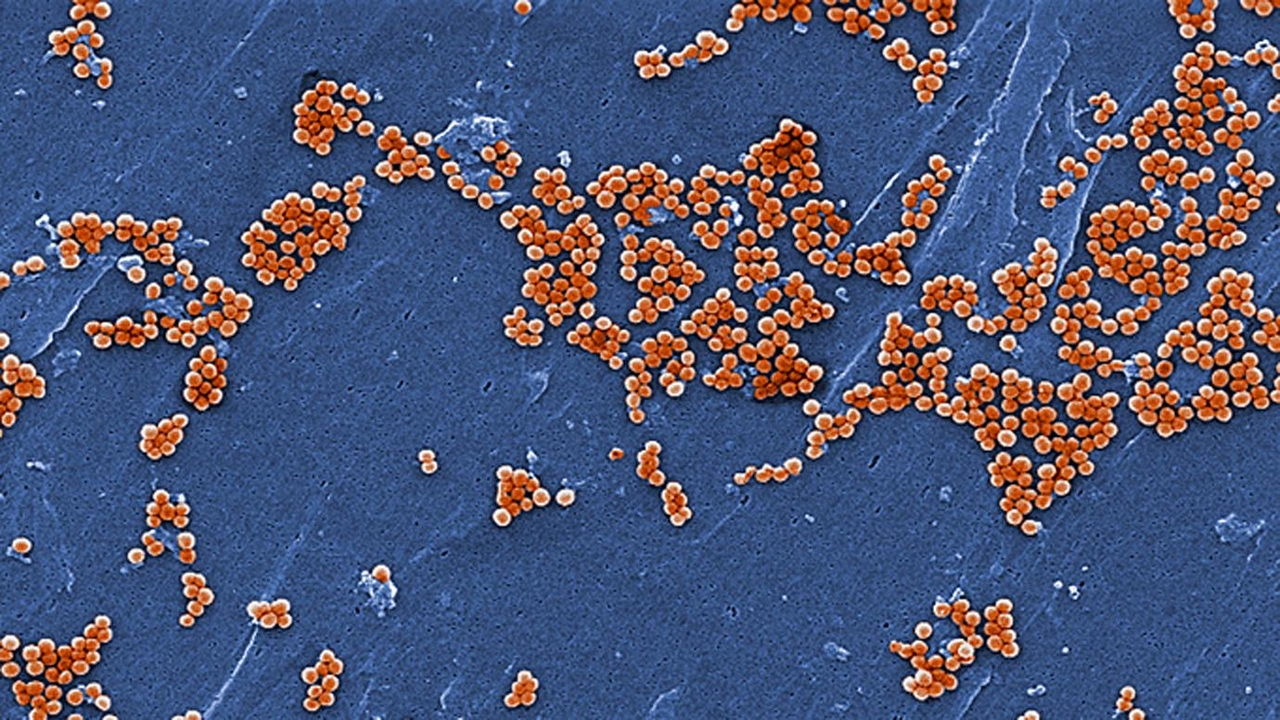
- Staphylococcus aureus is a Gram-positive, spherical bacterium (coccus), around 0.5–1.5 µm in diameter.
- The cells usually gather in grape-like clusters because they divide in multiple planes and stick together.
- No spore formation, non-motile.
- Able to grow in both aerobic and anaerobic environments (facultative aerobic/anaerobic), meaning they can live with or without oxygen.
- The name "aureus" means "golden" — because S. aureus colonies usually carry a gold-yellow pigment on agar media.
1.2. Physiology and adaptability
- Staphylococcus aureus tolerates high salt (halotolerant), able to grow in medium with high NaCl.
- Can grow over a wide temperature range (for example from ~4 °C to ~48 °C) and pH from ~4.2 to 9.3 in some strains.
- Capable of forming a biofilm on surfaces — an important factor helping them cling, survive a long time on surfaces and resist antibiotics more.
1.3. Biochemical properties & classification
- Catalase positive (decomposes H₂O₂ into O₂ and H₂O) — one of the quick tests to distinguish Staphylococcus from Streptococcus.
- Coagulase positive: S. aureus is a coagulase-positive staphylococcus — the coagulase enzyme clots plasma and is often used as a distinguishing marker.
- Some tests: non-motile, no gas produced in fermentation,...
1.4. Habitat and transmission
- Staphylococcus aureus commonly appears as a normal microbial component of human skin and nasal mucosa (~30% of people carry S. aureus in the nose) without causing dise
- When it crosses the body's protective barriers or finds a favorable environment, it can cause infections from mild to very severe (from skin pustules and subcutaneous tissue inflammation to blood infection and endocarditis).
1.5. Virulence factors and pathogenic role
- S. aureus has many virulence factors: surface proteins helping adhesion, toxins such as enterotoxin, TSST-1 (toxic shock syndrome toxin), hemolysin (destroying red blood cells), and the ability to form biofilms.
- For example: the ability to form biofilms lets the bacteria shelter from antibiotics and the immune system.
- In food: S. aureus produces enterotoxin (many types, A, B, C, D, E) — the cause of food poisoning when food containing these toxins is eaten.
1.6. Significance in the testing / food / environment industries
- Because S. aureus can live on skin, in the environment and in food, early detection and control of bacterial counts and/or the toxins they produce is very important for food safety, drinking water, food processing, animal feed, etc.
- In the drinking water, food production, cosmetics and pharmaceutical industries, contamination with S. aureus or its toxins would pose a great risk to end users.
- Especially in food processing or animal feed, S. aureus can produce heat-stable enterotoxin — meaning even when the bacteria are destroyed, the toxin remains and does harm.
2. Introducing the ELISA test kit for staphylococcal toxins from R‑Biopharm AG
- R-Biopharm AG is a company specializing in developing rapid-test, ELISA and PCR solutions for clinical diagnosis, food safety and animal feed.
- The company offers the RIDASCREEN® product line used in food and environmental analysis — using ELISA (enzyme-linked immunosorbent assay) to detect allergens, toxins and microorganisms.
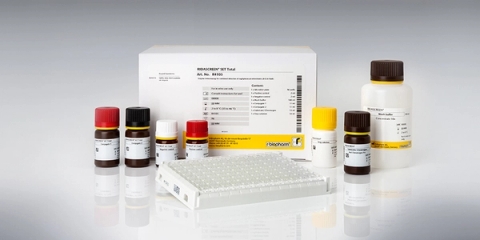
2.1. ELISA kit for staphylococcal toxins | RIDASCREEN® SET Total
- One of the typical products is the RIDASCREEN® SET Total — a sandwich-ELISA for detecting the combined enterotoxins of S. aureus (enterotoxins A, B, C, D, E) in liquid and solid food samples and in microbial cultures

* Standout specifications:
- Format: Microtiter plate 96 wells (12 strips × 8 removable wells) for 96 determinations (Art. No.: R4105)
- Incubation time of about 2 hours 45 minutes for the analysis process.
- Limit of detection (LOD) in the preparation: with the simple method: 0.25 ng toxin/mL (liquid) or equivalent to 0.375 ng/g of solid sample. With the dialysis-concentration method it is lower (0.05 ng/g).
- Recognized as the "Official European Screening Method" for detecting staphylococcal toxins in food.
- In addition, R-Biopharm also has other lines such as RIDASCREEN® SET A,B,C,D,E (Art. No.: R4101) — identifying the A–E toxin groups separately.
- Although this kit detects the toxin of S. aureus (enterotoxin), if you need to directly detect the bacterium itself (S. aureus) in the sample or determine drug resistance, the company also has PCR methods such as the SureFast® Staphylococcus aureus PLUS — real-time PCR for S. aureus.
2.2. Advantages and notes on use
* Advantages:
- The ELISA technique allows fast, sensitive and relatively easy detection in food / environmental testing laboratories.
- The product has been validated through multi-center trials to ensure repeatability and reproducibility.
- With SET Total, the ability to detect several toxins (A–E) at once is convenient for quick screening.
* Notes on application:
- This detects the toxins (enterotoxins) produced by S. aureus — not directly counting S. aureus bacteria. If you need to count or detect the bacterium, you need another method.
- Food samples rich in fat or protein, or complex sample matrices, can affect recovery — the manufacturer recommends using the "Dialysis Concentration Method" for hard-to-handle samples to reach a low LOD.
- A positive result (toxin detected) does not automatically mean a large population of live S. aureus bacteria is present — because the toxin can remain after the bacteria have d
- In the context of customers testing drinking water, food processing, animal feed... make sure the pre-treatment process and sample preparation suit your kit and sample matrix.
- If the customer wants to test for the S. aureus bacterium in the sample (for example food processing, water, surfaces...) and not only the toxin, you need to look further at microbiological methods/CFU counting or PCR, not just a toxin ELISA.
👉 See the detailed information for the ELISA kit for staphylococcal toxins | RIDASCREEN® SET Total (96 tests) R4105