
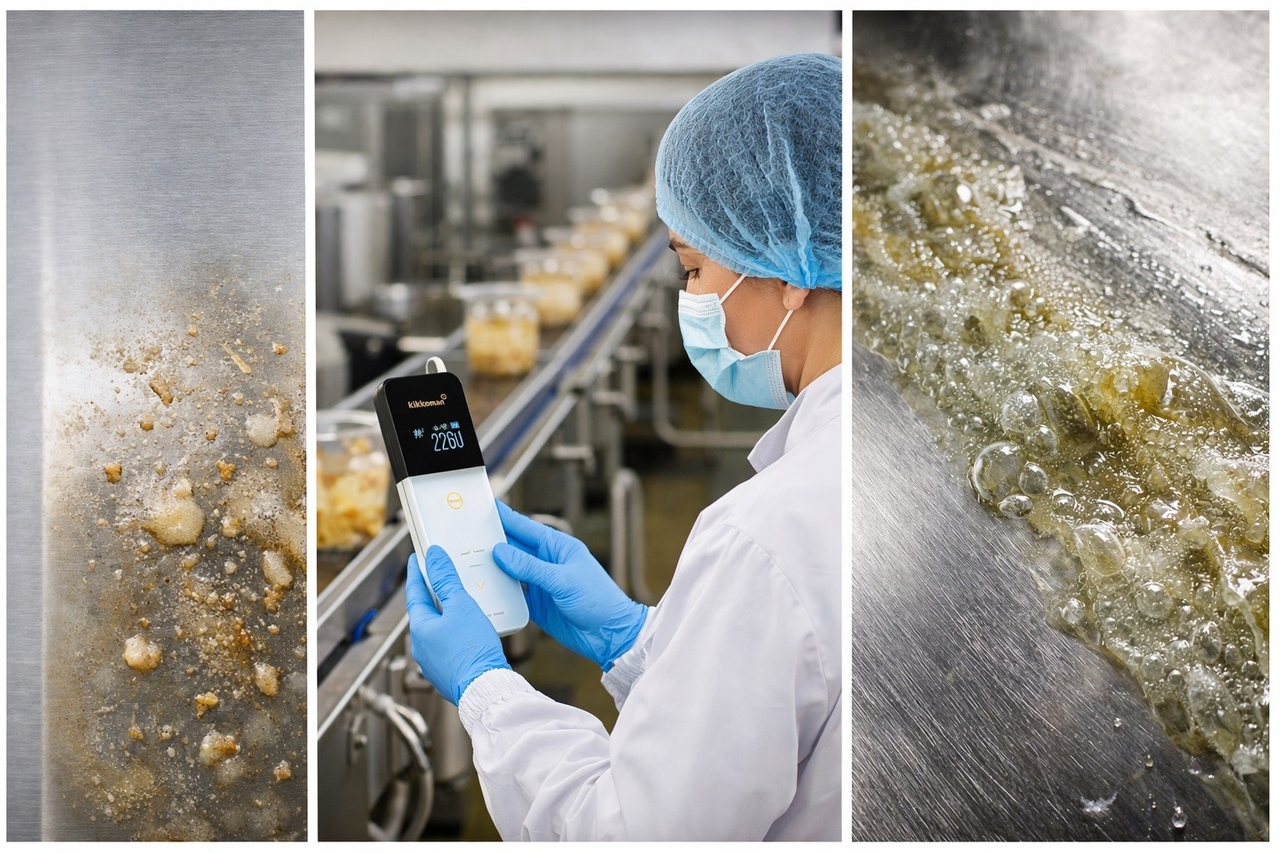
– However, when checked with an ATP test, the results show the ATP index is still high.
– So why does a clean-looking surface still show high ATP? The article below helps you understand the causes and the importance of hygiene verification by ATP testing.
What is ATP and why is it used for hygiene checks?
ATP (Adenosine Triphosphate) is the energy molecule present in all living cells such as:
– Bacteria
– Yeast
– Food cells
– Biological residue
When you use an ATP swab and an ATP meter, the system detects the ATP remaining on the surface. The result is displayed in RLU (Relative Light Unit), giving a quick assessment of surface cleanliness.
The important point: ATP comes not only from bacteria but also from leftover organic matter.
Why does a surface look clean but ATP is still high?
Below are the common reasons the ATP reading stays high even though the surface looks clean.
1. Residual oil and grease
Oils and fats from food processing are often hard to see with the naked eye after cleaning.
Especially in equipment such as:
– Conveyor belts
– Mixers
– Stainless steel surfaces
– Production piping
If the detergent is not strong enough or the cleaning process is not thorough, oil and grease can remain and push the ATP index up.
2. Protein from food raw materials
Protein from:
– Meat
– Milk
– Eggs
– Seafood
can stick to the surfaces of production equipment.
– Thin protein films are very hard to see with the naked eye, but they still contain biological ATP, driving ATP test results up.
3. Sugars and carbohydrates
In industries producing:
– Soft drinks
– Confectionery and baked goods
– Dairy
– Processed foods
sugars and carbohydrates can leave a thin film on surfaces after production.
These films:
– are not easily visible
– still contain ATP
– can be a nutrient source that lets microorganisms grow.
4. Biofilm – the dangerous microbial layer
Biofilm is a community of microorganisms attached to a surface and enclosed in a biological polymer layer.
Characteristics of biofilm:
– hard to detect with the naked eye
– adheres very firmly to equipment surfaces
– resists cleaning chemicals
Even when the surface looks clean, biofilm can persist and push the ATP index up.
Why does ATP testing matter for hygiene control?
The ATP test method brings many benefits to plant hygiene control:
Fast checks
Results can be obtained in tens of seconds, allowing instant assessment of cleaning effectiveness.
Detecting invisible contamination
An ATP test helps detect:
– food residues
– organic matter
– microorganisms
– biofilm
that the naked eye cannot see.
Improving the effectiveness of the sanitation program
Applying ATP testing helps:
– optimize the sanitation process (SSOP)
– reduce cross-contamination risk
– uphold food safety standards.
The ATP test – a key tool in the quality management system
Today many plants use ATP testing as part of their quality management systems:
– HACCP
– ISO 22000
– GMP
Routine ATP checks provide a scientific, objective way to evaluate sanitation effectiveness.
Conclusion
A surface that looks clean is not necessarily truly clean. Organic matter such as:
– oil and grease
– protein
– sugars
– biofilm
can remain on the surface and push the ATP index up.
That is why ATP testing is a key tool for detecting invisible contamination and controlling hygiene effectively in the plant.