
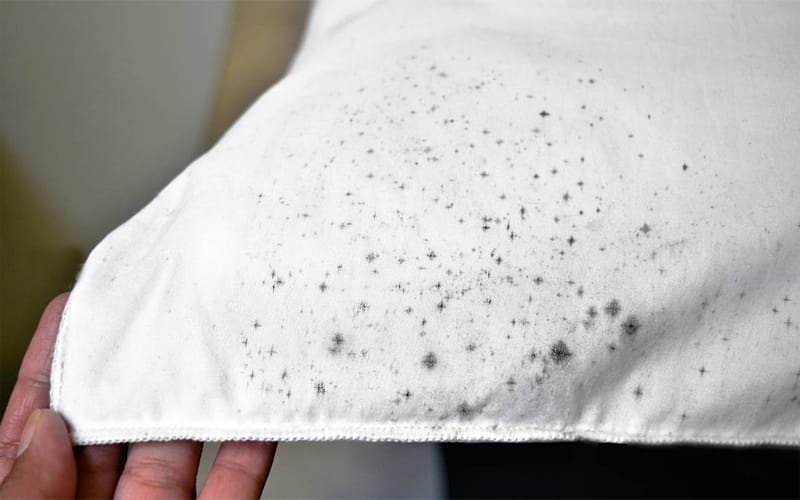
Why must mold be removed from clothes? What causes clothes to go moldy?
To open a lock you must find the key; to keep your clothes from going moldy we first need to find what causes the mold in order to prevent it. Here are some causes people commonly run into:
- - Putting clothes in the wardrobe before they are completely dry, or a damp wardrobe, is a favorable environment for mold to grow.
- - Soaking clothes too long without washing, or soaking a long time after washing without hanging them out.
- - A body that sweats a lot, or clothes splashed by rain not washed straight away.
- - Long humid weather keeping clothes damp for days, never fully drying.
- - Drying clothes in places without sun, closed off from wind and without airflow.
Did you know mold can produce mold toxins that cause cancer?
Pacificlab has already shared a similar article on the harms of mold. You can read it here
1. Super simple ways to remove mold from white clothes
Removing mold from clothes with lemon
Lemon contains citric acid; it whitens, cuts grease, fights bacteria and prevents fungus. Lemon is an ingredient already in every household fridge, and the acid in the lemon fruit is a lethal little weapon for removing all kinds of mold on clothes. We can remove mold in the following 2 ways:
- Cut the lemon into thin slices, then rub it onto the moldy spots.
- Squeeze out the lemon juice, dilute it with water, pour it into a spray bottle and spray directly on the moldy surface.
Afterwards, hang the clothes out in the sun for about 30 minutes to dry, then bring them in and rinse the clothes again with laundry soap. The mold marks will be gone.
Removing mold from white clothes with a potato
A potato? That's right — the potato is not only used to prepare dishes but also used for removing mold from clothes. If you don't believe it, try it yourself — it really does work. You only need to cut the potato, then gently rub the piece of potato over the moldy area until its juices have soaked evenly across the surface. After 3 minutes, the mold marks will be gone.
Removing mold from clothes with white spirit or alcohol
White spirit and alcohol are 2 ingredients with an Ethanol C2H5OH concentration strong enough to drive away every mold mark. Prepare a basin of white spirit or alcohol diluted with water at a 1:1 ratio. Soak the moldy clothes fully in the solution. After 2 hours, take the clothes out. Wash them as usual with soap. The mold marks will also be gone, returning bright white clothes to you.
Removing mold from white clothes with Baking soda
Baking soda, NaHCO3, is a good whitening agent. Depending on whether the mold spot is large or small, we adjust the amount of baking soda added, mixing it with laundry powder and water, then washing thoroughly with water. Hang it out in the sunshine and you will see an incredible result.
Removing mold from white clothes with Javel water
Javel water is commonly known as bleach. Its main components are NaClO and NaCl. This is the mold-removing agent for clothes every household uses to whiten clothes. So for mold marks, how should bleach be used for effect? For a widespread mold patch, dilute the bleach with water and soak the clothes for about 15 – 20 minutes. If the clothes have mold in only a few small spots, you should use a small brush. Dip it in bleach and scrub directly. Adding a little water to dilute the bleach increases cleaning effectiveness.
Removing mold from white clothes with H2O¬2 (Oxy A)
H2O2 - Hydrogen Peroxide is commonly known as Oxi già (Oxy A). With its effective disinfecting power, you only need to add a suitable amount of H2O2 to the washing machine and soak it together with the moldy clothes for 20 minutes. H2O2 not only removes mold marks for you effectively, but also disinfects your washing machine. You can learn more about H2O2's disinfecting effect here.
2. How to keep clothes from going moldy
These methods for treating moldy clothes with readily available ingredients will work well if you follow the instructions correctly. However, it is best to prevent this situation with a few clothes-storage tips such as:
- - Wash clothes right away when they get wet in the rain or when they soak with too much sweat
- - Clothes after rain, or worn through a day of work, must be washed clean right after you get home. If clothes are left damp too long, mold marks appear very easily.
- - Do not dry or store clothes in a damp environment. Clothes should be hung out somewhere with good sunlight
- - To keep clothes from going moldy, store them in a dry, well-ventilated place. Do not store clothes anywhere damp or easily damp
- - When drying clothes, also choose airy spots or places with lots of sunlight, so the clothes dry quickly, keep their quality and avoid mold.
- - Treat immediately when clothes show signs of mold
- - When you find that your clothes have gone moldy, you should treat the mold right away. If not treated in time, the mold patches appear more often and spread very q
- - Do not leave dirty clothes unwashed for days
- - Dirty clothes should be washed regularly. If you have time, you should wash clothes daily, because washing only after many days piles up and the bathroom environment is always damp, making your clothes very prone to mold, greatly hurting their appearance.
- - Use an air purifier to kill mold:
The market offers many lines of ozone generators, UV lamps or negative-ion, oxidizing-compound... devices. These devices help improve the cleanliness of the air in your home. At the same time they kill bacteria and yeasts/fungi effectively. Depending on purpose and budget, you can choose common ozone generators costing a few million dong up to advanced, effective machines at around 20–30 million to destroy mold. The most distinctive today is the NCC technology of ReSPR, killing bacteria and fungi 24/7 while staying safe for users. You can read about this product here.
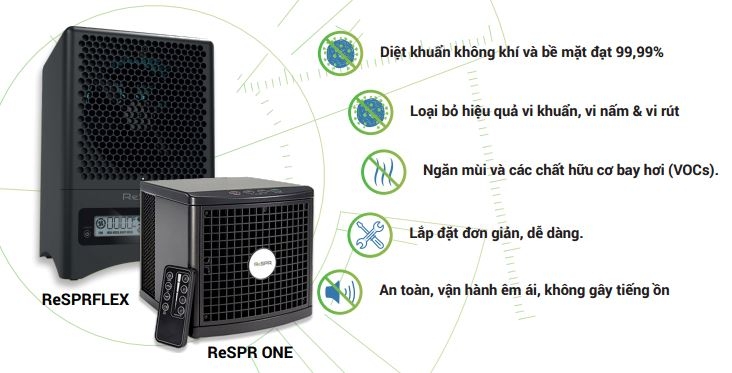
Unlike other commercial air purifier lines, ReSPR uses NCC technology (short for Natural Catalytic Converter), using a photocatalytic reactor chamber covered by a precious-metal film. The catalytic converter converts the surrounding moisture (H2O) into H2O2. ReSPR can kill mold, disinfect the air and surfaces, and dehumidify odors very well, bringing a fresh, clean atmosphere to your family.
Above are a few small tips where chemistry applies to removing mold from clothes. Pacificlab wants to send you this simple knowledge in the hope that the chemistry - biology field will be ever more meaningful in life. If you want to learn other chemistry knowledge in life in general and quality testing in particular, please follow and chat on our fanpage for answers. Or you can contact: the team of Pacificlab.