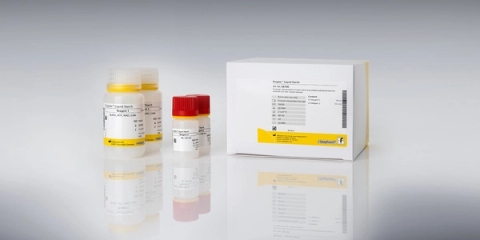
1. The role of starch in food
- Starch is the main storage carbohydrate of plants and serves as an energy source for the body (1g starch provides about 4 kcal).
- Starch is found in many foods: rice, corn, potatoes, cassava, wheat flour, confectionery, noodles, instant soup, processed food…
- Besides its nutritional role, starch also affects:
+ Product structure: viscosity, thickness, softness.
+ Sensory properties: color, gloss, chewiness.
+ Shelf life: gelatinization and retrogradation affect freshness
2. Analysis of starch in food
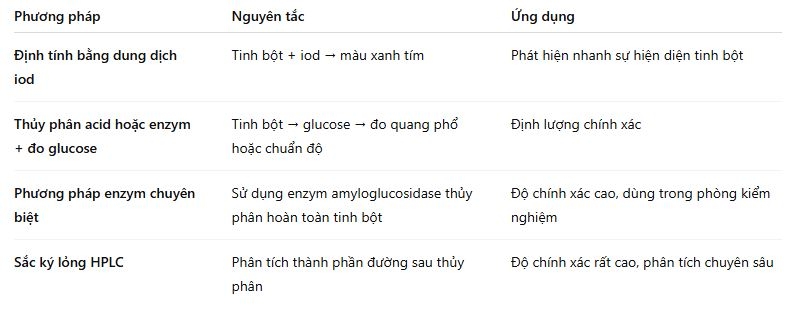
Depending on the requirements, the main methods for starch analysis can be qualitative or quantitative:
3. Why the starch parameter in food needs to be analyzed
3.1. Quality control and product formulation
- Starch content directly affects texture and flavor.
- Manufacturers need a stable formulation to maintain consistent quality.
3.2. Detecting adulteration in food
- Some facilities may add starch to milk, minced meat, seafood, sausages… to increase volume and reduce cost.
- Testing starch content helps detect undeclared blending
3.3. Compliance with nutrition labeling regulations
- Many countries (including Vietnam) require the carbohydrate content to be declared on the label.
- Starch is the main carbohydrate component, so it must be measured accurately to be declared correctly.
3.4. Meeting health needs and special diets
- People with diabetes or who are losing weight need to limit starch.
- Accurate information helps consumers choose suitable products.
3.5. Product research and development
Starch analysis helps manufacturers optimize their formulations: adjusting the viscosity of soup, the elasticity of noodles or the softness of bread.
4. Introduction to the Enzytec™ Liquid Starch E8100 starch analysis kit
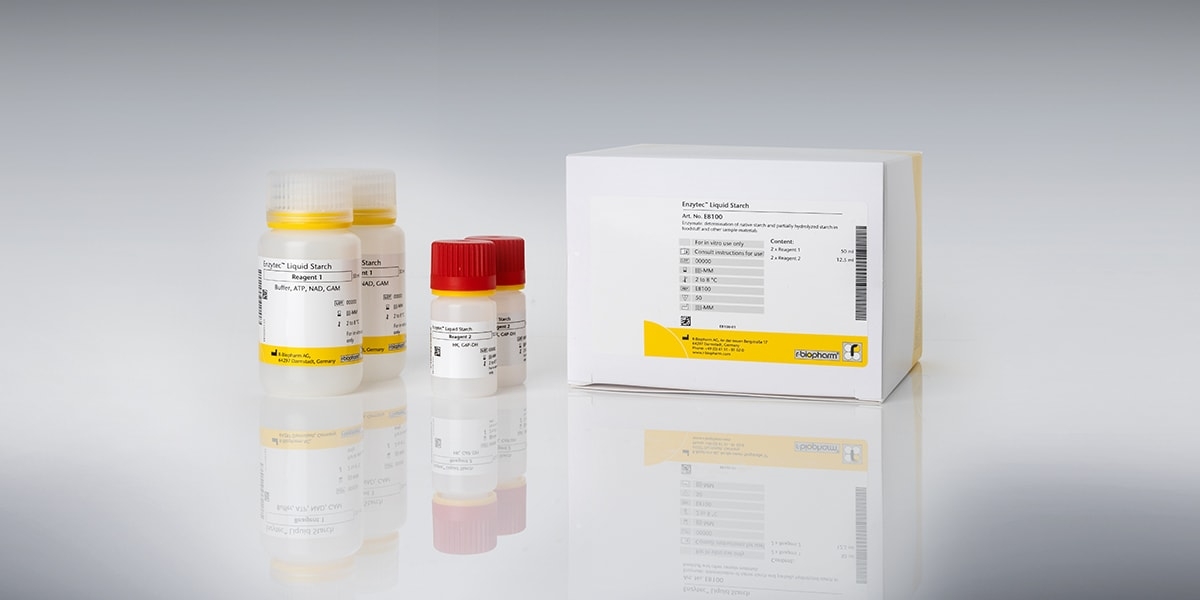
Enzytec™ Liquid Starch E8100 is the dedicated starch analysis kit from R-Biopharm, designed to accurately quantify starch content in a wide range of foods and raw materials.
4.1. Principle
- Specialized enzymes (amyloglucosidase and α-amylase) are used to completely hydrolyze starch into glucose.
- Glucose is then quantified by an enzymatic reaction on a spectrophotometer at a wavelength of 340 nm.
- Accurate results, good repeatability, little sensitivity to interfering substances.
4.2. Key advantages
- Accurate: starch quantification with low error.
- Fast analysis time: completed in about 30–60 minutes.
- Easy to operate: clear procedure with detailed instructions, requiring no complex equipment beyond a UV/VIS spectrophotometer.
- Suitable for analyzing many different sample types: cereals, wheat flour, rice, corn, processed products (bread, noodles, soup, snacks), meat, seafood, starch-fortified vegetarian products, and drinks containing modified starch.
- Compliance with international standards: suitable for testing laboratories and food manufacturers certified to ISO/ HACCP.
👉 See the kit for testing natural starch in food | Enzytec™ Liquid Starch E8100
4.3. Practical applications
- Control of starch content in food production to ensure quality and texture.
- Detection of undeclared starch addition as adulteration in meat, milk and seafood products.
- Support for accurate nutrition labeling of export products.
- Research and development of new products in the food and beverage field.
PacificLAB is the official distributor of the product Enzytec™ Liquid Starch E8100 in Vietnam, providing fast, accurate and cost-effective starch analysis solutions for laboratories, food processing plants and production facilities.