- The greatest advantages of this IAC column line are high recovery, superior cleanliness, and stable repeatability when the correct procedure is used.
- To help testing units achieve the best results, below is the standard procedure, important notes, and common mistakes when using R-Biopharm IAC columns.
1. Why must an immunoaffinity column be used for mycotoxin testing?
- Effective removal of impurities, optimized for HPLC and LC-MS/MS
- A highly clean solution raises sensitivity and reduces matrix interference
- Error control, ensuring compliance with AOAC, ISO, and EU standards
- Sample handling time savings, reducing repeat-sample costs
R-Biopharm supplies several types of immunoaffinity columns, optimized for each mycotoxin and specific application. Some notable product lines include:
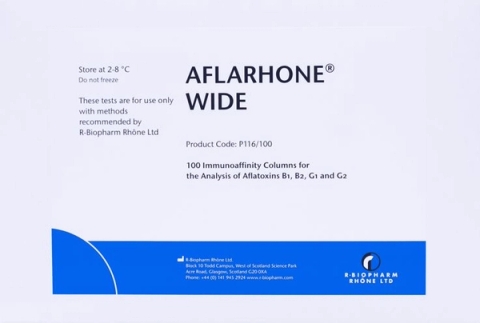
- Aflatoxin analysis immunoaffinity column | AFLARHONE® WIDE
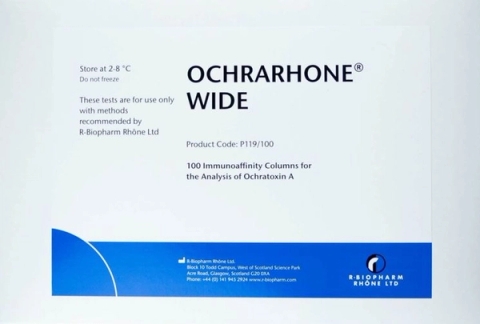
- Ochratoxin analysis immunoaffinity column | OCHRARHONE® WIDE
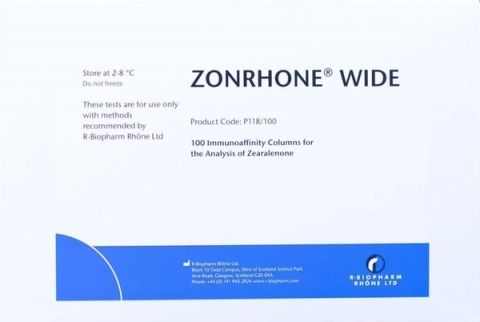
- Zearalenone analysis immunoaffinity column | ZONRHONE® WIDE
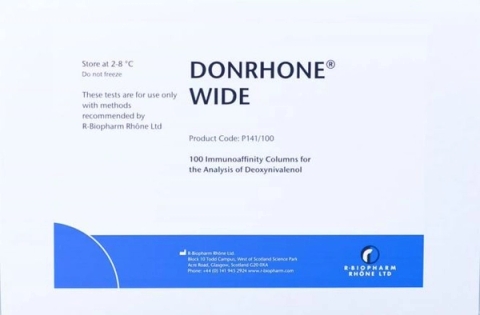
- DON analysis immunoaffinity column | DONRHONE® WIDE
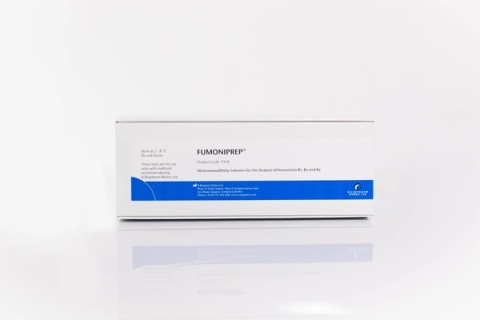
- Fumonisin analysis immunoaffinity column | FUMONIPREP®
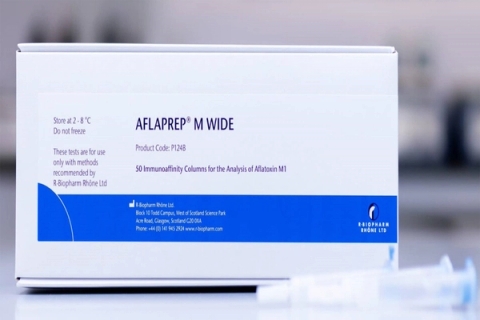
- Aflatoxin M1 analysis immunoaffinity column | AFLAPREP® M WIDE
2. Standard procedure for using R-Biopharm IAC columns (to achieve optimal recovery)
Step 1: Preparation and sample pre-treatment
Depending on the toxin, the R-Biopharm standard procedure includes:
a. Sample extraction
- Weigh the sample precisely as recommended (5–25 g depending on the toxin).
- Add the extraction solvent: methanol–water (70:30) or acetonitrile–water, depending on the kit/IAC column.
- Shake vigorously or homogenize for 2–5 minutes.
b. Filtration / centrifugation
- Filter through filter paper or centrifuge to remove sediment.
- For fatty samples (peanuts, corn, rice bran), the sample should be filtered a second time to increase clarity.
c. Dilution of the extract
- This step is extremely important to avoid destroying the antibody bonds in the IAC column.
- Dilute at exactly the instructed ratio (for example 1:4 or 1:7 depending on the column type).
- Check that the solution pH is between 6.0 and 8.0.
Step 2: Load the sample through the IAC column
- Mount the column on a stand and uncap the bottom to let the solution flow naturally.
- Use a pipette to load 1 mL/10–20 seconds; do not load too fast.
- Do not use pressure; do not squeeze the column; do not apply too strong a vacuum.
- Ensure the entire loaded solution passes through the antibody gel.
Step 3: Wash the column
- Wash with water/buffer at exactly the instructed volume (usually 10 mL).
- Goal: remove impurities completely, ensuring a clean background when going into HPLC/LC-MS/MS.
Step 4: Elute the mycotoxin
- Use pure methanol or the elution buffer (depending on the column type).
- The volume is usually 1–2 mL.
- Collect the eluate into a clean vial; dilute to volume or evaporate and re-dissolve if needed (HPLC/LC-MS/MS).
3. Common mistakes when using IAC columns and how to fix them
❌ Mistake 1: Loading the sample too fast → reduced recovery
- Cause: the solution does not have time to contact the antibodies, reducing toxin capture.
- Fix: keep the flow rate at 1 mL/10–20 seconds (dropwise flow).
❌ Mistake 2: The extract pH is out of range → antibodies are inhibited
- pH below 6 or above 8 both reduce binding efficiency.
- Solution: adjust the pH with dilute NaOH or HCl before loading the column.
❌ Mistake 3: The extract still contains too much methanol/acetonitrile
- Too much organic solvent destroys the antibodies and ruins the column.
* Fix:
- Dilute at exactly the instructed ratio.
- Re-check the initial extraction formula.
❌ Mistake 4: Too dirty a sample matrix
- Some oil-rich, fatty, or heavily pigmented samples can clog the gel.
* Solution:
- Centrifuge more thoroughly before running the column.
- Filter again with filter paper or a 0.45 µm membrane.
❌ Mistake 5: Holding the column in the wrong orientation
- An IAC column only works correctly when held upright.
- Fix: check the column stand again before running samples.
❌ Mistake 6: Inappropriate column storage temperature
- R-Biopharm columns must be stored at 2–8°C.
* Fix:
- Do not leave the column out of storage for too long.
- Do not freeze the column.
4. Tips for increasing recovery when using R-Biopharm immunoaffinity columns
- Ensure a slow, even flow rate.
- Always dilute the extract to the standard.
- Shake and mix the extraction solvent for the full time.
- Never reuse a column (an IAC column is single-use).
- Standardize the internal procedure to reduce deviations between operators.
5. Buying genuine R-Biopharm immunoaffinity columns in Vietnam
- The company Thai Binh Duong is the official importer and distributes the full range of immunoaffinity columns from R-Biopharm in Vietnam, including:
- Aflatoxin (AFB1, AFB2, AFG1, AFG2)
- Ochratoxin A (OTA)
- Fumonisin (FUM B1/B2)
- Zearalenone (ZEN)
- Deoxynivalenol (DON)
- T-2 / HT-2
✔ Stock always available
✔ Competitive prices
✔ Free technical advice
✔ Support for building SOPs and method validation
Using the correct standard procedure when running an R-Biopharm IAC column helps the laboratory achieve optimal recovery, reduces errors, increases reliability, and saves costs.