
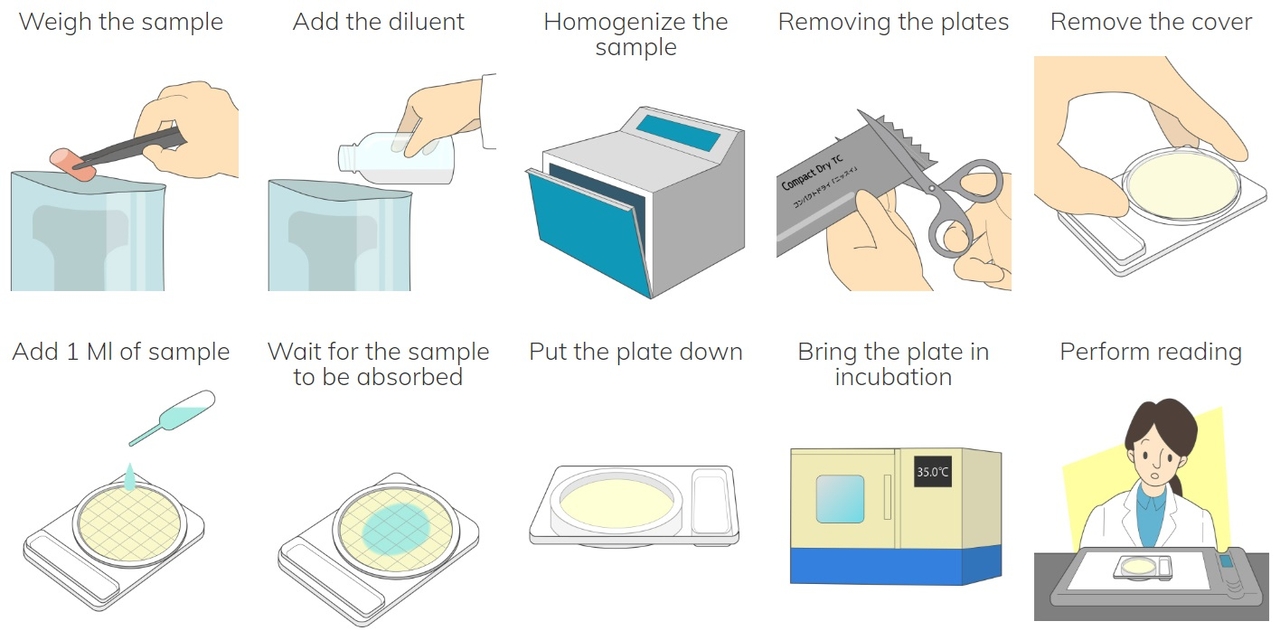
The article below gives detailed guidance on the Compact Dry plate procedure for QC rooms and can be used as internal training material.
- Compact Dry is a dry-medium plate used in microbiological testing, manufactured by Shimadzu Diagnostics (Japan). The plate comes with a
* Common analytes:
- Total aerobic microorganisms (TC)
- Coliform
- E. coli
- Staphylococcus aureus
- Salmonella (with enrichment)
- Yeasts and molds
1. Sample preparation
Preparing the sample correctly determines the accuracy of the result.
1.1. Required tools
- Analytical balance
- Sterile homogenizer bags
- Stomacher
- Volume pipettes and sterile tips
- Dilution solution (buffered peptone water or 0.85% NaCl)
1.2. Sample dilution principles
🔹 For solid samples (food, animal feed)
- Weigh 25 g of sample
- Add 225 mL of dilution solution
- Homogenize for 1–2 minutes
→ This yields a 10⁻¹ dilution
- Continue decimal dilutions if needed (10⁻², 10⁻³…)
🔹 For water samples
- It can be plated directly if the density is low
- Or diluted if a high microbial load is expected
👉 Note: shake well before drawing the sample to ensure the microorganisms are evenly distributed.
2. Pipette the exact volume
This step is extremely important.
Standard volume:
✅ 1.0 mL of sample per Compact Dry plate
Standard handling:
1. Place the plate on a flat surface
2. Open the lid
3. Drop exactly 1 mL into the center of the plate
4. Close the lid immediately
The sample will spread evenly by itself thanks to the internal membrane structure.
⚠ Be careful not to:
- Spread the sample with a spreader
- Shake the plate
- Drop more than 1 mL
- A wrong volume will skew the quantitative result (CFU).
3. Incubation time
The incubation time depends on the analyte:
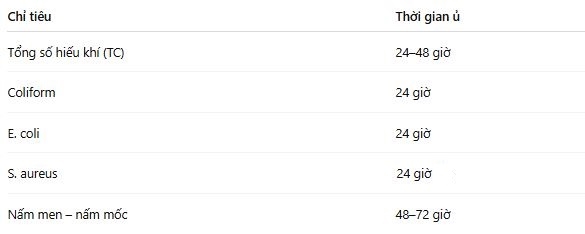
👉 Do not read the result too early or too late, because:
- The colonies may not be developed enough
- Or they may overgrow and overlap, making counting difficult
4. Incubation temperature
The standard temperatures commonly used:
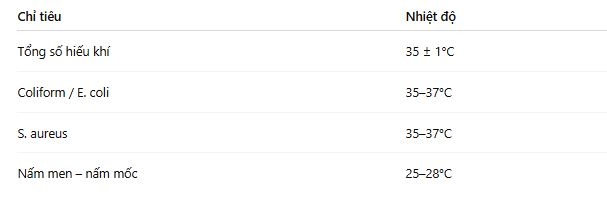
📌 You must use an incubator with periodic calibration.
A temperature deviation can:
- Slow microbial growth
- Or kill heat-sensitive microorganisms
5. How to read the colony results
5.1. General principles
- Count all colonies with the characteristic color according to the instructions for each plate type
- Choose plates with 30–300 CFU for the calculation
5.2. Example of reading colony colors
Depending on the plate type
- TC: red colonies
- Coliform: red/purple colonies
- E. coli: blue
- Molds: filamentous colonies with the characteristic color of each mold type.
- Yeasts: blue, white, or off-white colonies
👉 Always consult the technical documentation supplied with each product code.
6. Calculating the result (CFU/g or CFU/mL)
Formula:
CFU = number of colonies x dilution factor
Example:
- 45 colonies counted at the 10⁻² dilution
→ Result: 45 × 10² = 4.5 × 10³ CFU/g
7. Common mistakes in the QC room
- Not mixing the sample well before drawing
- Wrong pipette volume
- Wrong incubation temperature
- Leaving plates tilted during incubation
- Reading the result outside the prescribed time
Building an internal SOP reduces the variation between operators and increases result reliability.
8. Advantages of standardization with Compact Dry
✔ Fewer handling errors
✔ A standardized testing procedure
✔ Easier training of new staff
✔ Suited to ISO, HACCP, and FSSC audits
Especially useful for QC rooms in:
- Food factories
- Bottled water plants
- Cosmetics manufacturing facilities
- Animal feed factories
Building a standard operating procedure with Compact Dry not only ensures accurate test results but also raises the professionalism of the QC room. When followed correctly:
- Sample preparation
- Pipette exactly 1 mL
- Incubate at the right time and temperature
- Read and calculate the result accurately
The QC room will control microbiological risks well and meet internal testing requirements as well as external assessments.
👉 Contact information
PACIFIC SCIENCE & TECHNICAL EQUIPMENT COMPANY LIMITED
No. 28 Street 20, Him Lam Residential Area, Tan Hung Ward, Ho Chi Minh City
Contact: Mr. Tien. Phone: 0972598642
Email: xuantien@pacificlab.vn