

- Controlling mycotoxin levels plays an important role in ensuring food safety, product quality and meeting regulatory testing requirements.
- Among modern analytical methods, HPLC-based mycotoxin analysis and LC-MS/MS are widely applied thanks to accurate quantification, high sensitivity and good selectivity. However, to obtain reliable results, sample preparation and cleanup before chromatography cannot be skipped.
- One of the most commonly used solutions is the IAC (Immunoaffinity Column). This technology helps clean the extract, removes many matrix interferences and captures the target toxins before chromatographic analysis.
- So how is mycotoxin testing with IAC combined with HPLC/LC-MS/MS carried out? What should be noted to optimize recovery and result reliability?
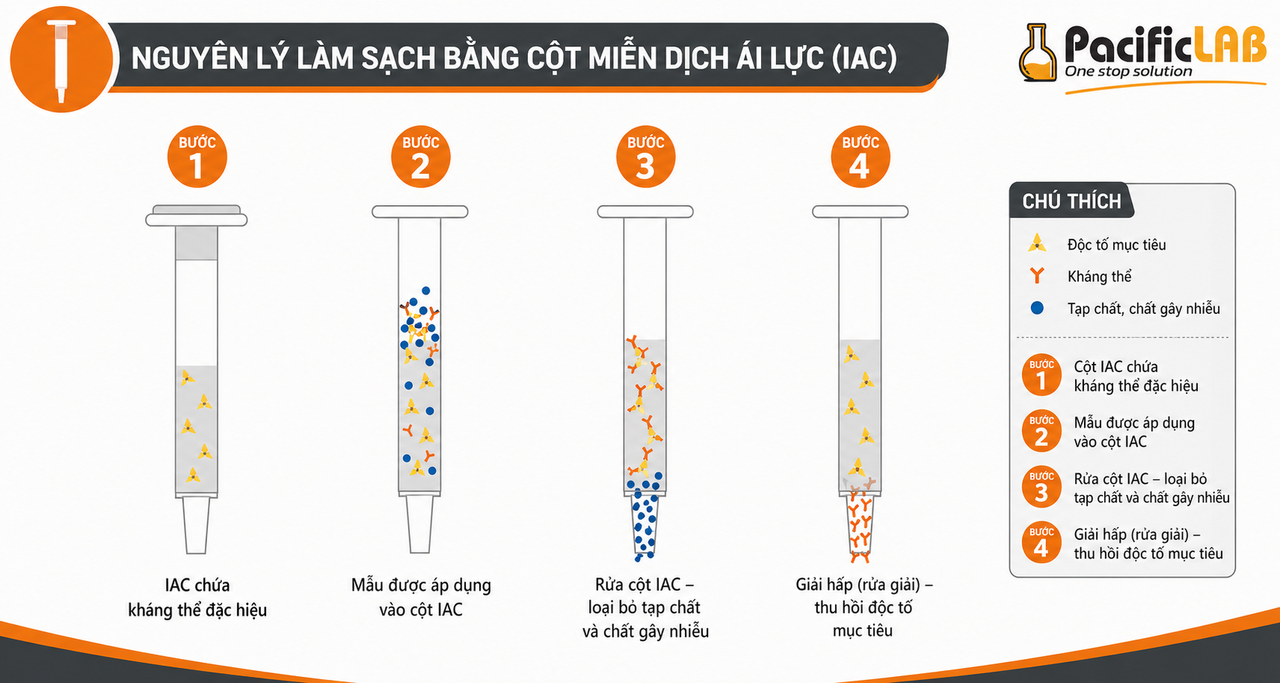
1. The role of IAC immunoaffinity columns in mycotoxin analysis
- An IAC immunoaffinity column is a sample cleanup material that uses the specific binding mechanism between antibodies and the target analyte. Inside the column, specific antibodies are immobilized on a solid support, recognizing and retaining the matching toxin as the sample extract passes through.
- For mycotoxin analysis, depending on the toxin to be tested, the laboratory can choose an IAC specific to aflatoxin, ochratoxin A, zearalenone, deoxynivalenol (DON), fumonisin or other toxin groups according to the product's application range.
* Why use IAC before HPLC or LC-MS/MS analysis?
- First, to remove matrix interferences. Food and animal feed extracts can contain fats, proteins, pigments and many other compounds. These components can affect chromatographic separation or cause matrix effects in mass spectrometry. IAC retains the target toxin and helps remove many unwanted components.
- Second, to increase selectivity during sample cleanup. Thanks to the antigen–antibody interaction, IAC can retain the target analyte better than non-specific cleanup methods in suitable applications.
- Third, to improve result reliability. When the process is optimized and properly controlled, IAC cleanup can reduce interference, improve chromatographic peak recognition and support more accurate mycotoxin quantification.
- Fourth, to standardize sample preparation. Using a suitable IAC column helps the laboratory build a reproducible sample pre-treatment process, convenient for quality control and method validation.
2. Mycotoxin testing workflow with IAC combined with HPLC/LC-MS/MS
- The specific process depends on the mycotoxin type, sample matrix, required quantification limit, IAC column type and the validated chromatographic method. However, a typical workflow includes the following steps.
* Step 1: Sampling and homogenization
- Samples must be taken representatively from the product lot, then ground, mixed or homogenized by a suitable method to ensure uniformity before weighing for analysis.
- For non-homogeneous matrices such as cereals, oilseeds or animal feed, homogenization is especially important because mycotoxins can be unevenly distributed across the lot.
* Step 2: Extracting mycotoxins from the sample
- Weigh the sample according to the chosen method, then add a suitable extraction solvent to release the toxins from the matrix.
- The solvent and extraction ratio must be selected by mycotoxin type and matrix. Some workflows use water, methanol or acetonitrile combined with water at defined ratios.
- After extraction, the sample is shaken or homogenized, then filtered or centrifuged to collect the extract. If needed, the extract is further diluted or solvent-adjusted before loading onto the IAC column.
Note: Solvent composition, pH and dilution ratio must be compatible with the column manufacturer's instructions. An unsuitable solvent can reduce antibody binding to the target toxin.
* Step 3: Sample cleanup with the IAC immunoaffinity column
- This is a key step in the HPLC mycotoxin analysis workflow.
- The prepared extract is passed through the IAC column at a suitable flow rate. The specific antibodies in the column bind the target mycotoxins, while many other matrix components are washed away with the flow-through.
- After loading, the column is usually washed with a suitable solution to remove remaining impurities. The toxin is then eluted from the antibodies with the elution solvent specified in the method, and the eluate is collected for analysis.
- Parameters to control include:
- Flow rate during loading and column washing.
- Volume and composition of the wash solution.
- Elution solvent and elution volume.
- Recovery of the target toxin.
- Column storage conditions and shelf life.
- The IAC column must be selected for the correct toxin type and a matrix range confirmed by the manufacturer. Do not assume one column type handles all mycotoxin groups effectively.
* Step 4: Preparing the sample solution before chromatographic analysis
- The eluate may need evaporation, reconstitution, dilution or filtration through a suitable membrane, depending on the analytical method.
- The goal of this step is to bring the sample into a solvent and volume compatible with the HPLC or LC-MS/MS system, while limiting components that could affect the chromatography column and detector.
- For LC-MS/MS, pay special attention to solvent composition, salts and remaining compounds that could foul the ion source or change signal response.
* Step 5: Mycotoxin analysis by HPLC or LC-MS/MS
- After IAC cleanup, the sample solution is injected into the chromatographic system to separate and quantify the toxins.
- The HPLC method is usually combined with a fluorescence detector (FLD) or another suitable detector, depending on the mycotoxin's properties and the validated method. Some analytes may require derivatization before fluorescence detection.
- The LC-MS/MS method combines liquid chromatography with tandem mass spectrometry, allowing identification and quantification based on retention time and characteristic ion transitions. This technique suits analytical methods with high sensitivity and selectivity requirements, especially when testing multiple toxins or matrices.
- The choice between HPLC and LC-MS/MS depends on the analyte, detection and quantification limits, regulatory requirements, instrument capability and the validated test method.
* Step 6: Data processing and result evaluation
- Results are calculated based on the calibration curve and the validated quantification procedure. The laboratory should review retention times, analyte signals, identification criteria and factors affecting the results.
- Quality control checks may include:
- Method blanks.
- Spiked samples or control samples with suitable reference values.
- Recovery of mycotoxins through the whole process.
- Repeatability and reproducibility as required.
- Limit of detection (LOD) and limit of quantification (LOQ).
- Assessment of matrix effects and signal stability.
- Results should only be reported when the method's acceptance criteria are met.

3. How does IAC connect to the HPLC/LC-MS/MS system?
- IAC and the chromatographic system play two different but directly complementary roles.
- IAC focuses on cleanup and capture of the target analyte, while HPLC or LC-MS/MS performs separation, identification and quantification of the toxin.
* The overall workflow can be described as:
Food or feed sample → Extraction → Filtration and dilution → IAC cleanup → Elution → Sample preparation → HPLC/LC-MS/MS → Data processing and reporting.
- In this workflow, IAC is usually used as an offline pre-treatment step, meaning the sample is cleaned on a separate column before being injected into the chromatographic system. An IAC column is not automatically plumbed in series with the HPLC column.
- Proper combination reduces the matrix load on the chromatographic system, supporting analytical performance and improving result reliability.
4. Factors affecting the effectiveness of IAC and HPLC mycotoxin analysis
Choosing an unsuitable IAC column
Each column has its own binding characteristics, capacity and application range. Using a column for the wrong target toxin or beyond the recommended capacity can reduce recovery.
Suboptimal sample extraction
Extraction solvent, extraction time and sample-to-solvent ratio can affect the amount of toxin released from the matrix. The process must suit each matrix and its performance confirmed.
Incorrect flow rate and loading conditions
A flow rate that is too high, or loading conditions incompatible with the manufacturer's instructions, can affect antibody–mycotoxin binding.
Matrix effects in LC-MS/MS
Even after cleanup, some matrix components can still affect ionization, causing signal suppression or enhancement. Using IAC therefore does not mean matrix effects are fully eliminated; they must be assessed with suitable experiments.
Missing quality control steps
A clear signal is not enough to prove accuracy. Evaluating recovery, repeatability, LOD, LOQ and other validation criteria is necessary to demonstrate method fitness.
5. IAC applications in mycotoxin testing
Immunoaffinity columns can be used in mycotoxin testing workflows across many fields, depending on the column type and its confirmed application range.
- Cereals and cereal products: Controlling toxins such as aflatoxin, DON, zearalenone or fumonisin by suitable methods.
- Peanuts, oilseeds and nuts: Aflatoxin analysis and related target toxins.
- Coffee, spices and food ingredients: Supporting sample cleanup before toxin quantification where appropriate.
- Milk and dairy products: Testing aflatoxin M1 according to validated workflows.
- Animal feed: Monitoring mycotoxins that can affect ingredient quality and feed safety.
Column selection should be based on the toxin to analyze, the sample matrix, the quantification limit and the method requirements. Not all IAC columns are suitable for every application above.
6. Why choose quality IAC columns for the testing lab?
- In an analytical workflow, the HPLC/LC-MS/MS instruments are only part of the system. The quality of sample preparation also directly affects the reliability of the final result.
- A suitable IAC column can help the laboratory:
- Improve the selectivity of the sample cleanup step.
- Reduce interference from unwanted matrix components.
- Support suitable recovery when the process is optimized.
- Standardize sample pre-treatment.
- Help protect the chromatographic system from part of the fouling matrix.
- When choosing a product, the laboratory should check the target toxin type, column capacity, confirmed matrix range, compatible solvents, usage instructions and the manufacturer's performance data.
7. R-Biopharm IAC immunoaffinity columns – A mycotoxin sample cleanup solution
- For laboratories building or optimizing a mycotoxin testing workflow, the IAC immunoaffinity columns from R-Biopharm are worth considering when the specific product matches the analyte and matrix to be tested.
- The IAC solution can be integrated into sample pre-treatment before HPLC or LC-MS/MS analysis, improving the selectivity of the cleanup step and supporting analytical data quality.
- When choosing R-Biopharm IAC columns, businesses should determine in advance:
- The mycotoxin to be tested.
- The matrix to be analyzed.
- The chromatographic system in use: HPLC-FLD or LC-MS/MS.
- The desired quantification limit.
- Requirements for the test method, recovery and validation.
- Choosing the right product and building a suitable process helps the laboratory optimize sample preparation, aiming for stable and reliable analytical results.
- Contact the supplier of testing equipment and consumables for advice on choosing R-Biopharm IAC columns suitable for the toxin type, matrix and analytical system in use.
👉 See the article: R-Biopharm IAC immunoaffinity columns for each mycotoxin type
Conclusion
- The mycotoxin testing workflow using IAC combined with HPLC/LC-MS/MS is a combination of selective sample cleanup and modern chromatographic analysis. IAC plays an important role in the pre-treatment stage, reducing matrix influence and supporting result reliability when used correctly.
- To optimize the HPLC mycotoxin analysis process, the laboratory should choose a suitable IAC column, control extraction and elution conditions, and validate the whole method's performance through quality control checks.
- Investing properly in sample cleanup is one of the factors that help laboratories build an effective, stable mycotoxin testing process that meets real analytical requirements.