
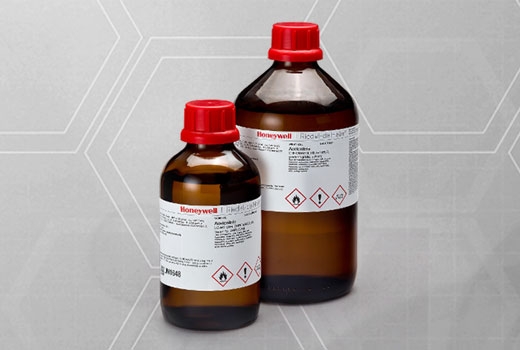
1. Which factors must be taken into account when selecting a solvent for analytical methods?
Depending on the field, solvents come in different purity grades:
• For liquid chromatography (HPLC, LC-MS)
• For gas chromatography
• For trace inorganic analysis (ASA, ICP)
• For semiconductors (VLSI, ULSI grade)
• For DNA / RNA / peptide synthesis
• For molecular biology (PCR)
• For cell culture
• For UV-VIS spectroscopy
1.1 UV-VIS spectrophotometry, the analytical solvent must:
- The lower the absorption of the impurities, the better
- Provide detailed absorption data
- If impurities absorb in the UV-VIS range, the following can occur:
(i) baseline rise in gradient elution mode,
(ii) reduced sensitivity and increased method uncertainty
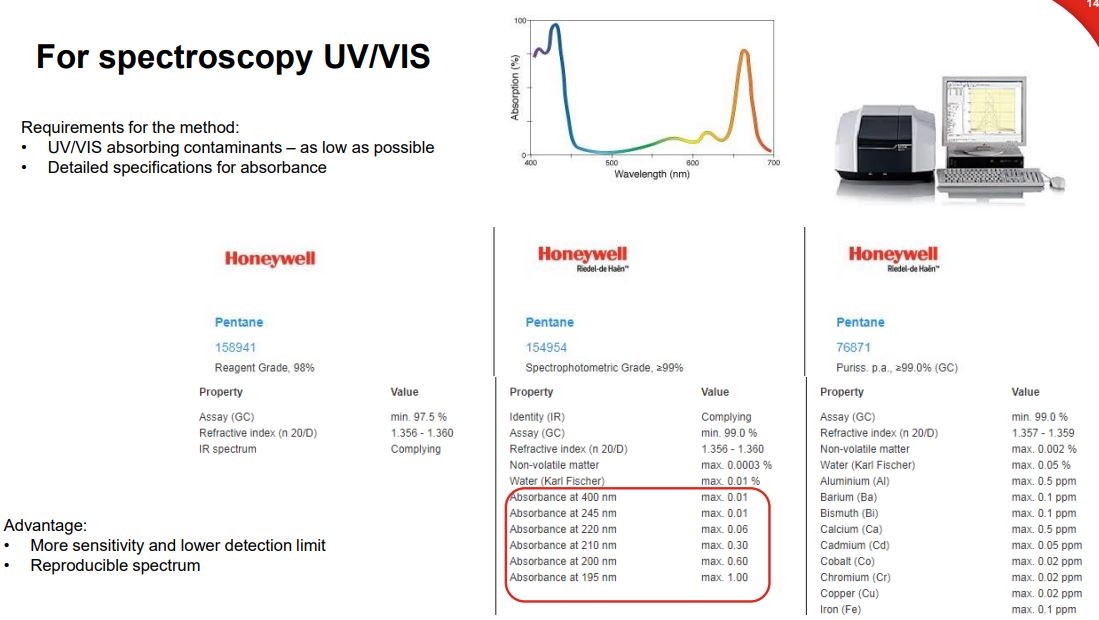
Absorption (Abs) of pentane solvent - Honey well company in UV-Vis.JPG
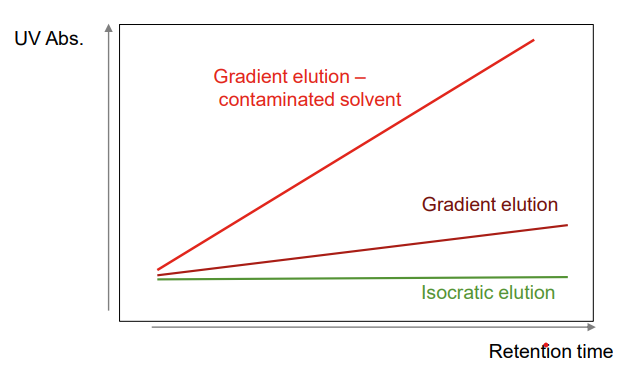
Diagram describing the operating modes in the spectrophotometric method with solvents with or without impurities
1.2 High performance liquid chromatography (HPLC)
Solvents in liquid chromatography must meet the following requirements:
- High purity
- Degassing in the mobile phase
- Free of particulates (0.2 µm filter)
- Low absorption impurities (UV-VIS detector), low fluorescence (fluorescence detector)
- Low metal content and low non-volatile residue (MS, ICP-MS detector)
- With an MS detector, impurities can cause: (i) instrument damage, (ii) ion suppression, (iii) formation of by-products. Therefore, the solvent used must be of very high purity and limit impurities such as: (i) absorption in the UV-VIS range, (ii): non-volatile substances, (iii) alkali metal ions and compounds that reduce ionization
1.3 Gas chromatography (GC)
In GC, the mobile phase is a gas, not a liquid solvent mixture. Therefore, the problems that occur with impurities in the solvent are relatively different from those of the methods mentioned above. Reagents are used to process and inject the sample. Therefore impurities in the chromatographic solvent are also present in the sample. Impurities will not be distributed continuously as in HPLC. Impurities can be separated in the GC column. Their peaks are also shown on the chromatogram. Impurities can be enriched during sample preparation. Sometimes, their retention times are also close to those of the analyte of interest.
In the case where impurities co-elute with the analyte, this leads to incorrect peak integration results. Too many impurities in the solvent can also foul the column and raise the baseline. With the trace analysis methods , the selection of 1 solvent of high purity becomes even more important.
The solvent purity required at this point can reach
1.4 Atomic absorption/emission spectroscopy (AAS/ICP)
With atomic spectroscopy, the choice of solvent must take the following into account:
- High purity
- Low metal and ion content
- Packaged in suitable bottles made of organic polymer.
2. Purity and impurities present in solvents, reagents
Purity is The percentage of chemical content matching the formula on the label after the amount of impurities has been subtracted
Table presentation: Common designations for the purity grades (decreasing from top to bottom) of chemicals in Eastern countries:
Latin name | Abbreviation | National name | Abbreviation |
purum speciale | pur. spec. | zvláště čistý | zv. č. |
purissimum | puriss | chemicky čistý | ch. č. |
pro analysis | p. a. | pro analýzu | p. a. |
purum | pur. | čistý | č. |
technicum | techn. | technicky | tech. |
* Impurities present in reagents can be chemical impurities (dissolved inorganic / organic substances), physical (dissolved gases, particulates) or/and biological (microorganisms or biological molecules).
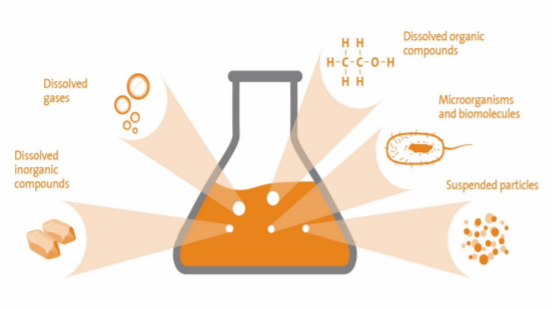
Types of impurities in solvents: dissolved gases, dissolved organic / inorganic compounds, microorganisms, suspended solids,... Depending on your analytical needs, you should pay attention to the types of impurities in the solvent (Item 1)
3. Different purity grades of solvents, chemicals
Currently, the grades of solvents and reagents are divided into 7 common types. Depending on the purpose of use, we will choose the solvent with the appropriate grade. Below is information on the purity from highest to lowest:
- ACS: Meets or exceeds the purity threshold of the American Chemical Society (ASC). At this grade, solvents and reagents are used in food, pharmaceutical or medical applications. In addition, they are also used for ACS applications, production processes requiring strict quality specifications and purity
- 95%.
- Reagent: Usually of a quality equivalent to ACS grade (95%). They are used in the food, pharmaceutical or medical fields. In addition, reagent grade is also suitable for laboratory applications and service analysis.
- U.S.P: Used mainly in laboratories. U.S.P grade has a purity meeting the requirements set by the United States Pharmacopeia. In some cases it can be used as a pharmaceutical.
- NF: NF grade does not have sufficient purity to meet the standards required by the National Formulary (NF). Solvents and chemicals at this grade are usually used for educational purposes or as chemicals of higher quality than intermediate grade.
- Lab: Chemicals or reagents at this grade contain high, defined amounts of impurities. They are usually used for educational purposes. Because the purity is not guaranteed, lab grade is not used in food, pharmaceuticals, or medicine.
- Purified: They are also known under other names such as pure or practical grade. Chemicals at this grade do not meet any official standard. Their intended use is usually educational. Because the purity is not guaranteed, pure grade is not used in food, pharmaceuticals, or medicine.
- Technical: They are used for commercial or industrial purposes. However, just like chemicals with a high unidentified impurity content, this chemical grade is also not used for food, pharmaceuticals, or medicine.
(https://www.labicom.cz/cogwpspogd/uploads/2018/06/Purity-of-lab-reagents-K.-Pokajewicz-Honeywell.pdf)
Chemicals and reagents play an important role in production, analysis, laboratories,… In order to ensure the requirements and purposes of products, results, experiments…, these chemicals and reagents need to ensure the following basic factors:
- Quality assurance parameters: purity and impurity content in the chemicals
- Intact packaging and labels containing all the necessary information
- Shelf life / recommended expiry date
Through this article, PacificLAB hopes you have understood the purity grades of solvents needed to choose the solvent standard that suits you.
Please like and follow PacificLAB's fanpage to gain more knowledge in the field of analysis and testing:
https://www.facebook.com/thaibinhduong.pacificlab
PacificLAB's technical team is always ready to advise you when needed. Please contact us!
Source: www.labicom.cz