
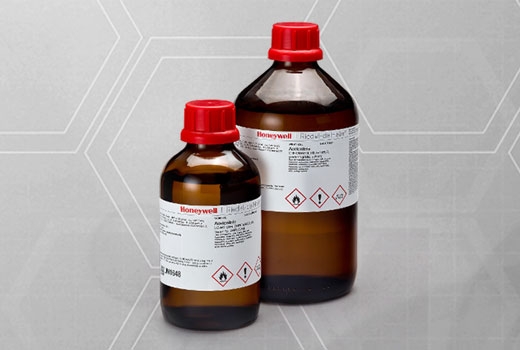
Acetonitrile and Methanol are two organic solvents have a low cavity formation energy, easily dissolve the analytes and are therefore often chosen for extraction and sample enrichment. The differences between these 2 solvents that should be mentioned are:
Pressure
Absorption spectrum
Elution capability
Storage capability
Selectivity of the elution (separation) process
Chromatographic peak shape
Analyte solubility
Decrease in solubility when mixed with buffer
Degassing in the mobile phase
Ionization efficiency of LC/ESI-MS
Now we will go into each of these differences in turn
1. Column pressure changes when switching from Acetonitrile to Methanol
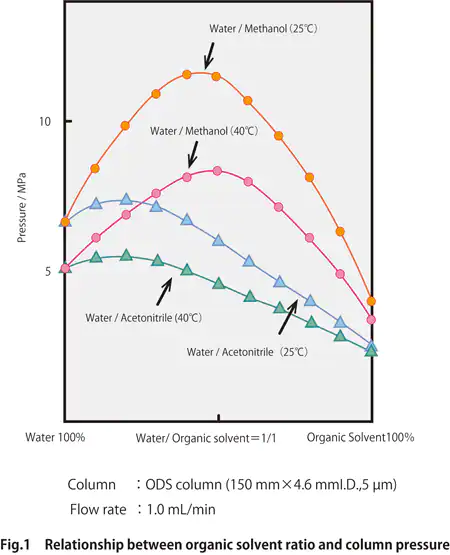
The relationship between the organic solvent ratio and the column pressureFigure 1 is an example of the solvent ratio and the conveying pressure of the water/acetonitrile and water/methanol mixtures. Pressure tends to decrease because the viscosity of the solvent decreases as the temperature rises. For water/acetonitrile and water/methanol solvents, the operating temperature of the column is set between 25-40oC. The results show that the pressure produced by methanol is higher. Therefore, when switching the mobile phase solvent from acetonitrile to methanol, the pressure of the column and instrument at that time needs to be checked again.
2. Absorption spectrum
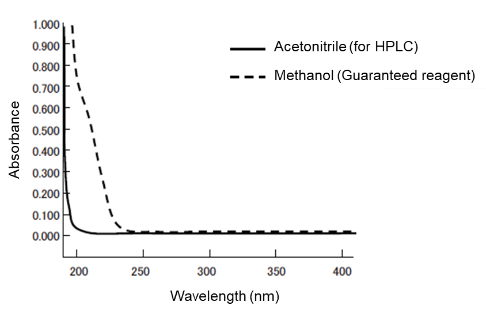
Figure 2. Absorption spectrum of acetonitrile used in HPLC and methanol (reagent)The absorbance of the acetonitrile solvent used in high performance liquid chromatography (HPLC) and methanol (reagent) are compared in Figure 2. Absorbance of the mobile phase solvent, the smaller it is, the lower the interference caused at the UV detector. Therefore, acetonitrile used in HPLC is suitable for analytes with high sensitivity at short UV wavelengths. In a concentration gradient background using a UV detector, acetonitrile used in HPLC is less prone to “ghost” peaks. Although many other organic solvents have higher water compatibility, few of them give a lower absorbance than acetonitrile.
| Wavelength (nm) | Absorbance | |
| Methanol (reagent) | Acetonitrile used in HPLC | |
| 200 | 0.7078 | 0.0235 |
| 210 | 0.4813 | 0.317 |
| 220 | 0.1959 | 0.077 |
| 225 | 0.0928 | 0.051 |
3. Elution capability
Overall, acetonitrile shows better elution capability than methanol. When acetonitrile or methanol is mixed with water at the same ratio, the elution capability of acetonitrile is clearly superior to that of methanol. Especially when mixed at a low ratio, the acetonitrile mixture may take no more than half the elution time of methanol for compounds with the same retention time.
Figure 3 shows an example of the separation of the paraben compounds, which are p-hydroxybenzoic acid, using an ODS column. When acetonitrile and methanol are mixed with water at the same ratio, the acetonitrile mobile phase solvent gives a shorter elution time. The scale shows the strength of the methanol/acetonitrile and water ratio, which is used to calculate the elution time when changing the solvents. If we use acetonitrile as the mobile phase solvent, water must be mixed at a ratio of 50/50 (v/v). Conversely, when changing to methanol, the methanol/water ratio must be 60/40 (v/v).
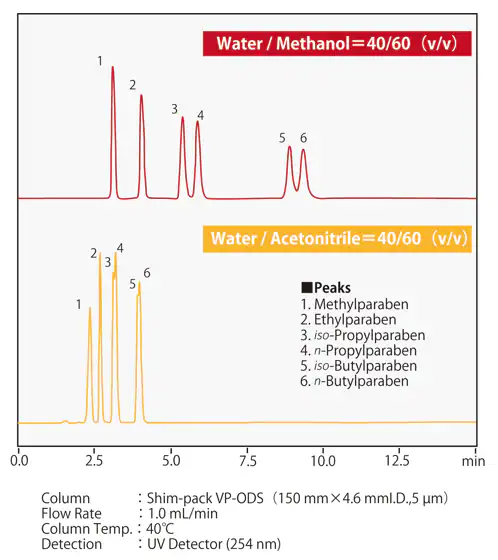
Figure 3. Comparison of the elution time between acetonitrile and methanol (p-hydroxybenzoic acid; parabens)
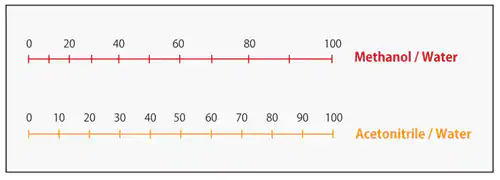
Comparison of the elution capability of the MeOH/water and ACN/ water mixtures. ACN elutes more strongly
4. Retention capability
Methanol and acetonitrile have different chemical properties. Methanol is a protic solvent while acetonitrile is a non-protic solvent. If the separation is not good when using acetonitrile as the mobile phase solvent, changing the mobile phase solvent to methanol, and at the same time changing the elution order, is a way to develop the analytical method.
Figure 4 is an example of separating benzene ring compounds with 1 hydrogen atom replaced by a carboxyl or hydroxyl group. Using methanol or acetonitrile as the mobile phase solvent. When the retention capability of the three compounds is the same. The elution order of phenol and benzoic acid depends on the solvent used. Depending on the type of column, some secondary interactions may occur due to the polar functional groups of the packing material in addition to the main modified functional groups such as ODS or C8 (octyl). However, secondary interactions do not always bring negative results.
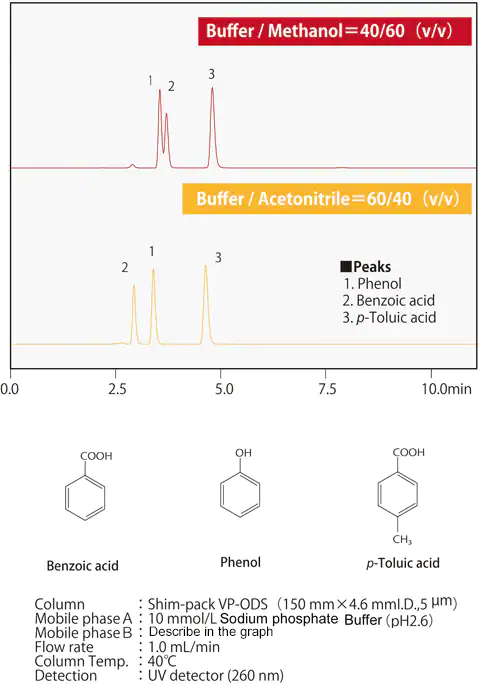
Figure 4. Difference in elution order between methanol and acetonitrile
Figures 5 and 6 show the separation of 13 cephalosporin antibiotics on a reversed-phase column. Methanol and acetonitrile solvents are used respectively. Under the same analytical conditions, the retention time and elution order are different between acetonitrile and methanol. As we already know, the elution order depends on the stationary phase. For example, when comparing ODS and C8 columns, the C8 column gives a poorer retention capability. However, due to the polar functional groups of the packing material, it is not simply that the retention capability is poorer, because the retention interaction also differs significantly. Because the retention interaction is affected by many different factors, we need to try combinations of different mobile phases and stationary phases to optimize the analytical conditions.
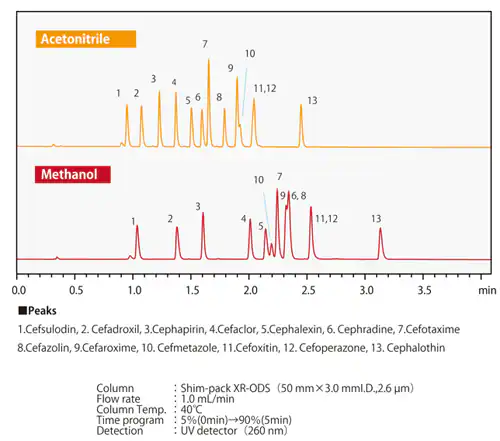
Figure 5. Separation of cephalosporin antibiotics using an ODS column
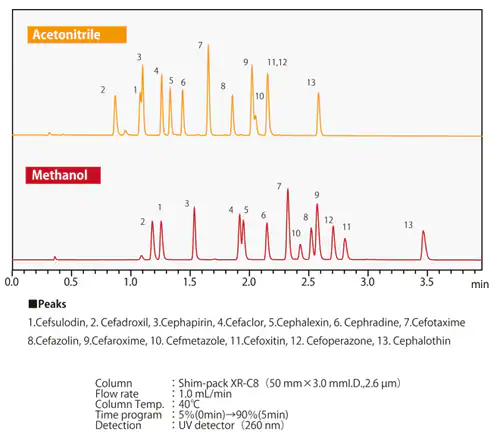
Figure 6. Separation of cephalosporin antibiotics using a C8 column
5. Selectivity of the elution (separation) process
The selectivity of the elution process depends on the solvent. The elution order can be reversed between methanol and acetonitrile. Selectivity in the separation process also depends on the mixing ratio with water and the nature of the soluble components. Therefore, it is not always the case that the selectivity of this solvent is higher than that of the other solvent.
For example, in separating positional isomers, the phenyl chromatography column is the most suitable for reversed-phase liquid chromatography. In this case, the separation capability will depend on hydrophobic interactions and π – π bond interactions. Figure 7 is an example of separating the positional isomers of cresol. Acetonitrile (CH3-C≡N) has 3 C-N bonds and 1 π electron, whereas methanol (CH3OH) has no π electron. For a phenyl column, using methanol as the mobile phase solvent promotes π – π bond interactions and improves the separation capability.
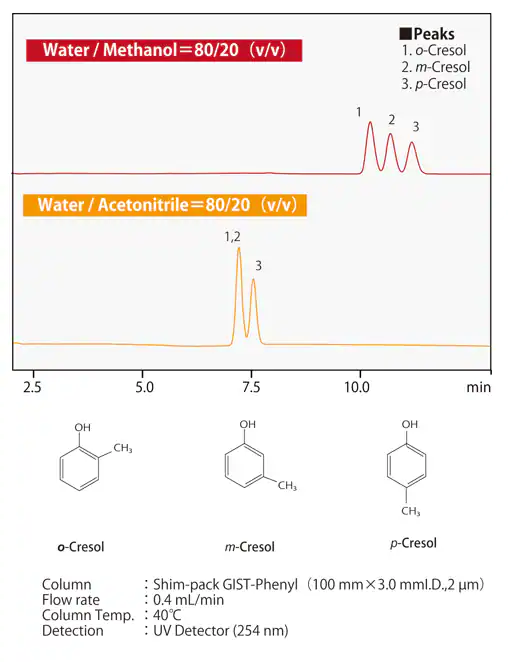
Figure 7. Difference in selectivity between methanol and acetonitrile (for the positional isomers of cresol)
6. Chromatographic peak shape
Peaks are tailed more when eluted with acetonitrile than with methanol. This tailing tendency is even more evident for compounds such as salicylic acid (phenol with carboxyl and methoxy groups in the ortho position). An explanation for this phenomenon is the different chemical properties of the organic solvent molecules, whereby the mobile phase solvent participates in the interaction (adsorption) between the silica surface and the analyte. However, for a reversed-phase polymer column, tailing is rarely seen when using acetonitrile as the elution solvent.
7. Analyte solubility
Methanol shows a higher ability to dissolve ionic compounds such as acid and base compounds than acetonitrile. For an analyte that dissolves well in the solvent, it will be easy to reduce the injection volume of the sample and adjust the concentration between the mobile phase solvent and the analyte.
8. Decrease in solubility when mixed with buffer
In reversed-phase chromatography, the buffer is essentially a salt of the mobile phase solvent dissolved in water. Depending on the type of buffer and the organic solvent, if the amount of solvent is too large it can lead to reduced solubility and cause inorganic salt precipitation. Tables 1 and 2 show the precipitation potential of the commonly used buffer mixtures at the corresponding acetonitrile and methanol ratios. The values in the tables indicate the volume ratio (v/v) at which precipitation begins to form. It can be seen that some buffer solutions do not precipitate with either of the 2 organic solvents, but overall methanol causes this situation less often.
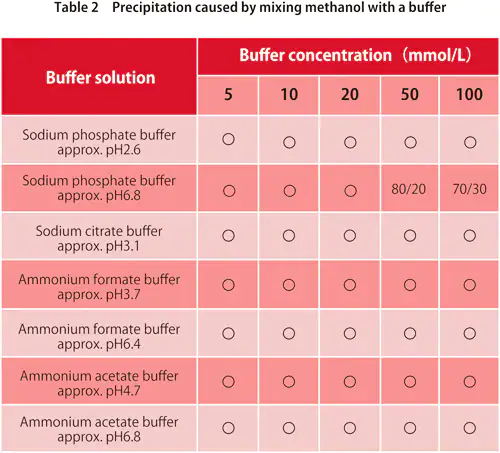
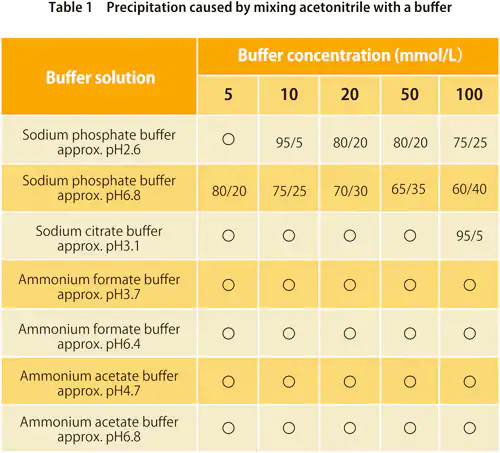
9. Degassing in the mobile phase
For isocratic elution, water and the organic solvent are mixed and stored before being used as the mobile phase solvent. When mixed with water, methanol gives an exothermic reaction. The amount of dissolved gas that is supersaturated will quickly escape from the liquid as gas bubbles (the degassing process). Conversely, acetonitrile gives an endothermic reaction, causing the solution temperature to drop below room temperature. When the acetonitrile mixture returns to room temperature, gas bubbles are gradually formed in the liquid. In addition, when this mixture is used to run the mobile phase while the temperature has not yet equilibrated with room temperature, the retention time will decrease and only stabilizes when the liquid reaches room temperature. Therefore, the temperature of the mobile phase throughout the degassing process needs to be considered carefully.
10. Ionization efficiency of LC/ESI-MS
The ESI ionization process starts from fine droplets in the mobile phase, therefore the lower the viscosity of the solvent, the more favourable it is for this process. By comparison, acetonitrile has lower viscosity than methanol, so its ionization efficiency is higher.
Above we have introduced the main points in the choice between methanol and acetonitrile as organic solvent in HPLC analysis. From the point of view of the analytical process, there are differences in column pressure, ultraviolet absorbance and buffer compatibility,... And when talking about resolution in the analysis, one needs to pay attention to elution efficiency, selectivity and retention capability.
Understanding these differences between methanol and acetonitrile, together with choosing a suitable column, will help improve your analytical method.
References: https://labchem-wako.fujifilm.com/asia/wako-blog/032966.html
https://www.shimadzu.com/an/service-support/technical-support/lib/methanol-acetonitrile.html
See more other articles
Or request an in-depth article on a topic / question
PacificLAB is pleased to accompany you in the field of analysis / testing.
Source: www.shimadzu.com