
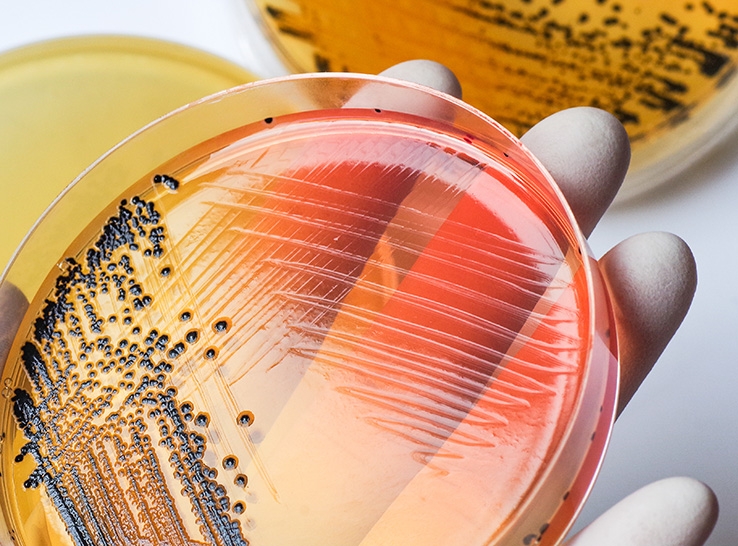
Salmonella is among the most common enteric pathogens, usually linked to contaminated food and water. To detect it, pre-enrichment and selective enrichment are essential steps to recover and multiply the organism before identification.
1. The role of enrichment media
Enrichment media serve to:
- Recover Salmonella cells damaged by heat treatment, chilling or harsh conditions.
- Build up Salmonella numbers to a detectable threshold.
- Suppress the growth of competing microorganisms, especially in matrices with heavy background flora (such as food, feces, wastew
* Depending on the stage, they fall into two types:
- Pre-enrichment media (non-selective): help recover damaged bacteria.
- Selective enrichment media: build up the Salmonella density while inhibiting unwanted bacteria.
2. Pre-enrichment media
2.1. Buffered Peptone Water (BPW)
- Main components: peptone, phosphate buffer.
- Mechanism: contains no inhibitors – it supports the recovery of damaged cells and allows Salmonella to grow in a neutral environment.
* How to use:
- Weigh 25 g (or 25 ml) of the food sample into 225 ml of BPW.
- Incubate at 37°C for 18–24 hours.
2.2. Lactose Broth
- Use: acceptable in some older ISO methods.
- Limitation: does not recover Salmonella as well as BPW.
3. Selective enrichment media
After pre-enrichment, the culture is transferred into selective enrichment media to encourage the growth of Salmonel
3.1. Rappaport-Vassiliadis Soya Peptone Broth (RVS or RVS broth)
- Components: soy peptone, magnesium chloride, malachite green.
- Mechanism: low pH (~5.2), high MgCl₂ concentration and malachite green – strongly inhibit non-Salmonella bacteria.
* How to use
- Take 0.1 ml of the pre-enrichment culture from BPW into 10 ml of RVS broth.
- Incubate at 42 ± 0.2°C for 24 hours (a high temperature optimal for Salmonella).
3.2. Müller-Kauffmann Tetrathionate Broth (MKTT or TTB)
- Components: peptone, beef bile, thiosulfate, tetrathionate, iodine-iodide solution.
- Mechanism: tetrathionate formed in the medium inhibits non-Salmonella Gram-negative bacteria. Salmonella has t
* How to use
- Take 1 ml of the pre-enrichment culture from BPW into 10 ml of MKTT broth.
- Incubate at 37 ± 1°C for 24 hours.
3.3. Selenite Cystine Broth (SC broth) (less common today)
- Mechanism: selenite inhibits background bacteria without much effect on Salmonella.
* How to use
- Take 1 ml from BPW into SC broth.
- Incubate at 37°C for 24 hours.
4. The typical Salmonella enrichment workflow
Below is the Salmonella enrichment procedure under the international standard (ISO 6579-1:2017):
* Pre-enrichment:
- 25 g/25 ml sample + 225 ml BPW → incubate at 37°C for 18–24 hours.
* Selective enrichment (two media in parallel):
- 0.1 ml BPW → 10 ml RVS broth → 42°C for 24 h.
- 1.0 ml BPW → 10 ml MKTT broth → 37°C for 24 h.
* Isolation on specific media:
After enrichment, streak onto media such as XLD, HE or BGA to identify Salmonella.
5. Some notes on using Salmonella enrichment media
- Always follow the standard inoculation ratios, incubation times and temperatures.
- RVS is more sensitive for classic Salmonella serovars, but may not be optimal for some heat-resistant or variant strains.
- Combining two selective enrichment media (RVS + MKTT) increases detection sensitivity.
Using the right enrichment media and following the incubation protocol strictly is the key to detecting Salmonella in foo BPW and selective media such as RVS and MKTT allow recovery and enrichment of the organism, ensuring high sensitivity and accuracy in microbiological testing methods.