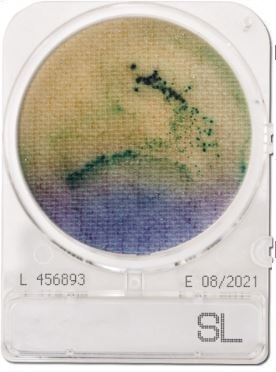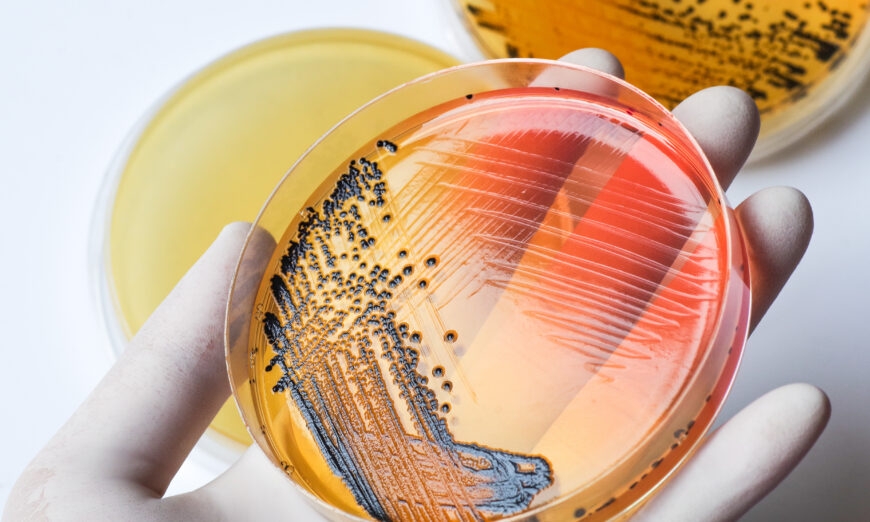
Culturing and isolating Salmonella in the laboratory plays an important role in identifying and controlling diseases caused by this bacterium.
1. Non-Selective Medium
– This is a medium allowing the growth of many kinds of microorganisms, not only Salmonella.
– TSA (Tryptic Soy Agar) medium: This is a popular non-selective medium, allowing the growth of many kinds of bacteria, including Salmonella.
2. Enrichment Medium
Enrichment media are used to promote the growth of Salmonella from a small original amount, helping improve the detection efficiency.
– RV (Rappaport-Vassiliadis) medium: This is a selective enrichment medium, designed to create optimal conditions for Salmonella to develop while inhibiting other bacteria.
- Selenite Cystine medium: This is another liquid medium that helps inhibit other bacteria and enrich Salmonella, especially in meat samples.
3. Selective Medium
Selective media contain special agents that help suppress other bacteria, creating favorable conditions for the growth of Salmonella.
- XLD (Xylose Lysine Deoxycholate Agar) medium: This medium contains deoxycholate, an agent that inhibits Gram-positive bacteria and some non-Salmonella Gram-negative bacteria.
– HEA (Hektoen Enteric Agar) medium</:>: HEA contains bile salts to suppress non-Enterobacteriaceae bacteria. In HEA, Salmonella produces colonies with typical black centers.
– BGA (Brilliant Green Agar) medium</:>: The BGA medium contains brilliant green, an agent suppressing other bacteria, making it easy for Salmonella to develop.
4. Biochemical Testing Medium
After isolating Salmonella, determining the biochemical properties is an important step in identifying the species.
– TSI (Triple Sugar Iron Agar) medium</:>: Used to assess the ability to ferment sugars (glucose, lactose, and sucrose) and produce H2S by Salmonella.
- Urease medium: Salmonella does not produce urease, so the result is negative. This helps distinguish Salmonella from other bacteria.
5. Compact Dry SL Salmonella ready-to-use dried agar culture plate
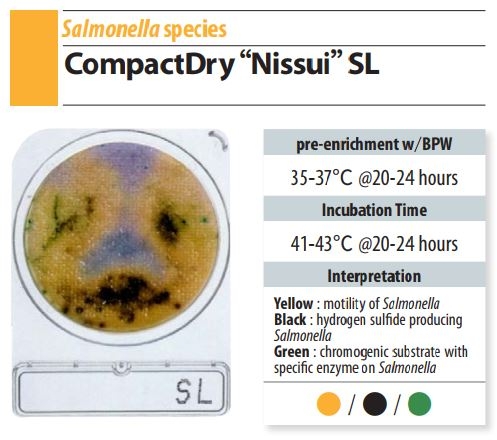
The Compact Dry Salmonella plate (Compact Dry SL) from Shimadzu Nissui is an effective product in detecting Salmonella in food.
* Advantages of the Compact Dry Salmonella plate:
– Saves time and effort: No need for complicated culture medium preparation, minimizing the accompanying steps.
- High accuracy: accurately detects the presence of Salmonella thanks to the selective medium and the specific color indicator.
– Easy storage and transport: The plate is compact, easy to store and transport without special refrigeration.
– See detailed information about the Compact Dry SL Salmonella plate product we supply here.
6. Culture Conditions
Culturing Salmonella requires specific conditions to achieve optimal efficiency.
- Temperature: Salmonella grows best at 35-37°C. In selective media, the temperature can differ and warming to 42°C enables detection to finish faster.
– Time: The incubation time is 18-24 hours for selective media. For enrichment media, the time can be up to 48 hours.
- pH: Salmonella culture media usually have a neutral or slightly alkaline pH to create suitable conditions for growth.
The procedure of culturing Salmonella from the original sample to isolation and identification is an important process that requires meticulousness and precision.