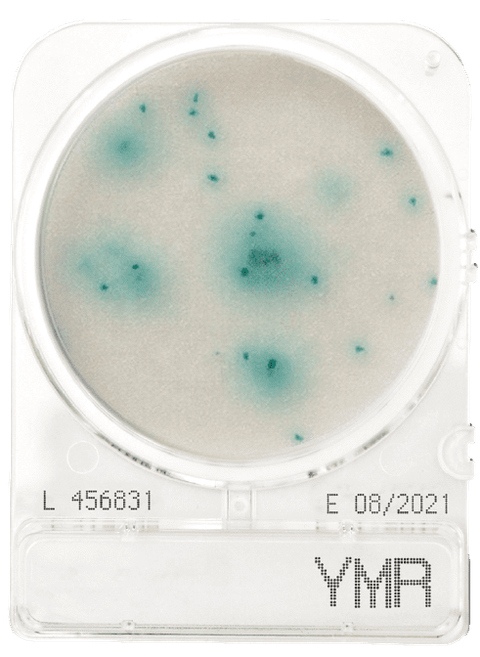
1. Scope of application
- This standard specifies the method using the Compact Dry YMR plate for the rapid quantification of 1) yeast and mould in food.
- This method is suitable for products with a water activity greater than 0.95.
- Annex A provides information on the results of the method's validation and the results of interlaboratory tests carried out by AOAC [7],[8] and NMKL - NordVal [9],[10].
2. Definition of yeast
Thermophilic aerobic microorganisms which, at 25 ºC when using the medium under the conditions specified in this standard, grow into round, shiny or dull colonies on the surface of the medium, usually with a regular edge and a slightly or strongly convex surface.
NOTE: Yeast in the medium grows into round, oval-shaped colonies.
3. Definition of mould
Aerobic thermophilic filamentous microorganisms which, under the conditions specified in this standard, grow into spreading tufts like down or flat growths, or into colonies on the surface of the medium, usually green in colour or with a structure bearing spores.
4. Colony
A visible mass of microbial biomass at one location, growing on or in a solid nutrient medium from a single living particle.
5. Principle of the test
A ready-prepared medium plate is used, comprising culture medium, a cold-water-soluble gelling agent, a chromogenic enzyme substrate and the antibiotic chloramphenicol. Inoculate 1 mL of the diluted test portion into the centre of the culture medium and let the test portion diffuse on its own. Yeast and mould grow and develop using the nutrients; the chromogenic enzyme substrate (X-phos) is used to detect and quantify yeast and mould after incubation at 25°C ± 1°C for 3 days; chloramphenicol inhibits the growth of bacteria. Count colonies of any colour (most colonies are green and blue) and filamentous (cotton-like) colonies.
6. Culture medium and diluent
Only use reagents of analytical grade; the water used is distilled or demineralised water, or water of equivalent quality, unless otherwise specified.
6.1. Compact Dry YMR plate
- The Compact Dry YMR Yeast and Mould Rapid plate contains nutrients, chloramphenicol, a chromogenic enzyme substrate (X-phos 2)) and a cold-water-soluble gelling agent.
- The plate measures 20 cm2, and the back of the plate has a 1 cm × 1 cm grid to make colony counting easier. Store this plate at 1ºC to 30ºC.
6.2. Peptone salt solution (MRD)
6.2.1. Composition
- Peptone (casein hydrolysed by enzymes) 1.0 g
- Sodium chloride (NaCl) 8.5 g
- Water 1000 ml
6.2.2. Preparation
Dissolve the components in water in a 1 000 mL flask or bottle, heating if necessary. Sterilise for 15 min in an autoclave (6.3) at 121 °C. Adjust the pH so that after sterilisation it is 7.0 ± 0.2 at 25ºC, if necessary.
7. Equipment, apparatus and consumables for preparation
Use the equipment and apparatus of a normal microbiology laboratory and the following equipment and apparatus:
- Analytical balance, capable of weighing accurately to 0.1 mg.
- pH measuring instrument, accurate to 0.1 pH unit at temperatures from 20ºC to 25ºC.
- Autoclave, controllable at 121 °C.
- Volumetric flask, capacity 1 000 mL.
- Pipette, capable of dispensing a volume of 1 mL.
- Vortex mixer.
- Peristaltic blender bag, with a filter membrane, capacity from 80 mL to 400 mL, for example: Stomacher bag.
- Sample homogeniser, for example: Stomacher.
- Incubator, able to maintain a temperature of 25 °C ± 1 °C.
- 10 Colony counter.
8. Sampling
- Sampling is not specified in this standard. Sampling should follow TCVN 11923 (ISO/TS 17728) [6]; for carcass surface sampling follow TCVN 7925 (ISO 17604) [3], and for sampling of milk and milk products follow TCVN 6400 (ISO 707) [1].
- The laboratory sample received must be a genuine representative sample and must not be damaged or altered during transport and storage.
9. Preparation of the test sample
- Prepare the test portion according to the relevant part of TCVN 6507 (ISO 6887).
- Prepare the test sample suspension.
- Weigh 10 g of the test portion, accurate to 0.1 mg, into a peristaltic blender bag (6.7). Add 90 mL of peptone salt solution (5.2) to the blender bag, place the bag in the sample homogeniser (6.8) and blend vigorously for 1 min ± 10 s.
- If serial tenfold dilutions need to be prepared, use the peptone salt solution.
* NOTE: Use a peristaltic blender bag with a filter membrane to avoid leaving small particles on the surface of the culture medium.
10. Procedure
- Take the number of Compact Dry YMR Yeast and Mould Rapid plates needed. If colonies are to be counted at successive dilutions, use a set of four plates. Label the plates with information about the test sample and the dilution.
- Open the plate lid, use a pipette to take 1 mL of the prepared test portion (see section 8), place it in the centre and close the plate lid. The test portion will diffuse automatically and evenly over the whole medium, turning into a gel. Handle carefully to avoid microbial contamination.
Samples with high viscosity, a dark colour or a pH that is too high, or which react with the redox indicator, may affect the results. For such samples, only analyse after diluting the sample, adjusting the pH of the sample with a buffer solution or other measures.
- Close the plate lid and place it in the incubator; incubate the plate at 25 ºC ± 1 ºC for 72 h ± 3 h. During incubation, keep the plate lid tightly closed to avoid moisture loss.
- Count colonies of any colour (most colonies are green and blue) and filamentous (cotton-like) colonies using a colony counter. White paper can be placed under the plate to make colony counting easier. The count on the plate must be adjusted by the dilution factor.
- When it is difficult to count colonies because of the large number growing in the medium, the total number of colonies can be calculated as 20 times the average number of colonies in the representative 1 cm × 1 cm squares counted at the four corners of the plate.
- The counting range is from 1 CFU/plate 3) to 150 CFU/plate. If a plate has more than 150 CFU/plate, dilute the test sample with a suitable diluent.
11. Calculation and expression of results
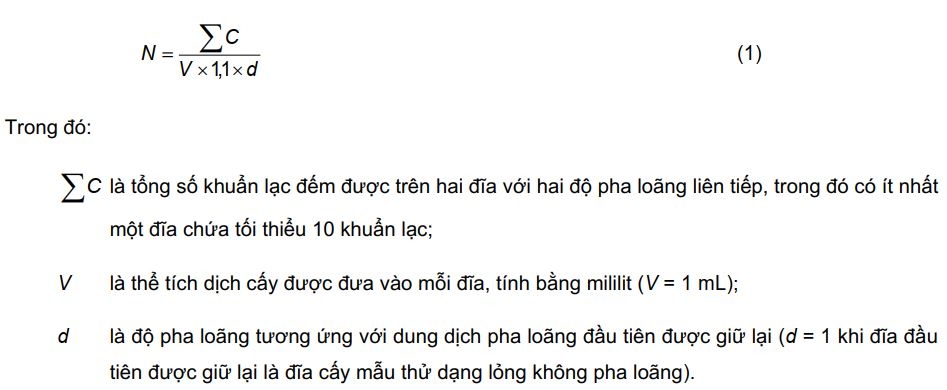
a) Calculate the total number of yeast and mould in the test sample, N, from the average number of colonies from two successive dilutions, using Formula (1):
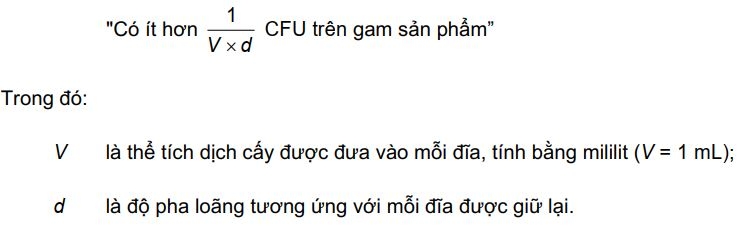
b) If the plates contain no colonies, report the result as:
c) If the colony count on a plate is between 1 CFU/plate and 3 CFU/plate, report the result as:

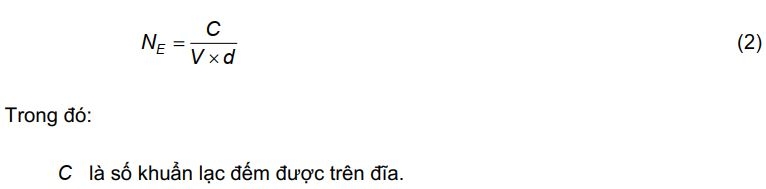
d) If the colony count on a plate is between 4 CFU/plate and 9 CFU/plate, calculate the estimated number NE of yeast and mould per gram of product using Formula (2):
e) If only the plate containing the last cultured dilution can be counted and contains from 10 CFU/plate to 150 CFU/plate, calculate the number of yeast and mould per gram of product, N', using:

f) If the colony count on one of the plates with all cultured dilutions gives a number of yeast and mould greater than 150 CFU/plate, report the result as:

12. Test report
The test report must include at least the following information:
a) all information necessary for the full identification of the test sample;
b) the sampling method used, if known;
c) the test method used, citing this standard;
d) any particular points observed during the test;
e) any operating details not specified in this standard or considered optional, together with any other unusual details that may affect the results;
f) the test results obtained.The above is information on the rapid quantification of yeast and mould using the Compact Dry YMR Yeast and Mold Rapid plate method according to Vietnamese standard TCVN 13876:2023. For more detailed information about the Compact Dry YMR plate product, please visit the following link:
https://pacificlab.vn/vi/shops/phong-thi-nghiem/dia-compact-dry-men-moc-nhanh-compact-dry-ymr-yeast-and-mold-rapid-shimadzu.html
Vietnamese standard certification document TCVN 13876:2023 for the Compact Dry YMR Yeast and Mold Rapid plate:
/uploads/news/2024_04/tcvn-13876-2023-compact-dry-ymr-men-moc-2023.08.25.pdf