
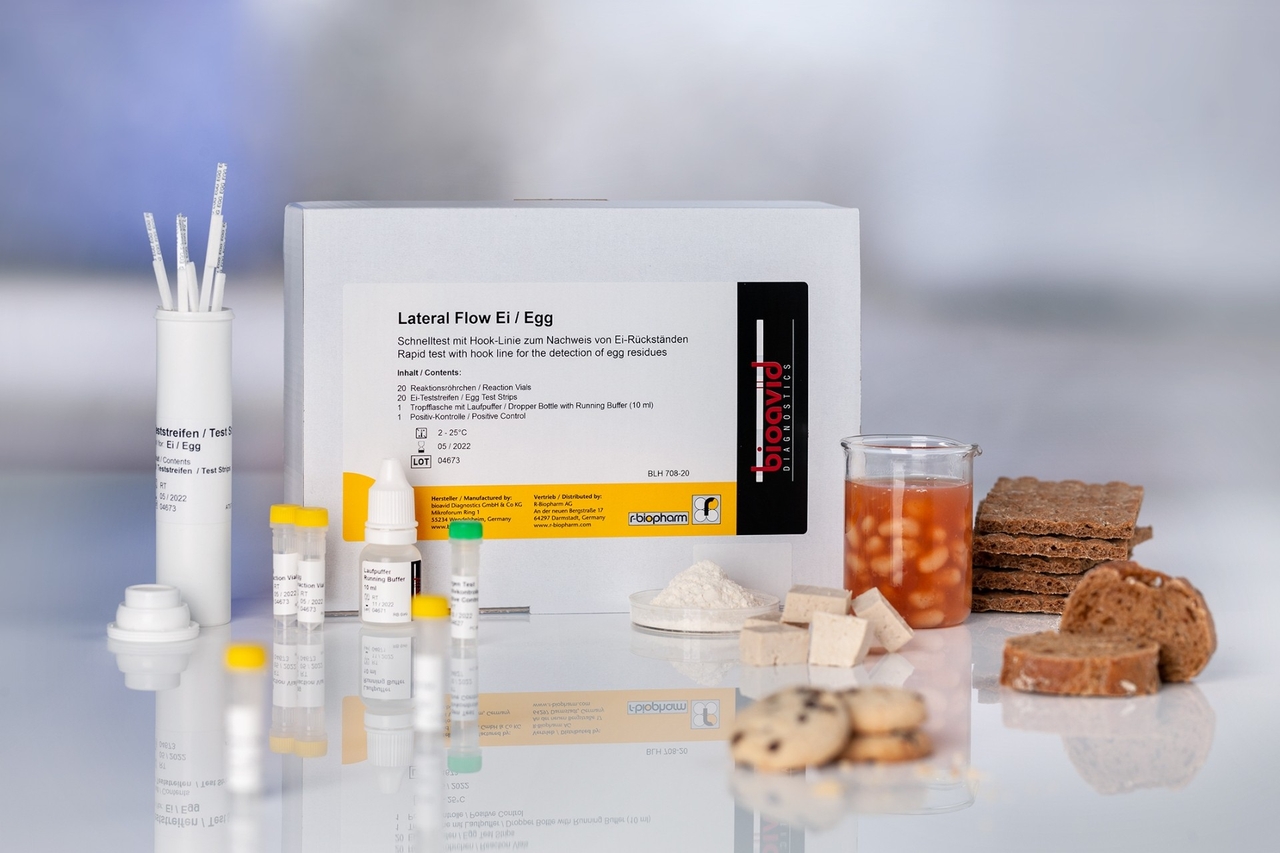
1. R-Biopharm Allergen Test Strips
* Sample preparation time
- Sample preparation (swabs, CIP water) ............................... approx. 1 minute
- Sample preparation (liquid samples) ..........................................................approx. 3 minutes
- Sample preparation (solid samples) .............................................................approx. 5 minutes
- Perform the test (incubation time) ..................................10 minutes
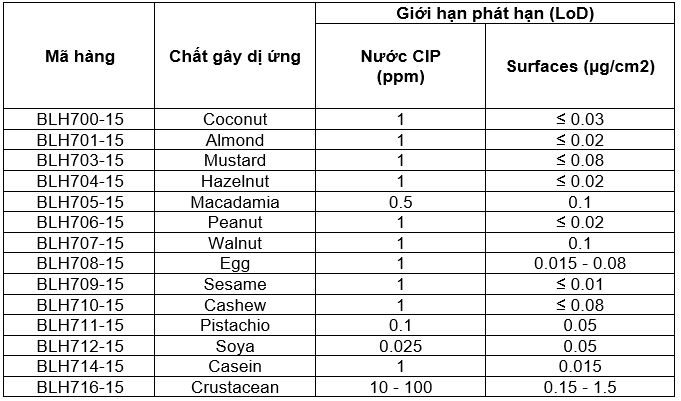
- The presence of detergents and disinfectants in the swab or CIP water sample, as well as the type of food sample being tested, can affect the detection limit. Detailed information can be found in the validation report.
2. General information
- In the case of food allergy, certain components of food (allergens) trigger an immune response in humans. This immune response is the cause of many different symptoms, which can range from a mild tingling itch in the mouth and skin rashes to life-threatening anaphylactic shock. Worldwide, around 2 - 8% of people suffer from food allergies. As there is currently no effective treatment for food allergies, affected people must follow a diet free of allergens. Labelling allergens on food is therefore necessary.
- Under Regulation (EU) No 1169/2011, the list of the 14 major allergens and the products containing them must be declared on the food label. Similar regulations exist in the USA, Canada, Australia and New Zealand. To prevent unintended contamination, the food industry must implement appropriate allergen management (for example raw material testing, production line checks).
- The R-Biopharm rapid allergen test strips provide a fast, simple and reliable method for detecting allergen residues. You can find a summary of the use of LFDs in allergen management in our infographic, which can be downloaded at www.r-biopharm.com.
3. Hook Line Technology - The difference that comes from R-Biopharm's new technology
- The most important challenge for safe and fast rapid test analysis LFD (Lateral Flow Test) is the false-negative result caused by very high allergen concentrations in the test sample. The term "high Hook Line effect" (also called the "hook effect"; EN 15633-1. 2019) is observed when a very high amount of analyte is present in the sample. In this case, test line development can be inhibited and the test result risks being incorrectly assessed as negative (or the analyte cannot be detected).
- The line on the test strip makes this effect clearly visible. A missing Hook line indicates a high allergen content in the sample and can no longer be assessed as negative.
4. Principle of the allergen test strips in food
- The principle of the test is the antigen-antibody reaction. The reaction vial contains antibodies specific to the allergen. After adding the running buffer, the sample (for example supernatant, swab sample, CIP water) is added to the reaction vial. If the sample contains the target antigen, antigen-antibody complexes form. After incubation, a dipstick is placed into the reaction vial. Capillary action causes the liquid to flow up the dipstick.
- The dipstick has three zones where the reaction takes place and where lines for visual evaluation can form. First, the control line to verify the test run; this line always appears. Second, the test line, where antigen-specific antibodies are immobilized. If the target antigen is present, the antigen-antibody complexes formed earlier react with the antibodies immobilized on the test line, leading to the formation of antibody-antibody complexes. Third, the hook line, where the target analyte is immobilized and will appear as long as specific antibodies against the target analyte are present and unbound. The result is read visually. The test is very fast, reliable and requires no laboratory equipment for most applications.
5. Contents of the rapid allergen test kit
Each allergen test strip kit contains enough reagent for 15 tests.
- Reaction vials: contain labelled antibodies in a stable dry form, to be dissolved with running buffer. Quantity: 15 vials.
- Allergen test strips (allergen test strips): 15 strips
- Dropper bottle with running buffer: 8ml
- Positive control (positive control): must be dissolved with 1 mL distilled or deionised water
- 100 µL plastic pipettes: 15 pieces
- Swabs for taking surface allergen samples: 15 swabs
- Pre-filled PBS vials (containing 1,2 mL PBS; used for sampling (moistening the swab, rinsing the swab): 15 vials
6. Notes and precautions for users
- Bring the test kit to room temperature (20 - 25 °C / 68 - 77 °F) before use. Do not open the test strip tube when it is colder than the surrounding environment, as the test strips may be damaged by moisture.
- After removal, do not return the test strip to the test strip tube.
- Test strips are sensitive to moisture. Therefore, remove the test strip from the tube immediately before use.
- The product/test is suitable only for its intended use.
- All reagents and materials must be recovered or disposed of after use at the customer's responsibility, in accordance with the principles of human and environmental protection. Please comply with applicable national regulations on waste disposal (for example Waste Management Law, Regulations on Hazardous Chemicals, etc.)
7. Testing procedure for the allergen test strips
7.1. Positive control (if required)
- Add 1 mL distilled or deionised water to the positive control and leave for 5 minutes. Then use 0,1 mL as the sample in the test. The positive control can be stored at -20 °C (-4 °F) for at least one year.
- Do not freeze and thaw repeatedly. The dissolved or thawed control is stable for 2 days at room temperature (20 - 25 °C / 68 - 77 °F).
7.2. For solid food samples
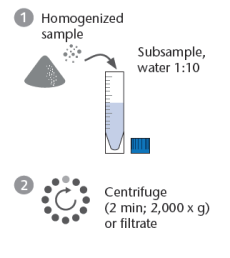
- Grind/mix a representative amount of sample (for example 5 - 50 g) and dilute the sample at a ratio of 1:10 (1+9) in distilled or deionised water (for example 1 g of sample + 9 mL distilled or deionised water). Mix until a homogeneous suspension is obtained.
- Centrifuge for 2 minutes at 2,000 x g or filter. The supernatant or extract should be as free of particles as possible.
7.3. For liquid food samples
- Mix a representative amount of sample thoroughly (for example 5 - 50 mL) and dilute the sample at a ratio of 1:10 (1+9) in distilled or deionised water (for example 1 mL of sample + 9 mL distilled or deionised water). Mix until a homogeneous suspension is obtained.
- Particle-containing extracts must be centrifuged for 2 minutes at 2,000 x g or filtered. The supernatant or extract must be free of suspended solids.
7.4. For CIP water
- It is possible to use 0,1 mL of rinse water or process water (CIP water) directly in the test.
7.5. Surface samples (using swabs)
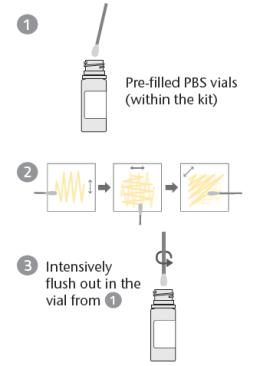
- Use one vial (pre-filled with PBS) for each sample. Moisten a clean swab with the PBS in the vial.
- Swab the area to be checked using a cross technique in all directions (see the figure on the right).
- Release the sample from the swab into the vial in step 1: press the swab into the vial, twist gently and move it up and down.
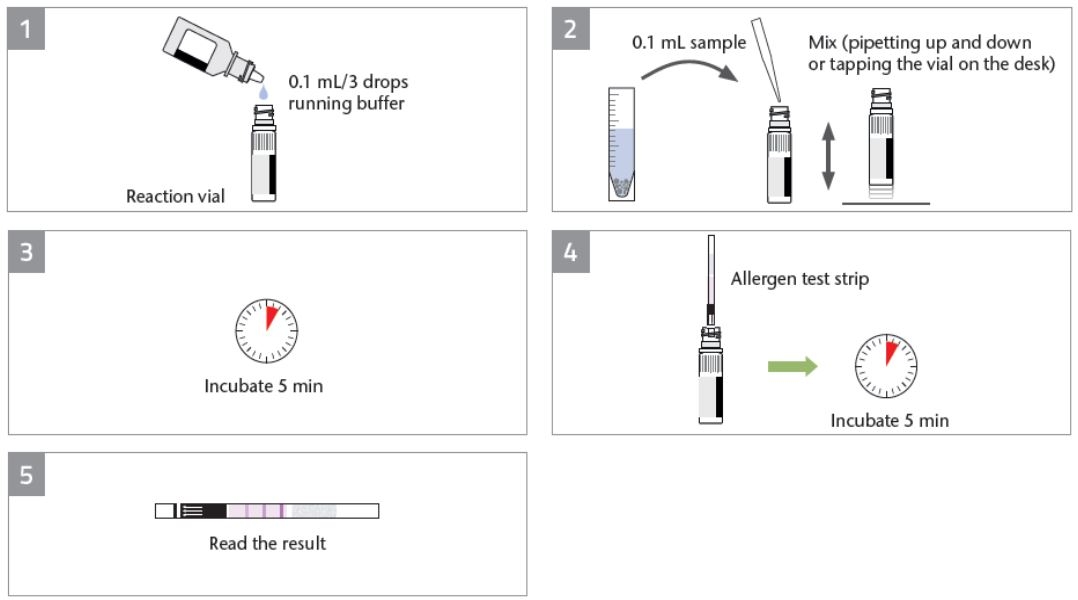
7.6 Allergen test strip procedure
Write down the sample ID on the reaction vial and open it.
1. Add 0,1 mL (3 drops) of running buffer to the reaction vial.
2. Add 0,1 mL of sample (supernatant, CIP water or swab sample) to the reaction vial (a single-use plastic pipette graduated to 0,1 mL is supplied in the kit) and mix thoroughly by carefully pipetting up and down (about 3 times) or by closing the reaction vial and mixing well by lightly tapping the vial on the table a few times. The liquid must turn red
3. Incubate for about 5 minutes.
4. Immediately before use, take the allergen test strip out of the test strip tube. Close the test strip tube again immediately. Insert the test strip into the reaction vial with the arrow pointing down.
5. Read the result at exactly 5 minutes.
7.7. Interpretation of results
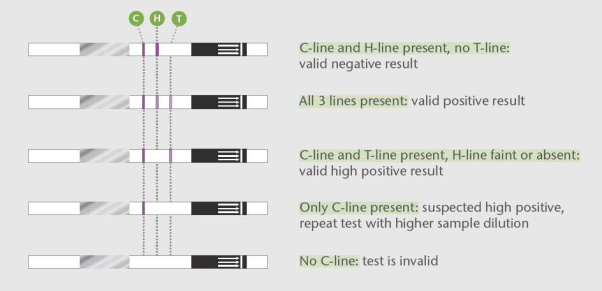
- The allergen test strips contain three lines in the reaction zone: the control line (C, top line), the hook line (H, middle line) and the test line (T, bottom line). In total, between 1 and 3 purple lines can appear in the reaction zone on the test strip. The control line (C) shows that the test has been performed correctly and must therefore be present on every valid test strip.
- The test line (T) indicates the presence of the target residue in the sample. Very high concentrations of allergenic residues can reduce the intensity of the test line or completely prevent the test line from forming. The hook line (H) acts as an “alarm line”. If this line is missing, the sample has a high allergen content. In this case, a missing test line must not be interpreted as a negative result.
8. Limitations
- Because of the large number of different food types, the manufacturer of the test kit cannot validate all food types for testing. The suitability of each food type for use in the test must be verified by the user.
- Some solid samples containing cereal flour and/or thickeners can affect accurate Hook Line development if they are diluted at a ratio of 1:10. Therefore, very viscous samples should be tested at a dilution ratio of 1:20. In this case, note the lower sensitivity due to the higher sample dilution.
- For test samples containing polyphenols (for example coffee, cocoa, spices, wine) or samples with a high oil content, bioavid absorption buffer should be used (product code BS810-15).
- Intact particles hinder the development of the Hook Line technology and must be diluted at a ratio of 1:20 (instead of 1:10) with distilled or deionised water. In this case, note the lower sensitivity due to the higher sample dilution.
- The tests of the allergen test strip kit are qualitative tests. They do not allow quantitative evaluation, even if the test lines develop differently (T)
9. Note
Specific product information can be found in the validation report. To validate unknown food samples, an SOP (Standard Operating Procedure) will be provided on request.