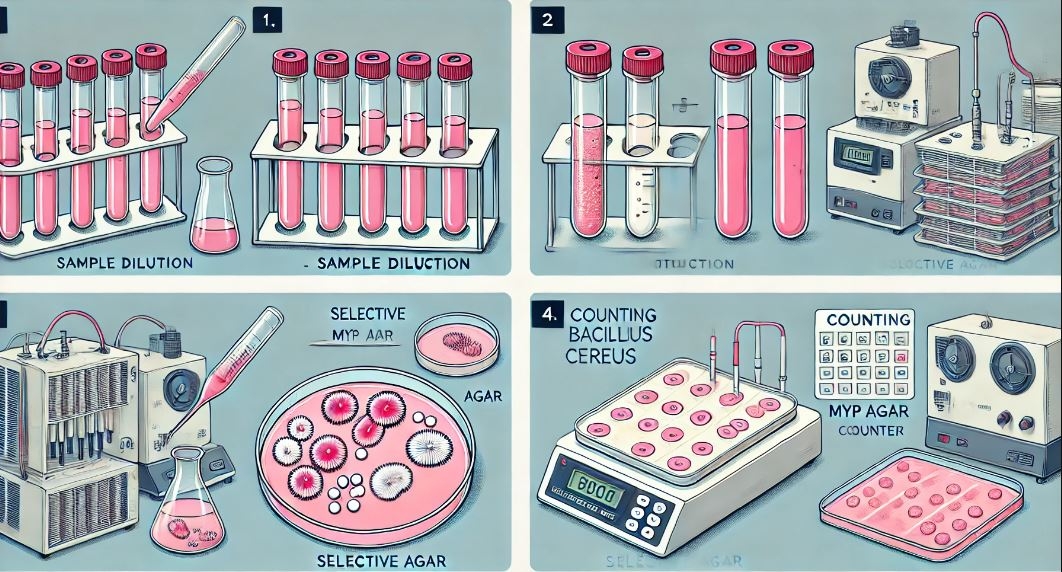
The procedure of quantifying Bacillus cereus by the colony count method
1. Sample preparation
- The food or water sample is prepared by grinding, homogenizing, and then diluted if necessary.
- Carry out dilutions by decimal series (1:10, 1:100, 1:1000,...) to reduce the bacterial density to a countable level.
2. Choosing the culture medium
- MYP medium (Mannitol Egg Yolk Polymyxin Agar) is a selective medium dedicated to isolating and counting Bacillus cereus.
- Another possible choice is the PEMBA (Polymyxin Egg Yolk Mannitol Bromocresol Purple Agar), similar to MYP.
3. Plating the sample
- Take 0.1 ml or 1 ml of the diluted sample and spread it evenly on the surface of the agar.
- If using the pour plate , the sample will be mixed with melted and cooled agar before it sets.
- Use aseptic technique to avoid contamination from other microorganisms.
4. Incubating the plates
- Place the Petri dishes in the incubator and incubate at a temperature of 30°C to 37°C for about 18-24 hours.
- After the incubation, the Bacillus cereus colonies will appear as characteristic pink colonies surrounded by a precipitation zone on the MYP medium.
5. Counting the colonies
- Count the characteristic Bacillus cereus colonies on each plate.
- Only count plates with a number of colonies between 30 to 300 colonies to ensure accuracy.
6. Calculating the results
- The density of Bacillus cereus bacteria in the original sample is calculated by the formula:

- If the sample was diluted, you need to multiply the result by the dilution factor.
- The result will be expressed as CFU/g for food samples or CFU/ml for water samples.
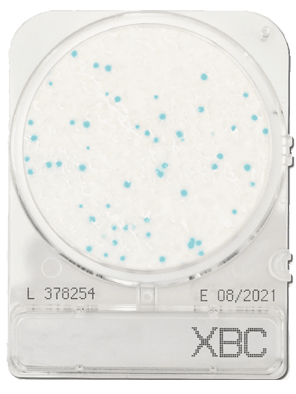
To save the cost of buying microbial media and the petri dishes needed for conventional plating, we would like to introduce the Compact Dry Bacillus pre-poured, freeze-dried medium plate method — a convenient method that saves a great deal of cost compared with the conventional plating method. Compact Dry is a convenient tool for quantifying Bacillus cereus in food or water samples. The Compact Dry BC Bacillus cereus plate comes with a dried medium already inside the plate and can be used to quantify this bacterium quickly. Below is the procedure for quantifying Bacillus cereus with Compact Dry plates:
1. Sample preparation
- Take the food or water sample to be tested. Food samples are usually ground or homogenized.
- Dilute the sample with a sterile diluent (for example 0.85% physiological saline) to make sure the bacterial count is in the countable range.
- A decimal dilution series (1:10, 1:100, 1:1000,...) is usually used to create solutions with different concentrations.
2. Using the Compact Dry BC Bacillus cereus plate
- Open the Compact Dry Bacillus cereus plate
- Take 1 ml of sample already diluted and drop it directly onto the surface of the Compact Dry plate. The sample will self-diffuse and soak evenly through the dry medium in the plate.
- Close the lid of the Compact Dry plate to avoid contamination.
3. Incubating the plate
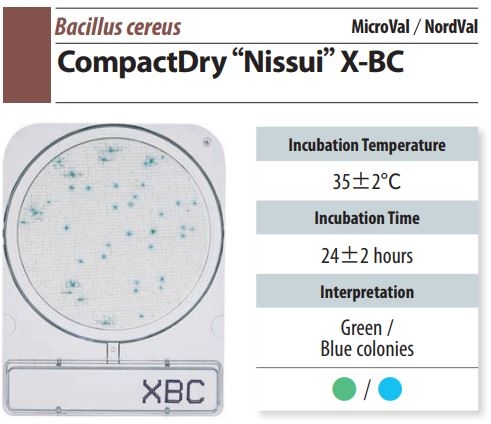
- Place the plate in the incubator and incubate at 35°C for about 24 hours.
- Bacillus cereus will grow into characteristic colonies, usually blue or with another characteristic color they have.
4. Counting the colonies
- After the incubation, check and count the number of Bacillus cereus colonies that appeared on the Compact Dry plate.
- The colonies of Bacillus cereus usually have a characteristic color and are easy to distinguish from other bacteria.
5. Calculating the results
- The density of Bacillus cereus bacteria in the original sample is calculated by the formula:
- Example: If there are 50 colonies on the plate from a 1:100 diluted sample, and you dropped 1 ml of sample onto the plate, the density is calculated as follows:

- The final result is expressed as CFU/g (for food) or CFU/ml (for water).
- Compare the result with the food safety standards or regulations to assess the level of contamination of the sample.
6. The advantages of the Compact Dry BC Bacillus cereus plate
- Rapid: The Compact Dry plate comes with the medium, reducing preparation time, saving costs, and labor.
- Convenient: The plate is compact, no culture medium preparation needed.
- High accuracy: The selective medium helps detect Bacillus cereus clearly and precisely.
- This method is suitable for checking the amount of Bacillus cereus in food, especially in samples such as milk, meat, and grain-based products.
Please see our product details at the following link: