
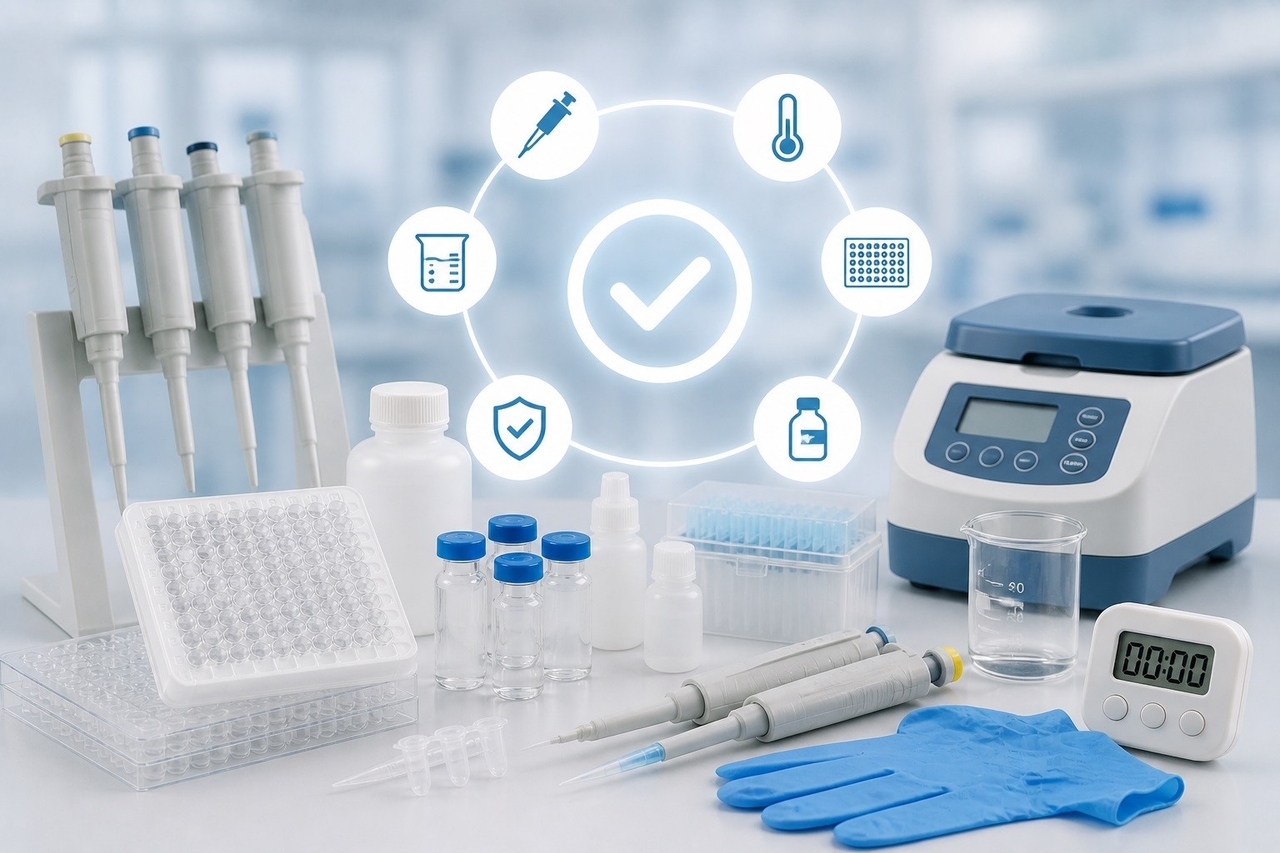
A key factor that determines the accuracy of results is 👉 vitamin testing equipment and consumables
Many businesses experience:
- Skewed test results
- Instability between test runs
- Results that cannot be reproduced
👉 The cause often lies in incomplete or substandard equipment preparation
What is vitamin testing with a kit?
Vitamin testing with a kit is a method that uses rapid test kits to determine vitamin content in:
- Foods
- Milk
- Functional foods
- Animal feed
👉 R-Biopharm kits are currently widely used because they are:
- Easy to use
- Fast
- Suited to internal QC
Checklist of equipment needed for vitamin testing
To perform vitamin analysis with a kit, the QC room needs to prepare the following basic equipment:
1. Micropipette
- Purpose: drawing and measuring the sample precisely
* Note:
- Regular calibration is required
- Choose the correct volume range
2. Microplate / well tray
- Purpose: holding the sample and the reaction
👉 This is a key component of many vitamin test kits
3. Incubator
- Purpose: maintaining a stable temperature for the reaction
- Especially important for: microbiological tests, enzyme tests
4. Timer
- Purpose: controlling the reaction time
- A timing deviation = a wrong result
5. Reader (if needed)
Depending on the kit:
- A spectrophotometric reader may be needed
- Or reading by eye
- Some R-Biopharm kits can: work without complex equipment
6. Sample storage refrigerator
- Purpose: storing samples and chemicals
- Avoid: vitamin degradation and skewed results
Vitamin testing consumables needed
Besides equipment, vitamin testing consumables are also very important:
✔️ Solvents and chemicals
- Extraction solvent
- Standard solution
- Buffer
✔️ Pipette tips
Should use:
- Sterile
- Single-use
✔️ Test tubes / sample vials
- Heat-resistant
- Non-reactive with the sample
✔️ Gloves, masks
Ensuring:
- Safety
- Avoiding cross-contamination
✔️ Filter paper / filtration tools
- Used in the sample processing step
Preparation procedure before vitamin testing
To ensure accurate results, you must:
Step 1: Check the equipment
- Calibrate the pipette
- Check the incubator temperature
Step 2: Prepare the consumables
- Complete set of tips, test tubes
- Solvents that meet the standard
Step 3: Prepare the sample
- Homogenize the sample
- Avoid cross-contamination
Step 4: Read the kit instructions carefully
Each kit has its own procedure
⚠️ Common mistakes
- Not calibrating the pipette
- Using substandard consumables
- Storing chemicals incorrectly
- Not controlling the temperature
👉 These are the main causes of error in vitamin testing
Benefits of preparing the right equipment and consumables
The business will:
- Ensure accurate results
- Increase testing reliability
- Reduce errors
- Optimize costs
The optimal solution for the QC room
For the highest effectiveness, you should:
- Use the standardized standardized vitamin test kit of R-Biopharm
- Combine with a standard procedure
- Train QC staff
Conclusion
Preparing the right vitamin testing equipment and vitamin testing consumables is the key factor that helps:
- Ensure accuracy
- Raise QC effectiveness
- Reduce the risk of deviation
This is a step that cannot be skipped when deploying vitamin testing with a kit in a business.
📞 Contact for advice
If you are looking for:
- A list of complete vitamin testing equipment
- A suitable vitamin test kit
- The optimal QC solution
👉 Contact us for detailed advice: https://pacificlab.vn/vi/shops/group/phan-tich-ham-luong-vitamin/