The methods for detecting Staphylococcus aureus in food generally follow international standards and are applied in microbiology laboratories. Below are the main methods:
1. Traditional agar plate culture method
The agar plate culture method is the classic way to detect the bacterium Staphylococcus aureus in food.
* Procedure
1. Sample preparation
- Weigh a food sample portion (usually 25 g) and dilute it in 225 ml of buffered peptone water or physiological saline solution (NaCl 0.
- Carry out successive dilutions of the sample (creating different dilution levels).
2. Inoculation and incubation
- Inoculate a quantity of the diluted sample solution onto a selective agar plate containing a medium such as Baird-Parker Agar or Mannitol Salt Agar (MS. aureus.
- Incubate the agar plates at 35-37°C for 24-48 hours.
3. Reading the results
- On Baird-Parker Agar, S. aureus colonies appear as black, shiny colonies with a white border (due to the reaction of the bacteria with the egg yolk in the medium).
- On the Mannitol Salt Agar medium, S. aureus forms yellow colonies (from mannitol fermentation) while other bacteria usually have red colonies.
4. Bacterial confirmation
Suspect colonies are further checked with biochemical tests such as:
- Catalase test: S. aureus is catalase-positive (produces gas bubbles when in contact with hydrogen peroxide).
- Coagulase test: S. aureus is coagulase-positive (clots blood plasma).
2. Compact Dry X-SA Staphylococcus aureus plate method
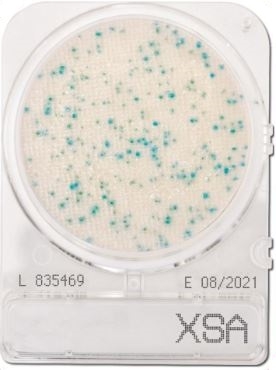
This is a modern method that uses the Compact Dry X-SA plate to detect Staphylococcus aureus in food. The method is fast, easy to perform and suitable for foods with low bacterial loads or foods requiring quantitative analysis.
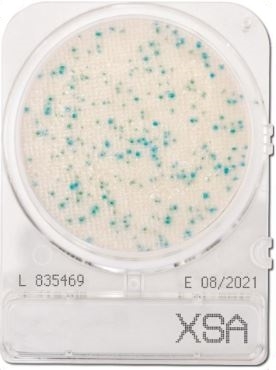
* Procedure:
- Sample preparation and dilution: Same as the traditional agar plate culture method.
- Spotting the sample onto the Compact Dry X-SA plate: Piper 1 ml of the diluted sample solution onto the Compact Dry plate and let the solution spread and diffuse evenly on its own.
- Incubating the plates: Incubate at 35-37°C for 24-48 hours.
- Reading the results: S. aureus colonies will appear as bright blue/pale blue colonies on the Compact Dry X-SA plate.
3. Real-Time PCR method
This is a molecular biology method used to rapidly detect the presence of genes specific to S. aureus (such as the nuc gene encoding nuclease).
* Procedure:
- DNA extraction from food samples or suspect bacteria.
- Performing PCR with primers specific to S. aureus.
- Results: If S. aureus is present, the specific gene will be amplified and displayed on the PCR system.
- See our Real Time PCR kit for Staphylococcus aureus testing here.

4. ELISA method (Enzyme-Linked Immunosorbent Assay)
This method is based on the antigen-antibody reaction, in which the S. aureus antigen (or its toxins) reacts with specific antibodies and is detected through an enzyme reaction.

* Procedure:
- Sample preparation: extract antigens or toxins from the food sample.
- Reaction with antibodies: The S. aureus antigens react with enzyme-linked antibodies.
- Reading the results: The enzyme reaction produces a colour signal (usually measured by spectrophotometry) to confirm the presence of the bacterium.
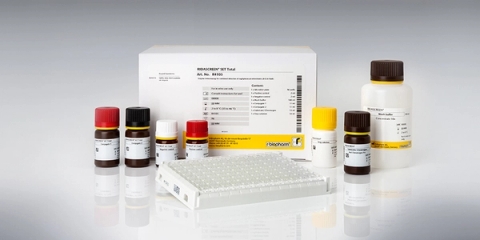
- See our ELISA kit for Staphylococcus aureus toxin testing here.
Depending on your purpose and laboratory conditions, you can choose one of the methods above to detect Staphylococcus aureus in food.
Contact us right away for advice on the product that fits your requirements!