
1. Principle of the PCR method
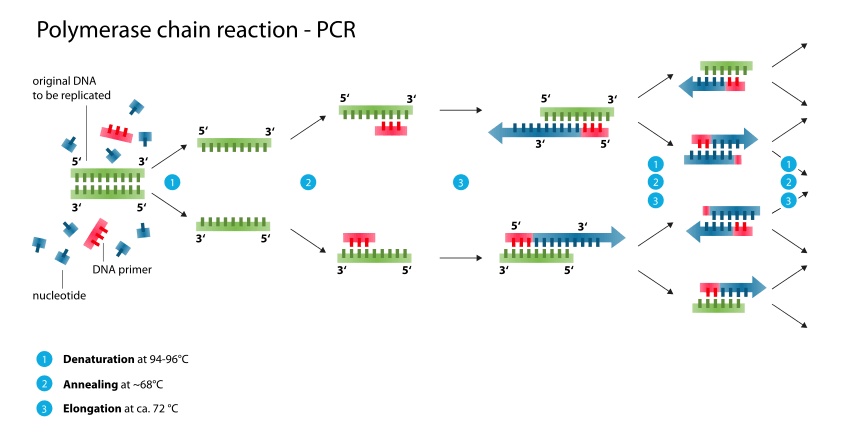
PCR is a technique for amplifying specific DNA sequences of microorganisms. This process takes place in three main steps:
- Denaturation: Template DNA is separated into two single strands under the effect of high temperature (~94-96°C).
- Annealing: Specific primer sequences attach to the target DNA sequence (~50-68°C).
- Extension: DNA polymerase enzyme synthesizes a new strand based on the DNA template (~72°C).
This process is repeated for many cycles (~30-40 cycles), helping to amplify a small amount of microbial DNA into a sufficiently large amount for detection.
2. Applications of the PCR method in microbiological testing
2.1. Detection of pathogenic microorganisms in food and drinking water
PCR helps detect pathogenic microorganisms quickly such as:
- Salmonella spp., Listeria monocytogenes, E. coli O157:H7, Campylobacter spp., Vibrio spp., Shigella spp.
- Detection of Norovirus, Hepatitis A virus in food and drinking water.
2.2. Testing of indicator microorganisms
PCR is used to test groups of microorganisms such as total Coliforms, E. coli, Enterococcus spp., helping to assess the level of microbiological contamination of the food production environment and drinking water.
2.3. Detection of antibiotic-resistant microorganisms and genetically modified organisms (GMO)
PCR can identify microorganisms with antibiotic resistance genes or genetically modified products (GMO) by searching for specific DNA sequences.
2.4. Identification of microorganisms in livestock farming and veterinary medicine
- PCR supports microbiological testing in livestock farming, helping to quickly detect pathogens such as Mycoplasma spp., Brucella spp., PRRSV (Porcine Reproductive and Respiratory Syndrome).
3. Advantages and limitations of PCR in microbiological testing
3.1. Advantages
- Fast: results can be obtained within a few hours, compared with traditional culture methods which take several days.
- High sensitivity and specificity: detects microorganisms at very low concentrations.
- Detection of non-culturable microorganisms: some bacteria do not grow on culture media but can still be detected by PCR.
3.2. Disadvantages
- Cannot distinguish live from dead microorganisms: PCR only amplifies DNA, so it cannot determine whether microorganisms are still active.
- Requires modern equipment and high expertise
- Prone to cross-contamination and false-positive results if not properly controlled.
4. Advanced PCR methods
- qPCR (real-time PCR): Measures fluorescence signals in real time, helping to accurately quantify microorganisms.
- Multiplex PCR: Amplifies multiple DNA sequences simultaneously, allowing detection of multiple microorganisms in a single run.
- RT-PCR (Reverse Transcription PCR): Detects viral RNA such as SARS-CoV-2, Norovirus, Hepatitis A.
5. PacificLAB – Supplier of high-quality PCR test kits
PacificLAB provides specialized PCR test kits for microbiological testing, helping laboratories and businesses control food safety, drinking water and the production environment. With PCR and real-time PCR test kit lines from reputable brands, we are committed to bringing accurate, fast and effective testing solutions.
📌 If you are interested in PCR test kit products, please contact us for detailed advice!