
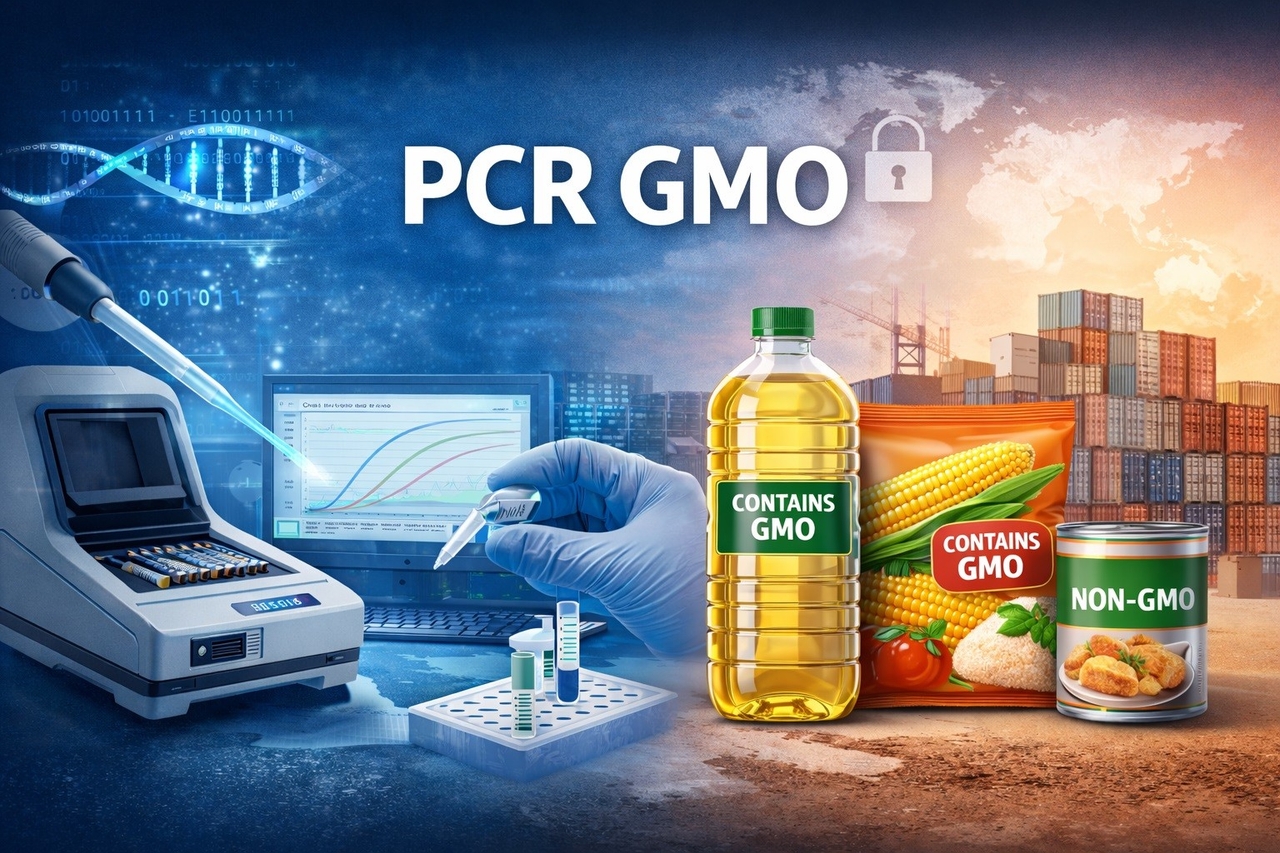
- This creates an urgent requirement for food and animal feed businesses to control GMOs and comply with GMO labeling rules.
- In practice, GMO labeling is not only a legal requirement but also a factor directly affecting:
+ The ability to export to demanding markets
+ Brand reputation in consumers' eyes
+ The risk of product recalls and administrative fines
- Among today's control tools, the PCR GMO method is seen as the core solution, enabling businesses to proactively detect, assess and manage GM content.
1. GMO labeling rules in Vietnam — what do businesses need to know?
2.1. The legal basis for GMO labeling in Vietnam
In Vietnam, the management and labeling of genetically modified food is regulated through multiple legal documents, including:
- The Food Safety Law.
- Decrees and circulars guiding genetically modified organisms.
- Regulations related to the labeling of food containing GMO ingredients.
Accordingly, food products with GM ingredients exceeding the prescribed threshold must be labeled GMO, in order to guarantee consumers' right to know.
2.2. Challenges for businesses in practice
Many businesses face difficulties because of:
- Imported raw materials of inconsistent origin
- A lack of periodic GMO testing data
- Inability to determine the actual GMO content
- The risk of unintentional non-compliance
Therefore, implementing GMO testing by PCR right at the raw material intake stage is a proactive, sustainable solution.
2. Comparing GMO thresholds between Vietnam, the EU, the US and Asia
2.1. The GMO threshold — the deciding factor for labeling
- Each country and region has a different GMO threshold, which decides whether GMO labeling is required. This is a point export businesses care about especially.
2.2. Comparing GMO thresholds in the major markets
🔹 The European Union (EU)
- GMO threshold: 0.9%
- Labeling is mandatory if it exceeds the threshold
- Applies a very strict GMO control policy.
- Requires a quantitative PCR analysis method.
🔹 The United States (USA)
- Does not apply a hard GMO threshold like the EU
- Requires transparent disclosure of biological origin
- GMO testing mainly serves traceability
🔹 Japan, Korea
- GMO thresholds usually range from 3–5% depending on the product group
- Strict control of imported raw materials
- Prioritize GMO PCR testing
🔹 Vietnam and the ASEAN region
- Referenced to international practice
- Increasingly tightening requirements for GMO labeling and control
👉 This shows that PCR GMO is an indispensable tool for businesses seeking to meet several different markets at once.
3. Why PCR is the central method in GMO control
3.1. The PCR principle in GMO detection
PCR (Polymerase Chain Reaction) is a method for amplifying specific DNA segments, enabling the detection of:
- Gene sequences common in GMOs (screening)
- Specific genetic modification events (event-specific)
- Unlike indirect methods, PCR directly detects the modified genetic material, giving very high reliability.
3.2. The standout advantages of PCR GMO
- High sensitivity: detects GMOs at very low levels
- High specificity: clearly distinguishes individual GMO events
- Suitable for both qualitative and quantitative work
- Applicable to deeply processed foods
That is precisely why PCR GMO is widely used in:
- State testing laboratories
- Business laboratories
- International certification organizations
4. How does PCR GMO help businesses comply with labeling?
4.1. Proactive control of incoming raw materials
Through periodic GMO PCR testing, businesses can:
- Classify raw materials as GMO / non-GMO
- Control risk right from the import stage
- Negotiate clearly with suppliers
This is an important step in helping businesses build a sustainable quality management system.
4.2. Avoiding product recalls and fines
Failure to control GMOs can lead to:
- Incorrect labeling
- Surprise inspections by regulators
- Recalls of products on the market
- Serious damage to the brand
* PCR GMO helps businesses:
- Have scientific data proving compliance
- Reduce legal risk
- Protect long-term reputation
4.3. Raising brand reputation and competitiveness
Consumers increasingly care about:
- Non-GMO food
- Transparent product information
- Corporate social responsibility
Businesses that implement GMO testing by PCR will:
- Increase trust with partners
- Improve brand image
- Access export markets more easily
5. Applying PCR GMO in corporate quality management
PCR GMO is widely used by:
- Food businesses
- Animal feed factories
- Testing laboratories
- Agricultural import-export companies
Notably, the R-Biopharm GMO PCR test kits allow:
- Rapid GMO screening
- Accurate identification of each genetic modification event
- Compliance with ISO, EN and AOAC standards
In the context of increasingly strict GMO labeling rules, PCR GMO is not only a testing tool but has become a strategic solution helping businesses:
- Comply with the law
- Proactively manage quality
- Minimize business risk
- Raise reputation and competitiveness
Investing in and implementing GMO testing by PCR is a necessary step for businesses to develop sustainably and integrate internationally.
👉 Contact us right away for GMO consulting using the PCR method suited to your requirements!