
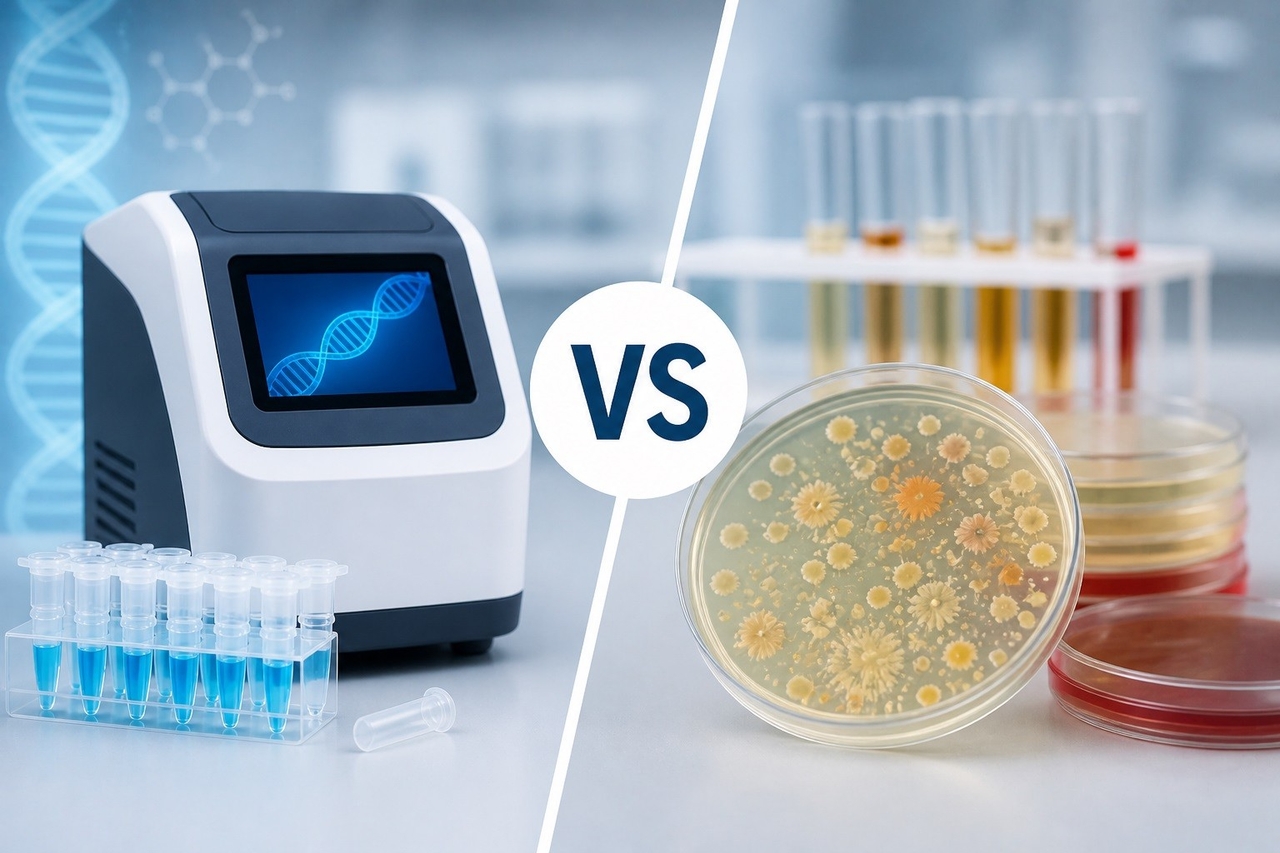
- Both are used to detect harmful microorganisms in food, beverages, and production environments. However, each has its own strengths and weaknesses.
👉 So between PCR and microbial culture, which is the optimal choice for a business?
Comparing PCR and the microbial culture method
1. Time to results
- PCR: 18–24 hours
- Culture: 2–5 days
👉 PCR is 3–5 times faster, letting a business:
- Shorten testing turnaround
- Speed up production and shipping schedules
2. Accuracy and sensitivity
- PCR: detects bacterial DNA → very high accuracy
- Culture: depends on the growth medium → easy to skew
👉 PCR can:
- Detect microorganisms at very low concentrations
- Reduce the risk of false negatives
3. Early detection capability
- PCR: detects bacteria even before they have grown
- Culture: needs time for the bacteria to multiply
👉 This is a key factor letting PCR:
- Block risks before products reach the market
- Limit product recalls
4. Total cost
Many businesses believe culture is cheaper, but in reality:
Traditional culture:
- Demands labor
- Raises warehousing costs while waiting for results
- Carries a higher risk of error
PCR:
- Higher initial investment
- But more economical in the long run
👉 Thanks to:
- Shorter time
- Lower risk
- Higher operating efficiency
When should PCR be chosen?
PCR is the right choice when a business:
- Needs rapid food microbiological testing
- Ships to export markets (EU, US)
- Wants to reduce the risk of product recalls
- Needs highly accurate results
When should the culture method be used?
Culture is still appropriate in some cases:
- Basic, low-cost testing
- Small laboratories without PCR equipment yet
- When viable microorganisms must be quantified
PCR solutions from R-Biopharm
Today, many businesses are switching to R-Biopharm PCR kits thanks to:
- High sensitivity and specificity
- ISO and AOAC certification
- Simple, easy-to-roll-out procedures
- Rapid detection of targets such as Salmonella, Listeria, and E. coli
👉 Helping a business:
- Increase testing throughput
- Meet export standards
- Strengthen competitiveness
Which method should a business choose?
The answer is not "choose one" but rather:
- A modern business should combine both methods
Where:
- PCR is used for rapid screening
- Culture is used for confirming results (confirm)
👉 This is the testing model widely applied around the world.
Conclusion
Comparing PCR and microbial culture shows:
- PCR leads on speed and accuracy
- Culture still has a role in traditional testing
👉 However, given today's competition and strict requirements, PCR is becoming the inevitable trend that helps a business:
- Reduce long-term costs
- Increase testing throughput
- Lower food microbiological risks