
1. Microbial culture medium - Nutritional requirements:
Based on the source of energy they use, microorganisms are divided into different metabolic groups. For example, phototrophic microorganisms obtain energy from light, chemoheterotrophic microorganisms use organic compounds, and chemoautotrophic microorganisms use inorganic compounds. Culture medium is a mixture of the necessary nutrients and substances that play an important role in the microorganisms' intracellular metabolism, maintaining the redox state, the osmotic pressure of the cell, and the pH stability of the medium.
Culture medium needs: (1) all the necessary nutrients, (2) a suitable pH for the microorganisms to grow, (3) a certain viscosity, (4) no harmful factors, (4) sterile.
Heterotrophic microorganisms need to be supplied with organic compounds in order to synthesize their carbon and energy source. Nitrogen is supplied in the form of NH3, an important component of protein and nucleic acid. Phosphate is added to the medium to provide phosphorus for the biosynthesis of nucleic acids and phospholipids; similarly, sulfate provides a source of sulfur for the synthesis of the two amino acids cysteine and methionine.
Bringing these characteristics together, culture medium is used to culture and study the biological characteristics of microorganisms. At the same time, it enables isolation, propagation, and preservation of microorganisms.
Methods for preparing culture medium:
When preparing a culture medium, the following principles should be noted:
- The medium should be designed to suit the nutritional requirements and assimilation capability of each type of microorganism, ensuring it is supplied with adequate nutrition.
- Adjust the ratio and concentration of the substances in the medium composition to balance the osmotic pressure between the medium and the microbial cell.
- Ensure the necessary physicochemical conditions for microorganisms to carry out their metabolic activities.
Basically, the process of preparing the growth medium will consist of 6 steps:
Step 1:
Weigh and measure each component of the medium accurately and mix them according to the correct protocol sequence to create a liquid or solid medium, depending on the purpose of use.
Step 2:
Do this in a clear medium to make it easy to observe the growth of the microorganisms. The most common filtering methods are: filtering through cotton, gauze, or filter paper.
Step 3:
Adjust the pH of the growth medium. - To adjust the pH, a 10% HCl acid solution or 10% NaCL is commonly used. However, some other chemicals can also be used such as: H3P04 , H2S04, KOH, NaHCO3,....- In the laboratory, litmus paper or bromothymol blue indicator can be used to check the pH; this method is fast and convenient, but not highly accurate. To achieve high sensitivity and accuracy, a pH meter can be used.
Step 4:
The medium will be distributed into containers such as test tubes, Erlenmeyer flasks, and petri dishes. The distribution operation must be quick, tidy, and skillful to prevent the medium from sticking to the container walls or the cotton stopper; distribution must be completed before the medium solidifies.
Step 5:
Sterilization of the medium will be carried out depending on the nature and specific conditions of each type of medium.
Step 6:
Store the medium in cool conditions, around 0-5˚C, limiting the effect of light and never allowing the medium to dry out. Note that before use, the sterility of the medium must be checked; place the medium in an incubator at 37˚C for 48-72h, then observe and discard any medium showing microbial growth.
Common types of medium for microbial culture methods:
Agar slant medium:
- When pouring the medium, keep the test tube slanted; this should be done immediately after the medium sterilization is finished and while the medium has not yet solidified. The amount of medium needed should occupy ¼ of the test tube volume.
- The agar slant culture method is used for subculture of aerobic microorganisms.
- Use a round-tipped inoculation loop to perform the subculture; after picking up the microorganism, the loop is inserted into the bottom of the agar surface inside the test tube. Gently move the inoculation loop on the agar surface in patterns such as: zigzag streak, spiral streak, or parallel streak.
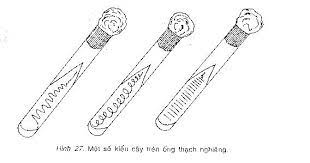
Agar butt tube medium:
- When pouring the medium, keep the test tube upright on the test tube rack and let it stand until the medium cools and solidifies. The amount of medium needed should occupy from 1/3 to ½ of the test tube volume.
- The agar butt tube culture method is used for subculture of anaerobic microorganisms.
- Use a needle-shaped inoculation loop to pick up the microorganism, then stab deep into the cylindrical agar block. Stab close to the bottom of the test tube and stab in three lines, one in the middle and two close to the test tube wall. During the operation, ensure the inoculation line is straight and gentle, without cracking or breaking the agar.
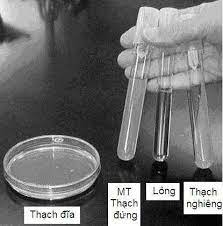
Agar plate (pouring agar into a petri dish):
- When pouring the medium, all operations must be performed in a laminar flow hood. The operation must be prompt and skillful to limit contamination of the medium. The agar surface must be smooth, flat, and about 2mm thick.
- After pouring the medium into the petri dish, wait 1-2 days and then check whether the medium is contaminated before putting it into use.
- For the plate culture method, a round-tipped inoculation loop or a pipet can be used.
- When streaking on a petri dish with a round-tipped inoculation loop, after picking up the microorganism, open the petri dish just enough to insert the loop inside. Sweep the inoculation loop gently and quickly over the agar surface in one of the following patterns: (a) in a zigzag pattern over the entire agar surface. (b) in straight parallel lines, (c) in four zigzag patterns at the four corners.
- The pipet method is usually applied for quantitative enumeration of microorganisms and for inoculating a relatively large amount of inoculum. There are two inoculation methods: (1) pipet 0,1ml of the inoculum to be studied, mix it into a test tube containing agar medium at 50˚C, cap with a cotton stopper and gently shake the test tube to distribute the microorganisms evenly in the agar, then pour into a sterilized petri dish, swirl the dish so the agar spreads evenly, let the agar medium solidify again and place it in an incubator under suitable conditions; (2) pipet 0,1ml of the inoculum, dispense it into the medium plate and use an inoculation loop to spread it evenly over the surface of the medium plate, then place it in an incubator with conditions and times suitable for each microbial species. New-generation culture medium - Compact Dry plate: In the past, preparing culture medium in the laboratory required a great deal of time, manpower, chemicals, and other consumable supplies.
But with the pace of industrialization and modernization, especially at a time bearing many consequences caused by epidemics as now, ensuring product quality while saving time and manpower, reducing costs, and increasing productivity is the top priority of businesses. Therefore, the ready-to-prepare medium plate - Compact Dry is the preferred choice in the microbiology laboratories of enterprises, pharmaceutical, food, and medical equipment factories,...
In the past, preparing culture medium in the laboratory required a great deal of time, manpower, chemicals, and other consumable supplies.

- Compact Dry plate with outstanding advantages such as:
- High specificity for each analytical indicator.
- High accuracy and easy analysis.
- Simple procedure, easy to use, and requires no training time.
- Convenient for the user as there is no need to prepare complicated medium chemicals, glassware, and consumable supplies.