
- One of the solutions used to improve sample preparation efficiency is the IAC (Immunoaffinity Column).
- But a question that often comes up is this: does using IAC columns increase the cost of mycotoxin testing, or does it actually save laboratory money over the long term?
- The answer lies not in the price of a single IAC column, but in the total cost of the entire testing workflow: chemicals, sample preparation time, the percentage of samples that must be re-analyzed and especially the cost of inaccurate results.
1. Why are immunoaffinity columns used in mycotoxin testing?
- IAC – Immunoaffinity Column is a sample preparation and cleanup product based on the specific interaction between antibodies and the target toxin.
- In a mycotoxin analysis workflow, samples usually go through extraction and cleanup before being analyzed on equipment such as HPLC, LC-MS/MS or corresponding analysis systems.
- IAC columns can help to:
- Clean the sample extract.
- Concentrate the target mycotoxin.
- Reduce matrix interferences.
- Improve the reliability of analytical results.
- Make subsequent analysis steps easier.
- This is why IAC mycotoxin columns are commonly used in workflows for mold toxins that demand high selectivity and accuracy.
2. Does a high IAC column price mean a high testing cost?
- Considering only the cost of consumables per sample, an IAC column can make testing feel more expensive. However, this calculation does not reflect the true cost of a mycotoxin analysis workflow.
- A laboratory should consider at least 5 cost groups:
Testing cost = consumables + chemicals + labor + handling time + rework/retesting cost
- Two of these are often overlooked:
The cost of re-analysis
If a sample gives an abnormal result or is affected by matrix interference, the laboratory may need to:
- Prepare the sample again.
- Extract it again.
- Use more solvents and chemicals.
- Use more consumables.
- Run the instrument again.
- Spend more technician time.
- With a large number of samples, these costs can add up significantly.
The cost of wrong or unreliable results
- This can be a far greater cost than the price of an IAC column. An inaccurate result can lead to:
- Confirmatory retesting.
- Longer lot retention.
- Delayed export decisions.
- Higher quality control costs.
- Risk with non-conforming products.
- Damage to the company's reputation.
- That is why, when evaluating mycotoxin testing costs, businesses should not only compare the consumable price per sample.
3. Comparison: the investment in IAC vs the cost of errors
- The two options can be sketched like this:
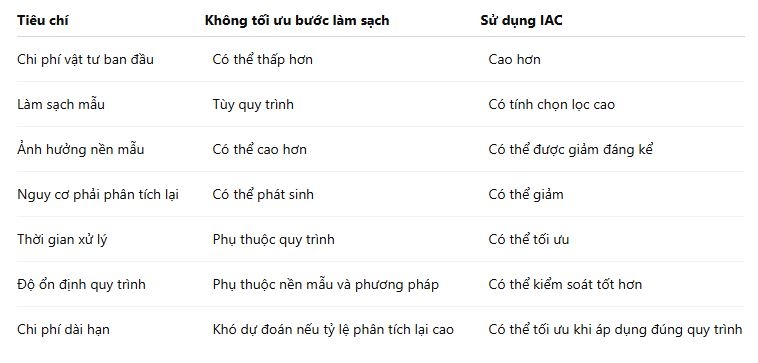
- What matters is that IAC should not be judged solely on purchase price per sample. Instead, the laboratory should calculate: the actual cost per acceptable result. That is the meaningful metric for evaluating the investment.
4. How can IAC optimize laboratory costs?
4.1. Manual sample preparation steps reduced
- A complex sample preparation workflow can involve many steps, many chemicals and lots of manual handling.
- Using a suitable mycotoxin immunoaffinity column can standardize the cleanup step, helping the laboratory build a more consistent preparation process.
- Once the workflow is standardized, technicians also find it easier to keep handling consistent across sample batches.
4.2. Reduced matrix effect risk
- Foods and animal feeds have very diverse matrices. Examples:
- Cereals.
- Animal feed.
- Coffee.
- Spices.
- Processed cereal products.
- Food ingredients.
- Components in the matrix can interfere with the analysis unless handled properly. IAC uses a specific capture mechanism for the target mycotoxin, helping clean the extract before analysis.
- This is especially valuable for laboratories handling many different sample matrices.
5. Sometimes the cost of errors exceeds the cost of consumables
- Try a simple example. A laboratory handles 1,000 mycotoxin samples. If a suboptimal process causes even a small percentage of samples to require retesting, the laboratory incurs additional:
- Chemicals.
- Solvents.
- Consumables.
- Technician time.
- Instrument running time.
- Management and sample storage costs.
- Suppose rework costs X VND per sample; only 50 extra samples requiring re-analysis gives:50 × X = the additional cost
- If an IAC workflow reduces the rework rate, the savings can offset part or all of the IAC consumable investment. This is the right way to approach laboratory cost optimization.
6. Long-term benefits of using IAC for mycotoxins
- IAC is not always the cheapest choice when considering consumable price per sample alone. However, for laboratories that routinely analyze mycotoxins, benefits must be evaluated across the whole workflow.
- Process standardization: a suitable cleanup solution helps the laboratory build a more consistent process across sample batches.
- Better use of technician time: with a standardized process, technicians spend less time on unnecessary manual steps.
- Lower re-analysis cost: a good sample preparation process can reduce the number of repeated analyses caused by preparation problems.
- Supporting higher laboratory throughput: when per-sample handling time is better controlled, the laboratory can accept more samples without necessarily adding corresponding resources.
- Lower quality risk: for mycotoxins, analytical quality directly feeds decisions on raw material and product control. So the cost of obtaining a reliable result usually matters more than simply finding the cheapest consumable.
7. When should businesses consider using IAC?
IAC is especially worth considering when the laboratory:
- Analyzes mycotoxins at high sample volumes.
- Handles many different sample matrices.
- Demands high extract cleanliness.
- Frequently encounters matrix problems.
- Has a significant sample re-analysis rate.
- Wants to standardize sample preparation.
- Uses HPLC or advanced analytical systems.
- Wants better control over result quality.
- Conversely, do not assume every mycotoxin analysis requires IAC. The choice must be based on the analytical method, mycotoxin type, sample matrix, equipment and the laboratory's requirements.
8. How to calculate ROI when investing in IAC
- To find out whether IAC really saves money, businesses can track several metrics before and after adoption.
Before using IAC
- Record:
- Chemical cost per sample.
- Handling time per sample.
- Rate of samples requiring re-analysis.
- Cost of re-analysis.
- Labor.
- Sample throughput per day.
After using IAC
- Keep tracking the same metrics. Then calculate:
Actual cost per sample = Total laboratory cost ÷ number of acceptable results
- If the cost per acceptable result drops and the process becomes more stable, the IAC investment can be more economical than judging by the initial consumable price alone.
9. Choosing a suitable IAC mycotoxin column matters more than picking the cheapest
- Not all IAC columns are designed for the same mycotoxin. Depending on the analytical goal, the laboratory may need IAC solutions for:
- Aflatoxin.
- Ochratoxin A.
- Zearalenone.
- Deoxynivalenol (DON).
- Fumonisin.
- T-2/HT-2 toxin.
- Other mycotoxin groups.
- Therefore, when choosing an IAC column for mycotoxin testing, consider together:
Target mycotoxin → sample matrix → analytical method → instrument → sensitivity requirement → sample preparation → cost per sample.
- A low-priced product that does not match the method or matrix can raise the total real cost.
Conclusion
- So, do IAC columns save mycotoxin testing costs?
They can – if chosen and applied with the right process.
- The price of an IAC column is only a small part of the laboratory's total cost equation. When evaluating effectiveness, businesses should include:
Consumables + chemicals + labor + time + re-analysis + error risk.
- For laboratories with high sample volumes and high demands on result quality, using IAC immunoaffinity columns can standardize sample cleanup, reduce interference and support operating efficiency.
- Rather than asking “Is IAC more expensive?”, businesses should ask: “What is the cost of obtaining one reliable mycotoxin result?”
- That is the right perspective for evaluating mycotoxin testing costs and building a long-term laboratory cost optimization strategy.
- See the mycotoxin immunoaffinity column products we supply here.