
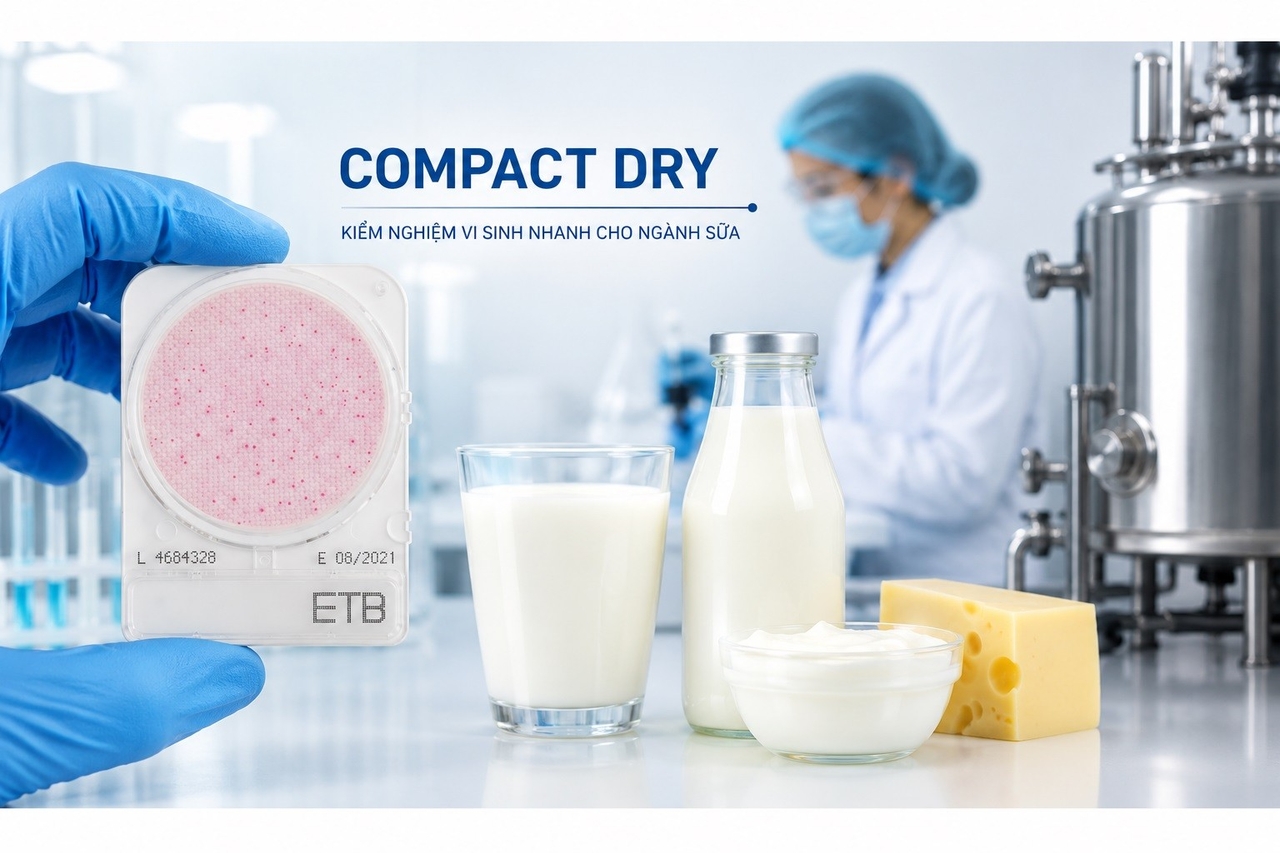
- Even a small error in production or packaging can lead to a risk of microbial contamination, directly affecting product quality, brand reputation and consumer health.
- In a context where dairy factories are increasingly focused on raising productivity and reducing laboratory operating costs, Compact Dry plates are becoming the microbiological testing solution chosen by many companies to replace the traditional agar pouring method.
Why dairy needs regular microbiological testing
Milk and dairy products are a nutrient-rich environment, very favorable for microorganisms to grow. Microbiological monitoring therefore needs to be carried out at many stages:
- Incoming raw materials.
- Water used in production.
- The production environment.
- Equipment and food-contact surfaces.
- Finished products before shipping.
Some important microbiological parameters for dairy factories are:
- Total aerobic bacteria count (Total Plate Count - TPC).
- Coliform.
- Escherichia coli (E. coli).
- Staphylococcus aureus.
- Yeast and mold.
- Enterobacteriaceae.
Controlling these parameters helps companies ensure their products meet the requirements of HACCP, ISO 22000, FSSC 22000 and current food safety regulations.
The limitations of traditional microbiological testing methods
Nowadays many QC laboratories still use the method of preparing media and pouring traditional agar plates. However, this method has many limitations:
Time-consuming preparation
Staff need to:
- Weigh out the medium.
- Prepare the medium.
- Sterilize it in an autoclave.
- Pour petri dishes.
- Store the medium.
The whole process can take many hours every day.
High operating costs
Companies have to invest in:
- An autoclave.
- A medium storage cabinet.
- Petri dishes.
- Experienced staff.
A high risk of errors
- Errors in preparing the medium or pouring the plates can directly affect the test results.
It takes up a lot of laboratory space
- Storing media, utensils and auxiliary equipment increases the need for laboratory space.
Compact Dry – the optimal solution for dairy factories
- Compact Dry is a dry culture medium system developed to simplify the microbiological testing process.
- The user only needs to drop 1 mL of sample onto the Compact Dry plate; the sample automatically disperses evenly over the entire surface and gels immediately, without pouring agar.
Key advantages
* No medium preparation needed
The plates are pre-manufactured and packed sterile.
Companies do not need to:
- Prepare the medium.
- Autoclave it.
- Pour plates.
This saves considerable time and labor.
* Easy to use
The process only consists of:
1. Preparing the sample.
2. Dropping the sample onto the plate.
3. Incubating.
4. Reading the result.
Even new staff can quickly become familiar with it and operate it correctly.
* Cost savings
Factories can significantly reduce:
- The cost of culture media.
- The electricity cost of the autoclave.
- Staff costs.
- Consumables inventory management costs.
* Easy-to-read results
The colonies appear in distinctive colors, allowing rapid identification and reducing errors when reading the results.
* Saves laboratory space
Compact Dry plates are compact, easy to store, and do not require much supporting equipment.
The types of Compact Dry suitable for dairy factories
Compact Dry TC
Used to determine: total aerobic bacteria count (TPC).
* Applications:
- Testing milk raw materials.
- Testing finished products.
- Monitoring line hygiene.
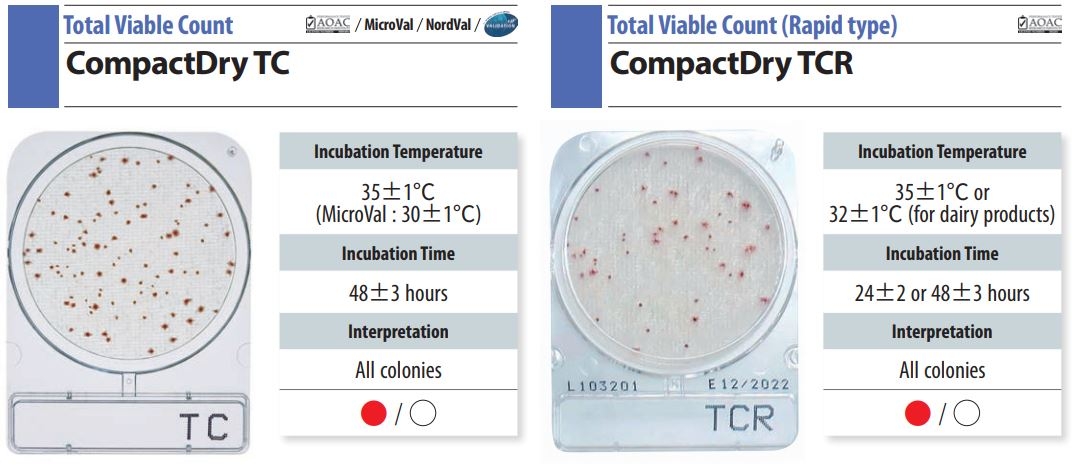
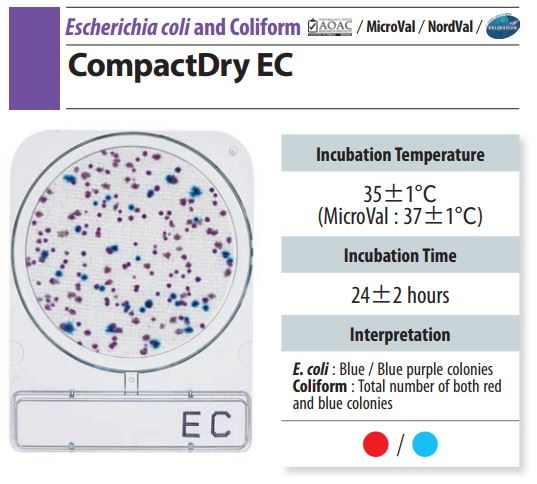
Compact Dry EC
Used to detect: E.coli, Coliform.
* Applications:
- Testing production water.
- Testing dairy products.
- Monitoring equipment hygiene.
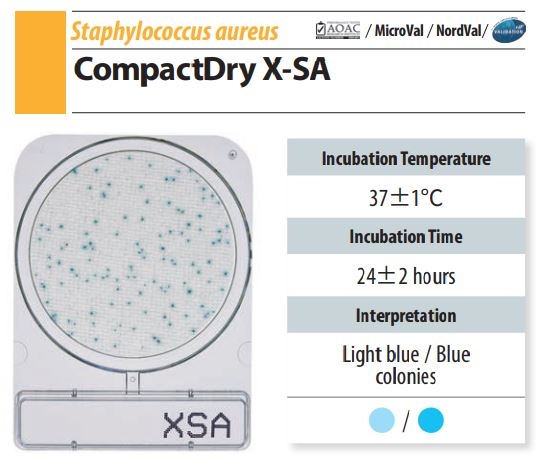
Compact Dry X-SA
Used to detect: Staphylococcus aureus.
* Applications:
- Controlling the risk of bacterial contamination from production staff.
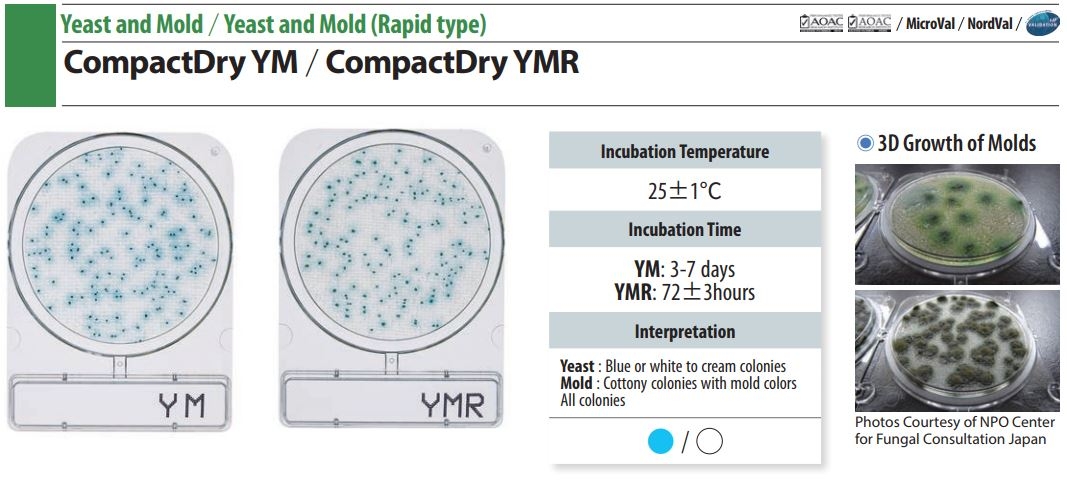
Compact Dry YMR
Used to detect: yeast & mold.
* Applications:
- Yogurt.
- Milk powder.
- Fermented products.
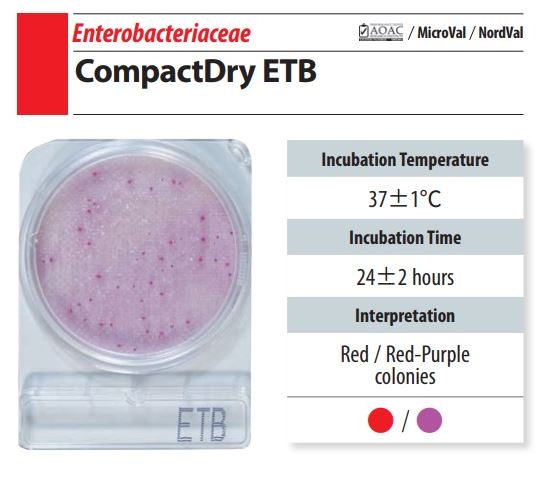
Compact Dry ETB
Used to detect: Enterobacteriaceae.
Applications:
- Assessing the cleaning effectiveness of the factory.
- Controlling the risk of cross-contamination.
Compact Dry applications in the dairy quality control process
Testing incoming raw materials
Assessing the quality of raw fresh milk before putting it into production.
Monitoring water use
Testing:
- Coliform.
- E. coli
- Total microorganisms.
Ensuring the water source meets hygiene requirements.
Testing the production environment
Assessing cleaning effectiveness on:
- Equipment surfaces.
- Conveyor belts.
- Storage tanks.
- Packaging areas.
Testing finished products
Confirming that products meet the standards before shipping.
The economic benefits of applying Compact Dry in dairy factories
Many companies have recorded clear benefits:
- Testing handling time cut by up to 50%.
- Considerable reduction in consumables costs.
- Less dependence on highly skilled staff.
- Faster QC results.
- Improved quality control effectiveness.
- Meeting the requirements of HACCP, ISO 22000 and FSSC 22000.
Conclusion
- For modern dairy factories, microbiological testing is not only aimed at meeting legal requirements, but is also a decisive factor in product quality and brand reputation.
- With fast, accurate, easy-to-use and cost-saving advantages, Compact Dry is becoming the optimal microbiological testing solution for the dairy industry. Applying Compact Dry helps companies improve quality control effectiveness, reduce laboratory operating costs and ensure products are safe before they reach consumers.