1. Microorganisms in food
- Detecting pathogenic microorganisms and monitoring typical spoilage organisms is very important to minimise production losses.
- Microorganisms are extremely small entities, mostly single-celled, although some may be multicellular. They are everywhere, found in water, soil, air and many different natural environments. In the food industry, microorganisms may occur naturally in food, be present on food surfaces (for example, fresh vegetables) or be introduced during production due to inadequate hygiene practices (for example, meat processing).
In the food industry, microbial contamination can be classified as:
- Virus
- Bacterial toxins in food safety
2. Microbiological testing methods in food
Microbiological testing in food can be classified into 2 methods: food testing and hygiene monitoring/hygiene control.
2.1. Detecting microorganisms in the production environment
- Microbiological tests for hygiene and cleaning control detect food residues on surfaces that have not been adequately cleaned in the production environment, which create a basis for microorganisms to grow. Colony counting in food or on surfaces can be carried out using the ready-poured freeze-dried agar Compact Dry plates, available for 13 different microbiological parameters. These plates use standard nutrient media and chromogenic substrates, converting into coloured products through bacterial metabolism. Compact Dry plates can test diluted food samples, swab samples from surfaces or membrane filter samples from liquids.
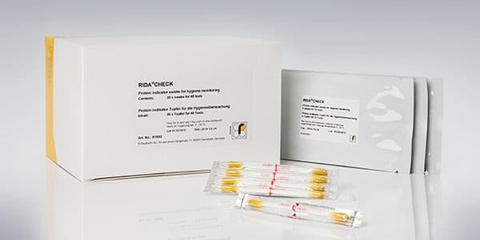
- Food residues on surfaces can also be detected using surface protein test swabs RIDA®CHECK or using the ATP meter for surface hygiene testing (LuciPac™A3 Surface ). Protein tests indicate the level of contamination through a detectable colour change in the reagent. ATP measurements are highly accurate, using a bioluminescence reaction recorded by the ATP meter Lumitester SMART. Both systems effectively control the hygiene process consistently, ensuring industrial hygiene and reducing the risk of contamination during food production.
Medium plate | Protein test swab | Lumitester Smart ATP meter |
|---|---|---|
Ready-to-use medium plate | Surface protein test | ATP measurement, hygiene control |
Number of bacteria on surfaces and in diluted food samples | Swab testing to detect food residues on surfaces | Detecting food residues on surfaces |
Easy and safe to use | A fast and reliable method | Fast and convenient to use |
2.2. Detecting microorganisms in food
- Bacterial toxins in food and beverage samples can be analysed by various test methods, including the ELISA test , the Real Time PCR test, the Compact Dry medium plate.
- To detect pathogenic bacteria, there are immunological methods (ELISA). RIDASCREEN® tests use sandwich technology, capturing the surface proteins of the bacteria in a microtitre well and detecting them with a second, enzyme-labelled antibody. This immunological detection requires suitable pre-enrichment procedures based on the type of pathogen.
- Detecting bacterial toxins can be done directly from the food sample (RIDASCREEN® SET Total and RIDASCREEN® SET A, B, C, D, E) or used to indirectly detect toxin-producing bacteria after pre-enrichment.
- Pathogenic bacteria and viruses can be identified with PCR molecular biology systems, such as the SureFast® PATHOGEN Real Time PCR kit. This modular system includes optimised DNA preparation via spin filter columns and TaqMan hydrolysis probe technology linked to the FAM dye. It is compatible with all common real-time PCR thermal cyclers. All PLUS kits include an internal amplification control, with a choice of amplification control dye depending on the type of cycler used.
- Optimising microbiological testing processes will ensure food safety and compliance with regulatory standards, protecting consumers and reducing the risk of contamination during food production.
RIDASCREEN® | SureFast® | Compact Dry medium plate |
|---|---|---|
Immunological test (ELISA) | Molecular biology test (Real Time PCR) | Ready-to-use medium plate |
To detect bacteria and bacterial toxins | To detect bacteria and viruses | Number of bacteria on surfaces and in diluted food samples |
A fast and reliable method | High specificity and speed; compatible with all standard PCR machines | Easy and safe to use |