
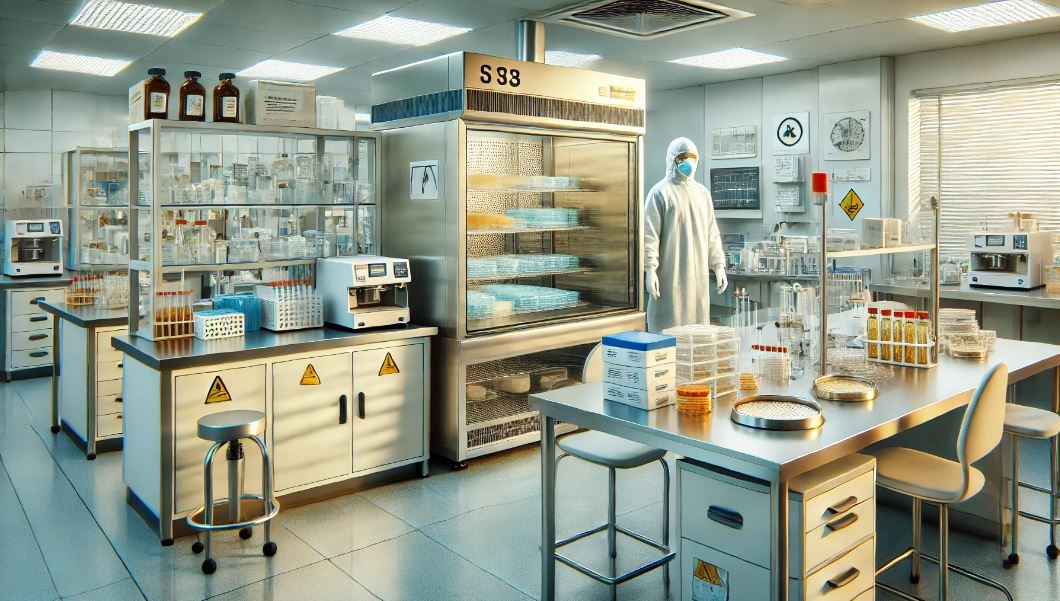
1. Basic equipment
– Biosafety Cabinet: Ensures a sterile working environment and prevents cross-contamination.
– Laminar Flow Hood: Creates a clean air stream, preventing contamination from the environment.
– Autoclave: Sterilises instruments and culture media.
– Incubator: Cultivates and grows microorganisms at the specified temperature.
– Microscope: Observes and analyses microorganisms.
– Refrigerator/Freezer: Stores culture media, food samples and microbiological samples.
– Shaker: Used to mix media or liquid samples.
– Centrifuge: Separates components in a sample by centrifugal force.
– PCR machine (Polymerase Chain Reaction): Used in DNA analysis of microorganisms.
– pH Meter: Measures the pH of food samples or culture media.
2. Instruments and consumables
– Petri dish: Holds culture medium for growing microorganisms. Or use ready-poured freeze-dried agar Compact Dry plates.
– Test tubes and caps: Hold samples and culture media.
– Micropipette and tips: used for aspirating and transferring samples
– Inoculation Loops: Used to take microbiological samples.
– Cotton, gauze and 70% alcohol: Disinfects surfaces and instruments.
– Culture media: Selective and non-selective media for growing microorganisms such as TSA, MRS, PDA, etc.
– Masks, gloves, laboratory coats: Personal protection and prevention of cross-contamination.
– Filter paper: Used to filter liquid samples.
3. Auxiliary equipment
– Conductivity Meter: Checks the quality of water used in the experiment.
– Dissolved oxygen meter: Assesses the quality of the culture medium.
4. Chemicals
– Indicators: Used to determine pH and in biochemical reactions.
– Sterilising and disinfecting agents: Disinfectant solutions such as NaClO (bleach) and ethanol.
– Buffer solutions: Ensure the medium has a stable pH.
5. Software and management systems
– Laboratory Information Management System (LIMS) software: Manages testing workflows and stores data.
– The choice of equipment and consumables will depend on the specific food testing objectives and type, together with the laboratory's scale and budget.
Microbiological laboratory design must comply with international and national standards to ensure safety, effectiveness and the prevention of cross-contamination. Below are the important microbiological laboratory standards to consider when designing:
1. Biosafety standards
– Biosafety Levels (BSL) classification: Microbiological laboratories are classified from BSL-1 to BSL-4 depending on the hazard level of the microorganisms handled. Food testing laboratories are usually at biosafety level BSL-1 or BSL-2.
+ BSL-1: For microorganisms that do not cause disease in healthy people.
+ BSL-2: For microorganisms capable of causing mild disease and transmitted through direct or indirect contact (low infection risk).
* Basic biosafety requirements include:
– Air control system (room air should be filtered and exhausted through HEPA filters).
– A biosafety cabinet designed to ensure isolation between the inside and outside environment.
– The room must be clearly separated with controlled access.
2. Microbiological laboratory standards
* Reasonable zoning of space: The microbiological lab must be divided into different functional areas to prevent cross-contamination. These include:
– Media preparation area: For preparing culture media.
– Inoculation and culture area: Must be under sterile conditions with a laminar flow hood or biosafety cabinet.
– Sample handling area: For processing and analysing food samples.
– Sample storage area: Includes refrigerators and freezers for storing samples and chemicals.
– Sterilisation area: Houses the autoclave and sterilisation equipment.
* Construction materials:
– Floors, walls and ceilings must be made of water-resistant, impermeable and easy-to-clean materials such as vinyl or ceramic tiles.
– Wall and floor corners should be rounded to prevent dust accumulation and make cleaning easier.
* Lighting and ventilation:
– Natural and artificial lighting must be adequate, but high-brightness, non-glare lamps should be used.
– The ventilation system must ensure airflow from clean areas to less clean areas, limiting the spread of microorganisms.
3. Equipment standards
– Biosafety equipment: Biosafety cabinets, autoclaves and disinfection systems are needed to minimise the risk of cross-contamination.
– HEPA air filters: Ensure air filtration to prevent harmful bacteria and microorganisms in the air.
– Washbasins and hands-free taps (foot-operated or sensor): Placed conveniently so staff can wash their hands before and after entering the work area.
4. Microbiological laboratory safety standards
– Personal protective equipment: Coats, gloves, masks and safety glasses must be available.
– Safety signage and procedures: Safety signs must be placed in clear positions. Disinfection, microorganism handling and isolation procedures must be thoroughly instructed.
– Emergency exits: Must be designed according to regulations, with clear signage and easy access in an emergency.
5. ISO standards
– ISO 14644-1: Cleanrooms and associated controlled environments: Applied in microbiological laboratory design to control airborne particle concentrations.
– ISO/IEC 17025: General requirements for the competence of testing and calibration laboratories: Laboratories must follow this standard to ensure the accuracy and reliability of test results.
6. Waste handling
Microbiological laboratories need a suitable biological waste management system. Microbiological waste must be sterilised before being released outside, usually through an autoclave or disinfection procedures.
7. Space and personnel management
– Changing room: A changing and PPE storage area is needed to ensure cleanliness when entering and leaving the work area.
– Handwashing and disinfection area: Handwashing stations and disinfectant solutions must be available at key entry and exit points.
8. Conclusion
– Designing a food testing microbiological laboratory requires strict compliance with biosafety, architectural, equipment and occupational safety standards. The design process must ensure a safe working environment for staff, prevent cross-contamination and ensure accurate test results.
– Thai Binh Duong Company is proud to be a leading provider in the design and construction of food testing microbiological laboratories, meeting international standards for biosafety and quality. With many years of experience and a team of highly qualified experts, we are committed to delivering the most optimal, effective and safe solutions for our customers.
– Thai Binh Duong has many years of experience designing and delivering microbiological laboratories in Vietnam. We have a deep understanding of international standards such as ISO 14644-1 for cleanrooms and ISO/IEC 17025 for laboratory competence. This allows us to provide designs that ensure strict compliance and suit each customer's requirements in the field of food testing.
– Microbiological laboratories designed by Thai Binh Duong not only ensure aesthetics but also comply with stringent biosafety requirements.
– We supply and install the most modern equipment such as autoclaves, incubators, PCR machines and microbiological laminar flow cabinets. All equipment is selected from reputable suppliers, meeting requirements for high accuracy and durability. In particular, we ensure that all consumables such as pipettes, petri dishes and culture media meet quality standards, helping the testing process run smoothly and accurately.
– Thai Binh Duong Company constantly strives to develop and improve its capabilities to become a trusted partner in the design and construction of food testing microbiological laboratories. With a team of skilled engineers and comprehensive solutions, we are confident in delivering outstanding value to our customers, ensuring safety and effectiveness in all testing activities.
– Please contact us for advice on designing a microbiological laboratory suited to your needs!