

1. What is microbial culture media?
- Microorganisms differ in nature, characteristics, habitat and even nutritional requirements, so they cannot be cultured with a single type of culture media. However, there are also microorganisms that cannot grow on culture media under any conditions – they are called parasites.
- Microbial culture is necessary to diagnose infectious diseases, collect antigens, develop serum tests for vaccines, conduct genetic research and identify bacterial species.
- Moreover, it is also necessary for isolating pure cultures, storing culture stocks, studying biochemical reactions, testing contamination, checking the effect of antimicrobial agents and preservatives, testing viable bacterial counts and testing antibiotic sensitivity.
- In this article we will focus on the composition, classification and the types of culture media used in the microbiology laboratory to study bacterial forms in more depth.
2. Classification of microbial culture media
- Microbial culture in the laboratory involves simulating the natural habitat or environment of an organism, and this can be done in the laboratory by creating culture media that meet their requirements. Therefore, many culture media have been developed by scientists according to the bacterial species to be cultured.
- Basic media contain a source of carbon and energy, a nitrogen source, growth factors and some trace elements. Common medium components include peptone, agar, water, casein hydrolysate, malt extract, meat extract, and yeast extract. In addition, the pH of the medium should be set appropriately.
- However, some components or supplementary nutrients are added to the medium when culturing specific microorganisms. Microbial culture media can be classified in three ways: by consistency, by nutritional composition and by their application.
2.1. Classification of microbial culture media by consistency
2.1.1. Solid media
- In these media, Agar is a long unbranched chain of polysaccharides added at a concentration of 1,5-2,0%. Most commonly, Agar 1,3% is used to prepare solid media in the laboratory. The medium solidifies at a temperature of 37ºC. Sometimes, instead of agar, other inert solidifying agents are used, such as gellan gum.
- Solid media are used to culture microorganisms in their complete physical form, to prepare pure bacterial culture bases or to isolate bacteria for the study of colony characteristics. Bacterial growth on solid media takes many different forms such as mucoid, circular, smooth, rough, filamentous, irregular and punctiform. The medium is not hydrolysed by microorganisms and contains no substances that inhibit growth. Examples of solid media are blood agar, nutrient agar, McConkey agar, and chocolate agar.
2.1.2. Semi-solid media
This medium has an agar concentration of 0,2-0,5% and because the agar concentration is reduced it appears as a soft substance, like jelly. It is mainly used to study the motility of microorganisms, to distinguish between motile and non-motile bacterial strains (through the U-tube and the Cragie tube) and to culture microaerophilic bacteria – bacteria on this medium appear as a thick streak. Examples of semi-solid media are: Hugh and Leifson oxidative fermentation medium, Stuart and Amies medium and Mannitol transport medium.
2.1.3. Liquid media
These media contain no trace of solidifying agents such as agar or gelatin, and heavy growth of bacterial colonies can be seen in the medium. Liquid media are also called Broth, they allow bacterial strains to grow evenly and turbidly when incubated at 37ºC for 24 hours. The medium is used for vigorous growth of microorganisms and fermentation studies. Examples include Tryptic soy broth, phenol red carbohydrate broth, MR-VP broth, and nutrient broth.
In addition, there are two-phase media, which include both solid and liquid media. And sometimes instead of agar, egg yolk and serum are added to the medium as a solidifying agent. Although these substances are liquid, they are re-solidified by using heat and the prepared medium is sterilized by the pour technique.
2.2. Classification of microbial culture media by nutritional composition
- Simple media: This is a multipurpose medium that supports the growth of non-fastidious bacteria and is mainly used to isolate microorganisms. Examples are nutrient broth, peptone water, and nutrient agar.
- Complex media: This is a medium containing nutrients in undetermined amounts that are added to create a specific characteristic of a bacterial strain. Examples are tryptic soy broth, blood agar, and nutrient broth
- Synthetic media: Synthetic media are a chemically defined type of medium produced from pure chemicals. A medium is defined as one with known component concentrations, such as sugar (glucose or glycerol) and a nitrogen source (such as ammonium salts or nitrate in inorganic form)
2.3. Classification of microbial culture media by application / chemical composition
2.3.1. Basic microbiological media
- These are simple media that are commonly used, with carbon and nitrogen sources that promote the growth of many microorganisms. They are also called general-purpose media and are considered non-selective media.
- Basic media do not require growth factors for the growth of non-fastidious bacteria and are suitable for culturing Staphylococcus and Enterobacteriaceae
- They are commonly used to isolate microorganisms in the laboratory or in subculture processes. Examples are nutrient broth, nutrient agar, and peptone water.

2.3.2. Enriched media
- This medium is prepared by adding supplements such as blood, serum or egg yolk to the basic medium. This medium is used to culture fastidious microorganisms because they need additional nutrients and growth factors.
- No inhibitory agents are used to prevent the growth of unwanted microorganisms. Enriched media such as enriched broth, selenite broth, and Gram-negative broth. After enrichment, the required microorganisms can be isolated by other culture techniques.
- Examples are chocolate agar, blood agar and Loeffler serum. Chocolate agar is used to culture N. gonorrhea while blood agar (prepared by adding 5-10% blood by volume to an agar base) is used to identify haemolytic bacteria.
2.3.3. Selective media
- This medium allows some bacteria to grow while inhibiting the growth of other bacteria. This is an agar-based medium used to isolate microorganisms in the laboratory. Selective growth of bacteria is determined by adding substances such as antibiotics, dyes, bile salts or by adjusting the pH.
- Crystal violet or brilliant green dye is added to inhibit the growth of Gram-positive bacteria without affecting the growth of Gram-negative bacteria. In contrast, phenylethanol agar inhibits the growth of Gram-negative bacteria but does not inhibit Gram-positive bacteria.
- Antibiotics are added to some media to make them selective for microorganisms that are resistant to these antimicrobial agents, such as Salmonella-Shigella agar and CIN agar
2.3.4. Differential or indicator media
- This medium contains indicators such as dyes or metabolisable substrates in the medium composition that produce different colours for the colonies of different bacterial species when they use or react with these components.
- This medium allows more than one microorganism to grow, however, bacterial colonies are differentiated based on their colour when chemical changes occur in the indicator substance, such as neutral red, phenol red, methylene blue.
+ In blood agar, three types of blood agar or haemolysis are observed: alpha, beta, and gamma hemolysis. It allows many microorganisms to grow, however, their haemolytic ability differs and this helps to distinguish bacterial colonies. For example, S. pyogenes completely haemolyses the blood cells (beta haemolysis), therefore completely clearing the medium around its colonies. S. pneumoniae partially haemolyses the red blood cells, producing a greenish medium, while gamma-haemolytic microorganisms such as Enterococcus faecalis, Staphylococcus saprophyticus and Staphylococcus epidermidis cannot haemolyse red blood cells, therefore causing no colour change in the medium.
+ Mannitol salts agar: The mannitol fermentation of Staphylococcus aureus turns the medium yellow, while cocci that are unable to ferment will turn it pink.
+ MacConkey agar: Distinguishes Gram-negative bacteria based on their lactose metabolism. Lactose-fermenting bacteria, such as Escherichia coli, Klebsiella spp, Citrobacter and Enterobacter form pink-red colonies, while non-lactose-fermenting bacteria, such as Salmonella, Shigella, Proteus, Providencia, Pseudomonas and Morganella form pale or colourless colonies.
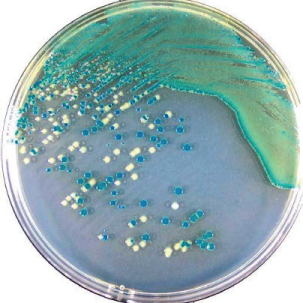
+ Thiosulfate citrate bile salts sucrose (TCBS) agar: A medium containing sucrose, which is used by fermenting bacteria and helps to distinguish them from non-fermenting microorganisms. Based on this characteristic, bacterial colonies of different colours form on the medium, making it easy to identify and distinguish them from each other. For example, V. cholerae ferments sucrose and forms slightly flattened yellow colonies with a translucent centre and margin. In contrast, V. parahaemolyticus cannot ferment sucrose and forms green to blue-green colonies
2.3.5. Transport media
An ideal transport medium maintains the viability of microorganisms without changing their number. They usually contain only buffer and salts for a specific microorganism. The lack of carbon, nitrogen and organic compounds in the medium prevents the growth of microorganisms. Transport media are used for obligate anaerobic bacteria that must have no molecular oxygen. Examples are: Amies media, aerobic transport media, and anaerobic transport media
- Transport media are useful for clinical samples that need to be transferred immediately to the laboratory to maintain the viability of latent pathogens and to prevent overgrowth of commensal or contaminating microorganisms. Examples include
+ Sach’s buffered glycerol saline:is used to transport stool from patients suspected of having shigellosis.
+ Cary Blair transport and Venkatraman Ramakrishnan media: Stool samples collected from patients suspected of having cholera are transported with this medium.
+ Pike’s medium: Throat samples containing Streptococci are transported with this medium.
2.3.6. Anaerobic media
- This medium is intended for anaerobic bacteria that require a low oxygen level, additional nutrients and a reduced redox potential. This medium is supplemented with hemin and vitamin K and oxygen is removed by boiling in a water bath and sealing with a paraffin film
- Examples: Thioglycollate medium and Robertson Cooked Meat (RCM) medium are commonly used to culture Clostridium spp
2.3.7. Assay media
Used for amino acid, vitamin and antibiotic assays. For example, antibiotic assay medium is used to determine the antibiotic efficacy of microorganisms.
2.3.8. Storage media
- Used to store microorganisms for longer periods, for example cooked meat broth with charcoal and egg saline medium.
3. Conclusion
- Microbial culture media are the source of nutrients and growth factors necessary for the growth of microorganisms and even plants under laboratory conditions. Each organism has different nutritional needs based on its habitat or living conditions. Therefore, a single culture media formula cannot be used to grow all organisms in the laboratory
- Many types of culture media have been developed by scientists to culture selected or desired microorganisms. They are classified based on nutritional composition, consistency and application or use in life science laboratories
- Microbial culture media serve many purposes in the laboratory such as isolating specific microbial strains, identifying pathogens, preparing a culture of a pure bacterial species, differentiating bacterial species and studying their response to certain antibiotics.
- Therefore, before deciding which culture media to use, it is important to identify the purpose of your research and in some cases the type of microorganism you want to study. This narrows down your options and helps you choose which media are best for your experiment, without wasting time and effort.
PACIFICLAB SCIENTIFIC AND TECHNICAL EQUIPMENT CO., LTD specialises in providing consulting solutions and building microbiology laboratories for food processing companies, seafood processing companies, beverage manufacturers,...For any information about products or any questions about microbiology laboratory solutions, customers are welcome to contact us for the most specific answers and advice.