

1. Methods for testing microorganisms in the air
Several methods are used to test microorganisms in the air, the most common are:
- Settle plate method: place the media plates at the position to be tested for a determined period of time (usually 15 minutes – 4 hours) for microorganisms to settle down and grow.
- Air sampling method (air sampler): use a device that draws a determined volume of air through the surface of a nutrient medium to collect the sample.
- Membrane filtration method: pass the air through a filter membrane, then culture the membrane on a nutrient medium.
- Among them, Compact Dry plates are a modern, convenient choice for carrying out testing by the settle plate method or in combination with an air sampling device.
2. How to sample microorganisms in the air using Compact Dry plates
- Compact Dry plates are a ready-to-use dry culture medium for microorganisms, developed by Shimadzu (Japan). Each plate is pre-coated with selective medium and colour indicator, ready for microbiological testing without manual medium preparation. To test microorganisms in the air, the following steps can be applied.
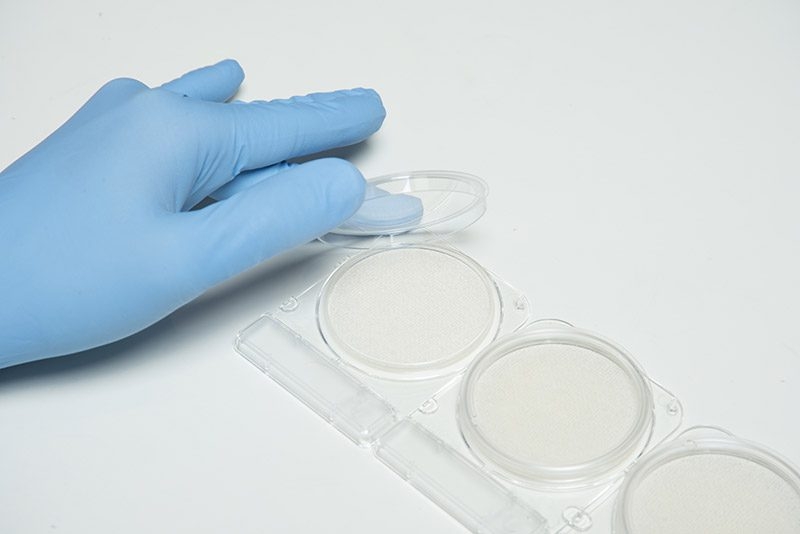
Step 1: Preparation
- Choose the type of Compact Dry plate suitable for the parameter to be tested (for example: Compact Dry TC for total aerobic bacterial count, Compact Dry YM for yeast – mold).
- Label the sample information: sampling location, time, date.
Step 2: Sampling by the settle plate method
- Open the lid of the Compact Dry plate and place it at the position to be tested (workbench, cleanroom, production area).
- The lid opening time is usually from 15 minutes to 60 minutes depending on the standard applied.
- After the specified period of time, close the lid carefully to avoid random contamination.
Step 3: Incubation
- Incubate the plate at a suitable temperature (for example: 35–37°C for bacteria, 25–30°C for yeast – mold).
- Incubation time is usually 24 – 72 hours depending on the type of microorganism.
Step 4: Counting and evaluating results
- After incubation, count the number of colonies growing on the Compact Dry plate.
- Results are expressed as CFU/plate or CFU/m³ of air (if using an air sampler with a defined volume).
- Compare with the limits specified in the air hygiene standard of the relevant industry (food, pharmaceutical, hospital…).
3. Advantages of using Compact Dry plates
- Easy to use: no culture medium preparation needed.
- Safe: closed design, limits the risk of cross-contamination.
- Convenient: easy to store at room temperature, long shelf life.
- Versatile: many plate types for different microbiological parameters.
- Accurate quantification: colonies grow clearly, easy to count.
In summary, the method for testing microorganisms in the air using Compact Dry plates is a fast, effective solution suitable for testing laboratories, food and pharmaceutical factories, and hospitals. This is a useful tool for monitoring environmental quality, helping to ensure product safety and public health.
👉 See the Compact Dry plates we supply here.