
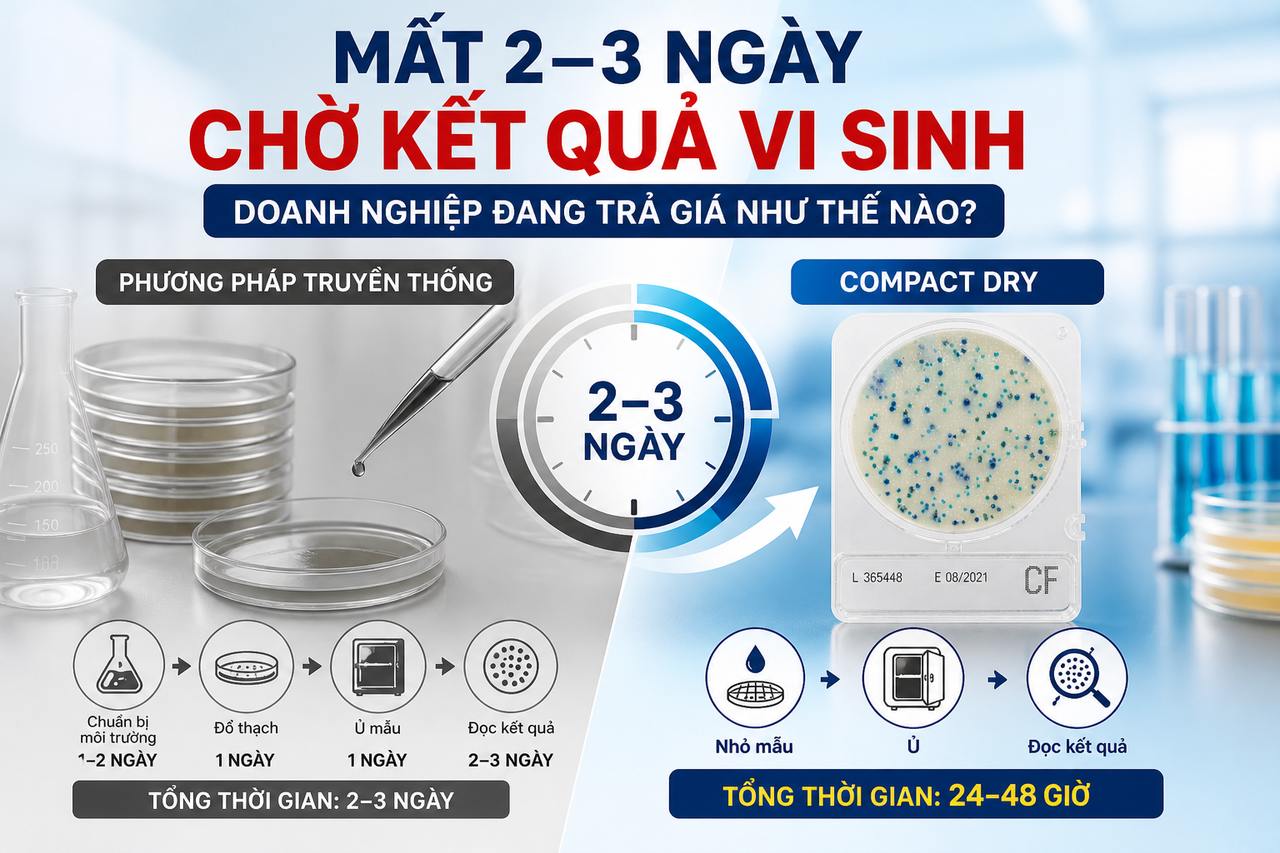
However, most businesses still use the traditional method, which means:
- It takes 2–3 days to get a result
- It may sound normal… but in reality, this is the “bottleneck” that costs businesses a great deal of money.
1. Why does microbiology testing take so much time?
1.1. A complex, multi-step process
- Preparing the culture medium
- Pouring the agar
- Sterilising
- Incubating the sample
- Reading the results
👉 Preparation alone takes 1–2 days
1.2. Long incubation time
- Microorganisms need time to grow
- Usually: 24–48 hours
👉 Total microbiology testing time: 2–3 days
2. How are businesses “paying the price”?
2.1. Slow shipment
- No results → dare not release from the warehouse
- Missing deadlines for customers
👉 Risk of losing contracts
2.2. Higher inventory costs
- Goods sitting and waiting for testing
- Higher storage costs
2.3. Slow response to risks
- If there is microbial contamination → detected late
- The whole batch may be affected
2.4. Lost business opportunities
- The market demands speed – and you are slow
- Competitors using rapid microbiology tests will have an advantage
3. Solution: Shorten the microbiology testing time
- To solve this problem, many businesses have switched to rapid microbiology testing, typically Shimadzu's Compact Dry plates.
How Compact Dry helps shorten the time
3.1. Skip the medium preparation step
- No need to prepare the medium
- No need to pour agar
- No need for an autoclave
👉 Saves 1–2 days
3.2. A simplified process
You only need to:
- Pipette the sample
- Incubate the sample
- Read the results
3.3. Fast and stable results
- The medium is already standardised
- Fewer handling errors
4. Time comparison: Traditional vs Rapid microbiology test

5. Benefits of shortening the testing time
When a business optimises microbiology testing time, you will:
- Ship faster
- Reduce inventory
- Increase capital turnover
- Actively control quality
- Increase competitive advantage
6. Real-world applications
- Beverage industry: rapid Coliform testing
- Food industry: controlling microbiology in output
- Seafood: reduce export time
- Milk: rapid testing before packaging
Conclusion
Losing 2–3 days waiting for microbiology results is not only a technical problem, but also:
👉 A cost – speed – competition equation
- Switching to rapid microbiology tests such as Compact Dry will help businesses:
- Shorten testing time
- Increase operational efficiency
- Reduce risk
👉 This is an inevitable trend for the modern QC lab.