1. Introduction to Listeria species in food
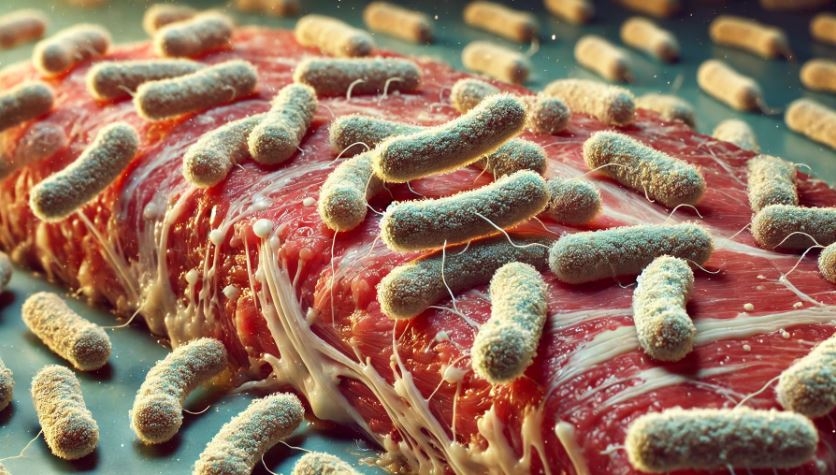
– Listeria species, or Listeria spp, is a bacterial genus in the family Listeriaceae, comprising many different species, among which Listeria monocytogenes is the most dangerous species to humans. This bacterium causes Listeriosis, a serious infection, especially for people with weakened immune systems such as pregnant women, the elderly, young children and patients with chronic diseases.
– Other species in the genus Listeria such as Listeria innocua, Listeria ivanovii, Listeria seeligeri, and Listeria welshimeri do not directly cause disease in humans but are also often present in food production environments and can affect product quality.

2. Sources and risk of Listeria species contamination in food
The bacteria Listeria species are often found in natural environments such as soil, water, animal manure and plants. From there, they can easily enter the food production and supply chain. Products prone to contamination with Listeria include:
– Ready-to-eat foods: Sausages, pate, cold cuts, cheese, and products made from raw meat.
– Products from unpasteurized milk: Soft cheeses such as feta, brie, or camembert.
– Fresh vegetables and ready-to-eat foods: Raw vegetables, salads, and fruits that have not been properly processed.
– Seafood and raw or undercooked meat: Especially salmon and refrigerated seafood products.
Their ability to grow at low temperatures helps Listeria species multiply easily in refrigerated food, increasing the risk of gastrointestinal infection.
3. Effects of Listeria contamination in food
Contamination with Listeria can cause symptoms ranging from mild to severe. In healthy people, symptoms usually include fever, muscle aches and diarrhoea, whereas in people with weakened immune systems, Listeriosis can cause serious complications such as meningitis, septicaemia, or even death. Pregnant women infected with Listeria face the risk of miscarriage, premature birth or stillbirth.
4. Methods for detecting Listeria in food
Detecting Listeria species bacteria in food is very important to ensure food safety and prevent disease outbreaks. Below are the common detection methods:
4.1. Traditional culture method
Growing bacteria on selective media is the standard approach for detecting Listeria species. The process consists of the following steps:
– Pre-enrichment and selective enrichment: Suspected food samples are incubated in a pre-enrichment broth and then transferred to a selective enrichment broth to encourage the growth of Listeria.
– Isolation on specific media: Media such as Oxford agar, PALCAM agar or ALOA (Agar Listeria Ottaviani and Agosti) are used to isolate and identify Listeria based on colony morphology.
– Advantages: The traditional technique has high accuracy and can identify Listeria species.
– Disadvantages: Long turnaround time, from 3-5 days, and requires a well-equipped laboratory.
4.2. Method using Compact Dry pre-poured agar plates
– Compact Dry is a fast, convenient and effective microbiological testing method, widely used in the food industry to test for pathogenic bacteria, including Listeria species. Developed by manufacturers of medical devices and microbiological technology, Compact Dry is a dry plate medium pre-loaded with nutrients and colour indicators for easy microorganism detection.
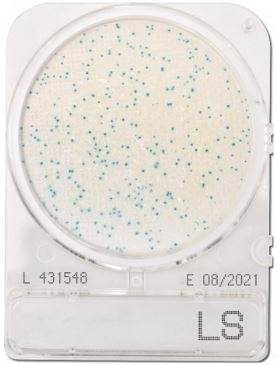
– Compact Dry allows the isolation and quantification of pathogenic bacteria in food, water and other product samples in just a few simple steps. This method is particularly useful for the rapid detection of Listeria species, thanks to its convenience and shorter turnaround time compared with traditional methods. Refer to the Compact Dry LS Listeria spp plate product details here.
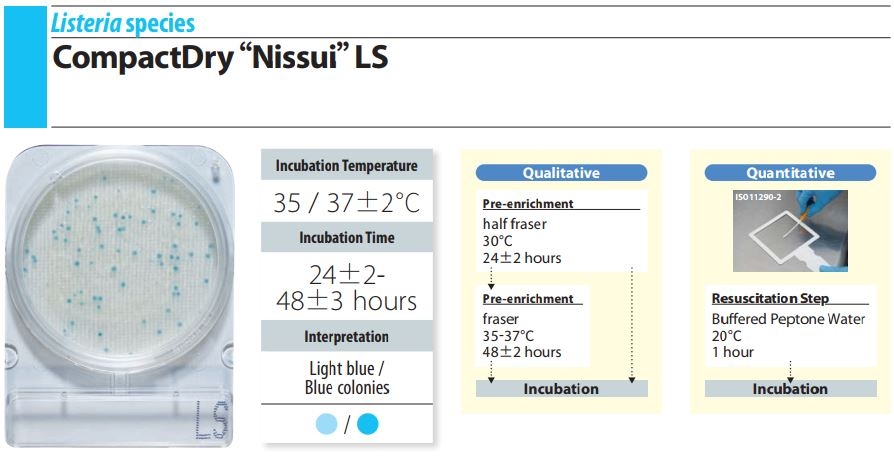
* Listeria spp testing procedure using Compact Dry plates
1. Sample preparation
– Suspected food samples contaminated with Listeria species (such as cold cuts, milk, vegetables) are diluted in sterile buffer solution.
– The dilution ratio is usually 1:10, meaning 10g of food sample is mixed with 90ml of buffer solution.
2. Inoculating the sample onto Compact Dry plates
– Pipette a volume of the diluted sample (usually about 1ml) directly onto the surface of the Compact Dry plate.
– Thanks to the automatic spreading mechanism, the sample is absorbed evenly over the surface of the nutrient medium in the plate.
– Once the sample has been fully absorbed, the Compact Dry plate is sealed and incubated at a suitable temperature (about 35-37°C) for 24-48 hours.
3. Incubating the plates
– After incubation, bacteria Listeria species (if present in the sample) will grow and form colonies on the surface of the Compact Dry plate.
– Thanks to the colour indicator integrated in the nutrient medium, Listeria colonies appear with a characteristic colour, making them easy to observe and count.
4. Reading the results
– Results are read by counting the number of colonies formed on the Compact Dry plate.
– Colony colour and shape allow the presence of Listeria species to be identified. Typically, Listeria monocytogenes produces colonies with a characteristic colour (for example white or light blue), depending on the type of Compact Dry used.
– Confirmation of results: if necessary, suspected colonies can be further isolated and identified by other methods such as PCR or MALDI-TOF to confirm the exact bacterial species Listeria.
* Advantages of Compact Dry plates in detecting Listeria species
– Fast and convenient: Compact Dry requires no complex media preparation, helping reduce time and effort. The technique is simple and requires neither extensive expertise nor complex equipment.
– Easy to read results: colonies of Listeria bacteria usually have a characteristic colour, making results faster and easier to read and count than with other methods.
– Fast turnaround: Compact Dry gives results in about 24-48 hours, faster than many traditional methods that take 3-5 days.
– Highly applicable: this method is suitable for testing Listeria species in many different sample types, from food to drinking water and surfaces in production environments.
* Disadvantages of Compact Dry plates
– Sensitivity may not be as high as PCR: Compact Dry plates are based on bacterial culture, so sensitivity may be lower than molecular detection techniques such as PCR, especially when samples contain few bacteria.
– Differentiation between Listeria species: the Compact Dry method may not accurately differentiate between Listeria (such as Listeria monocytogenes and Listeria innocua). This requires additional isolation and testing steps.
4.3. PCR method (Polymerase Chain Reaction)
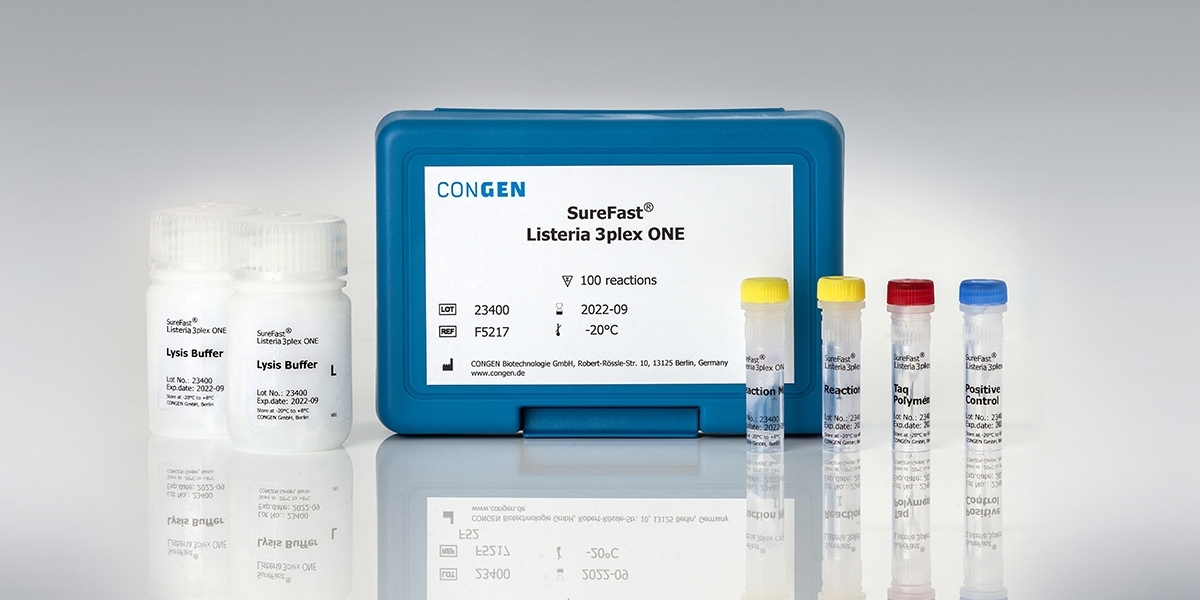
The PCR method is a powerful and rapid technique for detecting the DNA of Listeria in food. This method allows amplification of specific gene fragments of Listeria to identify the bacterium. Refer to the PCR kit for testing Listeria bacteria here.
– Advantages: the PCR method can detect bacteria in small numbers and gives results quickly (a few hours).
– Disadvantages: Requires expensive equipment and skilled technicians.
4.4. ELISA method (Enzyme-Linked Immunosorbent Assay)
ELISA is a method based on antigen-antibody reactions to detect Listeria through the specific signatures of bacterial antigens.
– Advantages: Gives fast results, is easy to apply at large scale and requires no complex equipment.
– Disadvantages: Lower sensitivity than PCR and false positives may occur in some cases.
4.5. MALDI-TOF MS method (Matrix-Assisted Laser Desorption/Ionization Time-of-Flight Mass Spectrometry)
MALDI-TOF MS is a method for identifying bacteria based on protein spectra. The bacterial sample is irradiated with a laser to generate ions, whose masses are then analysed to determine the bacterial species.
– Advantages: A modern and rapid method that can identify Listeria species within a few minutes.
– Disadvantages: Requires complex equipment and very high costs.
4.6. Biosensor rapid detection method
Biosensors use biological sensors to rapidly detect the presence of Listeria in food samples. This technology combines biological molecules (DNA, antibodies) with physical methods (optical, electrochemical).
– Advantages: Rapid detection and can be used on site.
– Disadvantages: Accuracy may not be as high as PCR or traditional culture.
5. Measures to prevent Listeria contamination in food
Besides using detection methods, preventive measures also play an important role in controlling Listeria:
– Food quality control: Follow safe food handling procedures, avoid using unpasteurized milk and ensure meat products are thoroughly cooked.
– Sanitation of the production environment: Regularly clean and disinfect food processing surfaces.
– Temperature control: Store food at appropriate temperatures to limit the growth of Listeria.
6. Conclusion
The bacteria Listeria species are a major threat to human health through contaminated food. With the ability to survive at low temperatures and in harsh conditions, detecting Listeria in food becomes an important factor in protecting community health. Modern methods such as PCR, ELISA, MALDI-TOF MS and biosensors have improved detection efficiency, helping ensure food hygiene and safety.
See our other articles on the same topic at the following link: