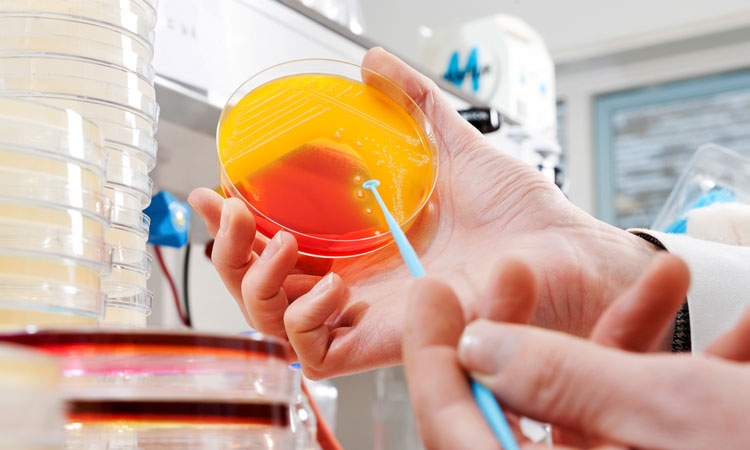
To detect and identify Listeria in food and environmental samples, using suitable culture media is necessary. Below is some detailed information about Listeria culture media types and the related procedure for detecting this bacterium.
Listeria is a gram-positive bacterium capable of surviving in many harsh conditions such as low temperatures and high salt concentrations. Therefore, the culture medium needs favorable conditions to support the bacterium's growth without being affected by other competing microorganisms.
1. The basic culture media for Listeria
The specialized Listeria culture media are designed to select for and promote the growth of Listeria monocytogenes, including:
– The PALCAM medium: PALCAM (Polymyxin-Acriflavine-Lithium chloride-Ceftazidime-Aesculin-Mannitol) is widely used to isolate Listeria. PALCAM contains selective compounds that block the growth of other bacteria. In this medium, Listeria produces gray-green colonies with a halo around them thanks to esculin hydrolysis, clearly distinguishing Listeria from other bacteria.
– The Oxford medium: the Oxford medium is also a selective medium for detecting Listeria. Like PALCAM, the Oxford medium contains antibiotics to suppress the growth of unwanted bacteria. Listeria colonies are usually gray to black because of their ability to hydrolyze esculin, forming a black halo around them.
- The Chromogenic medium (ALOA): this medium contains special color compounds that identify Listeria based on the metabolism of the phosphatidylinositol phospholipase C (PI-PLC) enzyme specific to Listeria monocytogenes. On ALOA, Listeria monocytogenes produces characteristically blue or green colonies.
– The Fraser medium: a semi-selective enrichment medium, Fraser Broth helps raise the Listeria density in the sample before moving to another selective medium. Fraser contains lithium chloride and esculin, letting Listeria be recognized by the black color of esculin hydrolysis.
– The LPM Agar medium (Listeria Enrichment Broth): LPM is an enrichment medium suitable for total Listeria species. LPM Agar creates ideal conditions for Listeria to grow in the early stage before moving to a selective medium for isolation.
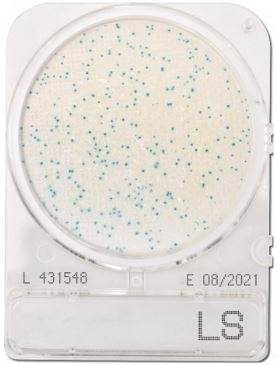
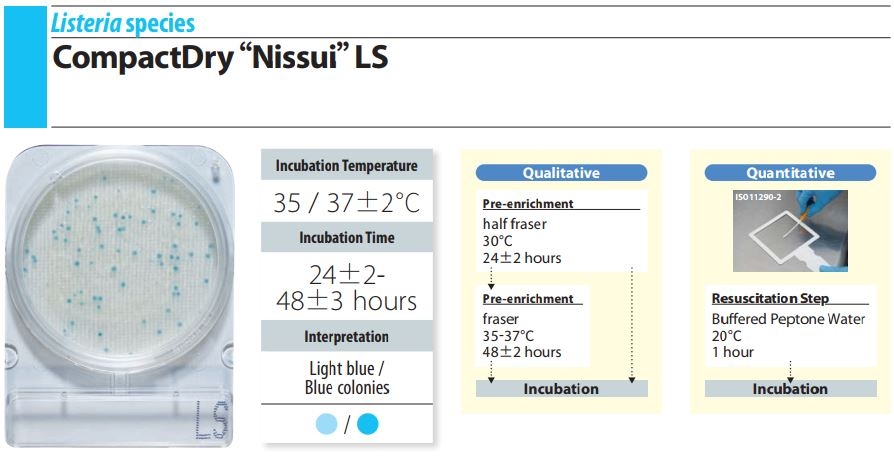
- The Compact Dry LS Listeria spp. plate is an effective product for detecting and quantifying Listeria spp. bacteria in food and production environments. This plate is made by Shimadzu Nissui of Japan and is designed to simplify the microbiological testing process, delivering fast, accurate results. See the Compact Dry LS plate we supply in detail here.
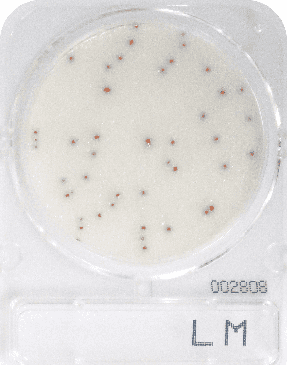
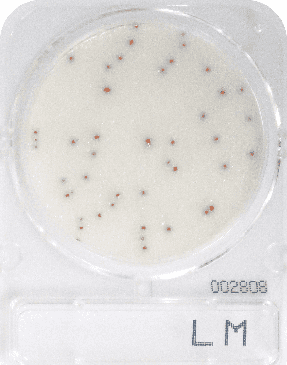
– The Compact Dry LM Listeria monocytogenes plate is a pre-poured freeze-dried agar medium plate, an effective product for detecting and quantifying Listeria monocytogenes in food and in food production environments. This product is designed to simplify the microbiological testing process, delivering fast, accurate results. See the Compact Dry LM plate we supply in detail here.
2. The procedure for culturing and detecting Listeria
The procedure for culturing and detecting Listeria monocytogenes usually includes these main steps:
– Sampling: collect samples from food, production environment surfaces, or related environmental samples.
– The enrichment stage: use enrichment media such as UVM (University of Vermont Medium) or Fraser to raise the Listeria count before moving to the isolation medium. In this stage the sample is incubated at 30°C or 37°C to create the best conditions for Listeria's growth.
- Isolation on selective media: after the enrichment stage, the sample is moved to selective media such as PALCAM, Oxford, or ALOA to detect the presence of Listeria based on colony shape and color.
– Confirmation by additional methods: once suspect colonies are observed, additional biochemical tests, such as the Catalase and Oxidase tests or gene confirmation, can be carried out to identify Listeria monocytogenes precisely.
3. The optimal incubation conditions
Listeria grows at many temperatures, but to optimize detection, the culture medium is usually incubated at around 35°C to 37°C for 24 to 48 hours. For some media such as ALOA, the temperature can be lower (about 30°C) to increase selectivity.
4. The challenges in culturing Listeria
– Competing microorganisms: some other microorganisms can also grow on the Listeria culture media, making it harder to isolate and identify this bacterium.
- The selectivity of the medium: although media such as PALCAM and Oxford have antibiotics added to raise selectivity, there is still a risk that resistant microorganisms grow and cause confusion.
– The presence of atypical strains: some Listeria strains may not produce typical colonies, making them difficult to identify on the selective media.
Culture media play an important part in detecting Listeria monocytogenes, supporting diagnosis and helping laboratories ensure food safety. Understanding the properties of the culture media and the Listeria testing procedures helps researchers and health professionals get accurate results, reducing the risk to public health.