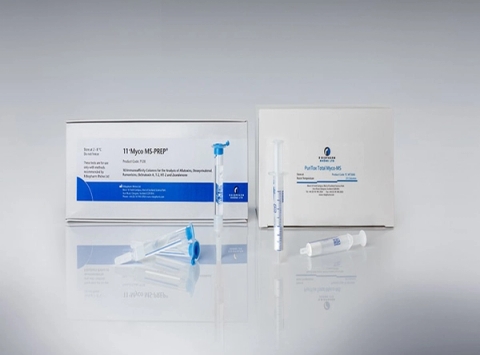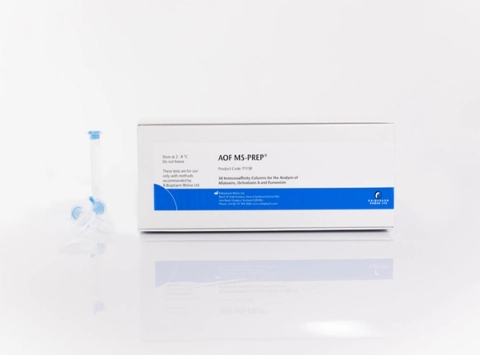
- LC-MS/MS is a modern analytical method used to detect and quantify substances at trace levels. Besides detecting veterinary drugs or pesticides, this method is commonly used to detect mycotoxins.
- LC-MS/MS has many advantages: very sensitive, efficient and suitable for many applications. Moreover, there are many multi-analyte analysis methods, which is very important, especially for mycotoxin analysis. However, LC-MS/MS also has a disadvantage: the analysis results are strongly affected by the sample matrix. These matrix effects cause uncertainty in the measurement.
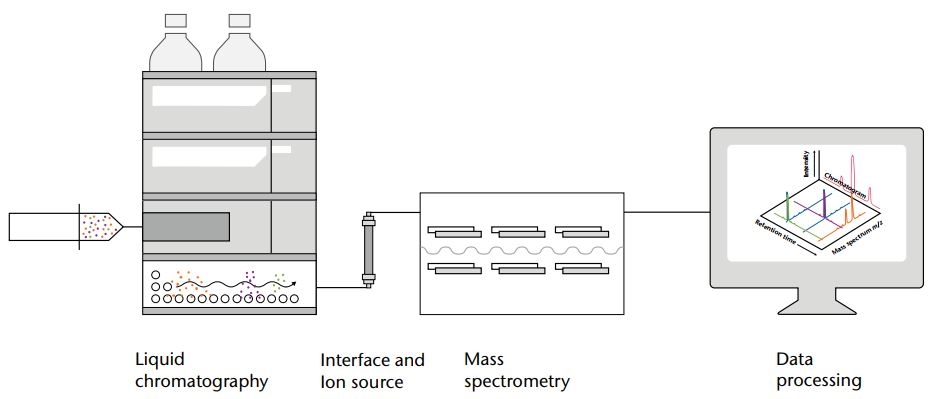
Matrix interferences in the LC-MS/MS method
- Matrix interference is caused by components in the sample, reducing or increasing the ionisation efficiency. This ion suppression or enhancement leads to under- or over-estimation of the analyte concentration, and therefore to uncertain results. Using suitable tools, these matrix interferences can be reduced or compensated for.
- One option is to use matrix-matched standards . Blank material and the real sample are treated in the same way and analysed together. Because the standard will be affected by the same matrix interferences as the sample, the matrix effects can easily be subtracted afterwards. Combined with a solid-phase extraction column (for example: PuriTox Total Myco-MS), this allows rapid and accurate analysis of simple samples. The disadvantage of this method is that two analyses must be performed (sample and standard sample).
- Stable isotope-labelled internal standards such as 13C standards are an alternative. Because these standards can be seen in LC-MS/MS, they can simply be added to the sample so that only one analysis is needed. However, these standards are expensive and available for only a few analytes.
- Another option for matrix interference is to remove the matrix entirely through sample clean-up. This can be done with immunoaffinity columns for one analyte or even for multiple analytes at once – for example with the 11+Myco MS-PREP® newly launched , which allows clean-up of eleven regulated mycotoxins in a single run. This immunoaffinity column is especially suitable for complex matrices such as spices or animal feed as well as baby food, for which very low detection limits are required. This solution allows rapid and accurate quantitative analysis without matrix-matched standards.