
1. What is ATP? How does ATP test technology usually work?
- ATP (Adenosine Triphosphate) is the energy molecule present in every living cell, including microorganisms, food, animal tissue and organic soil. The ATP test technology uses a bioluminescence reaction to measure the cleanliness – soiling level of a surface or water sample within seconds.
However, the major drawback of conventional ATP is:
- It only measures ATP, it does not measure ADP and AMP – two molecule forms that are present in greater amounts when ATP is degraded.
- Sensitivity depends on the amount of ATP remaining in the sample, so contamination risks are easily missed.
For this reason, the market has a demand for new technology that is more sensitive – more accurate – more stable.
2. What is Kikkoman's A3 technology?
Kikkoman – a pioneer in rapid hygiene testing – has developed the A3 (ATP + ADP + AMP). This is a proprietary technology that measures total bioenergy instead of just ATP.
* A3 technology is currently applied in:
- Lumitester Smart (ATP/A3 measuring device)
- Lucipac A3 Surface ATP swab (surface testing)
- Lucipac A3 Water ATP swab (water & CIP solution testing)
Thanks to the ability to measure 3 energy molecule forms simultaneously, the A3 system gives results much more reliable than conventional ATP.
3. Why is A3 technology up to 10 times more sensitive than regular ATP
3.1. Kikkoman A3 measures ATP – ADP – AMP as well
After cells die or organic soil is degraded, ATP breaks down into ADP and AMP. In food manufacturing practice:
- Usually only 20–40% ATP remains
- ADP & AMP make up the majority but cannot be measured by ATP test
A3 solves this problem by converting ADP and AMP into ATP, then luminescence → generating a signal 8–12 times stronger.
3.2. Kikkoman's proprietary enzyme system
- Lucipac A3 swabs contain a special enzyme system:
- Adenylate Kinase (AK) – converts AMP → ADP
- Pyruvate Kinase (PK) – converts ADP → ATP
- High-quality Luminase → amplifies the light signal
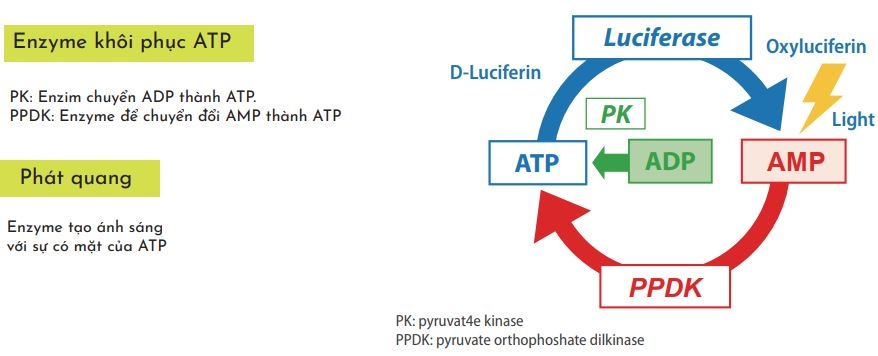
- Thanks to this, all biological markers are converted into ATP for measurement, with nothing missed.
3.3. Detecting even dead microorganisms
- Traditional ATP reacts strongly only with living cells. In contrast, A3 also detects destroyed cells, which still contain ADP/AMP.
* This is especially important
- After cleaning the production line (CIP)
- Surface checks before production.
- Control of the risk of microorganisms remaining.
3.4. Stable measurement signal & less interference
A3 technology minimizes the influence of:
- Temperature
- ATP degradation process
- Organic debris.
Therefore the results are stable – with little deviation – high reliability.
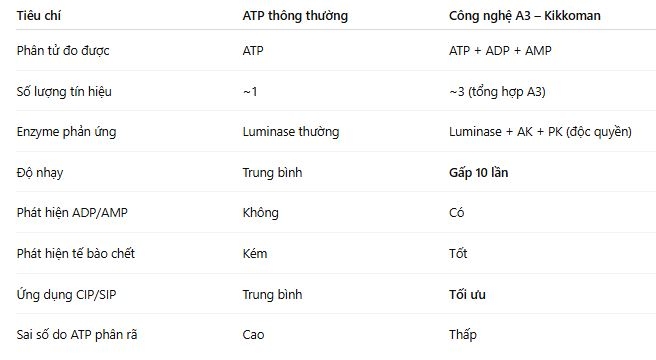
4. Comparison Table of Kikkoman A3 Technology & Conventional ATP
5. Conclusion – Why does A3 stand out?
- Because A3 measures all biological markers, not just ATP.
- Because A3 uses a proprietary enzyme system that increases the signal 10 times.
- Because A3 detects even dead or degraded microorganisms.
- Because A3 is most suitable for modern food hygiene control.
Therefore, Lumitester Smart + Lucipac A3 from Kikkoman is the highest standard today in rapid factory hygiene inspection.
* Kikkoman's A3 technology is a leap forward in ATP testing, helping:
- Increase sensitivity 10 times
- More comprehensive detection
- Stable and accurate signal
- Meets modern food safety standards well
👉 If you are looking for the most rapid – accurate – reliable hygiene assessment solution, Kikkoman A3 is the number 1 choice.