
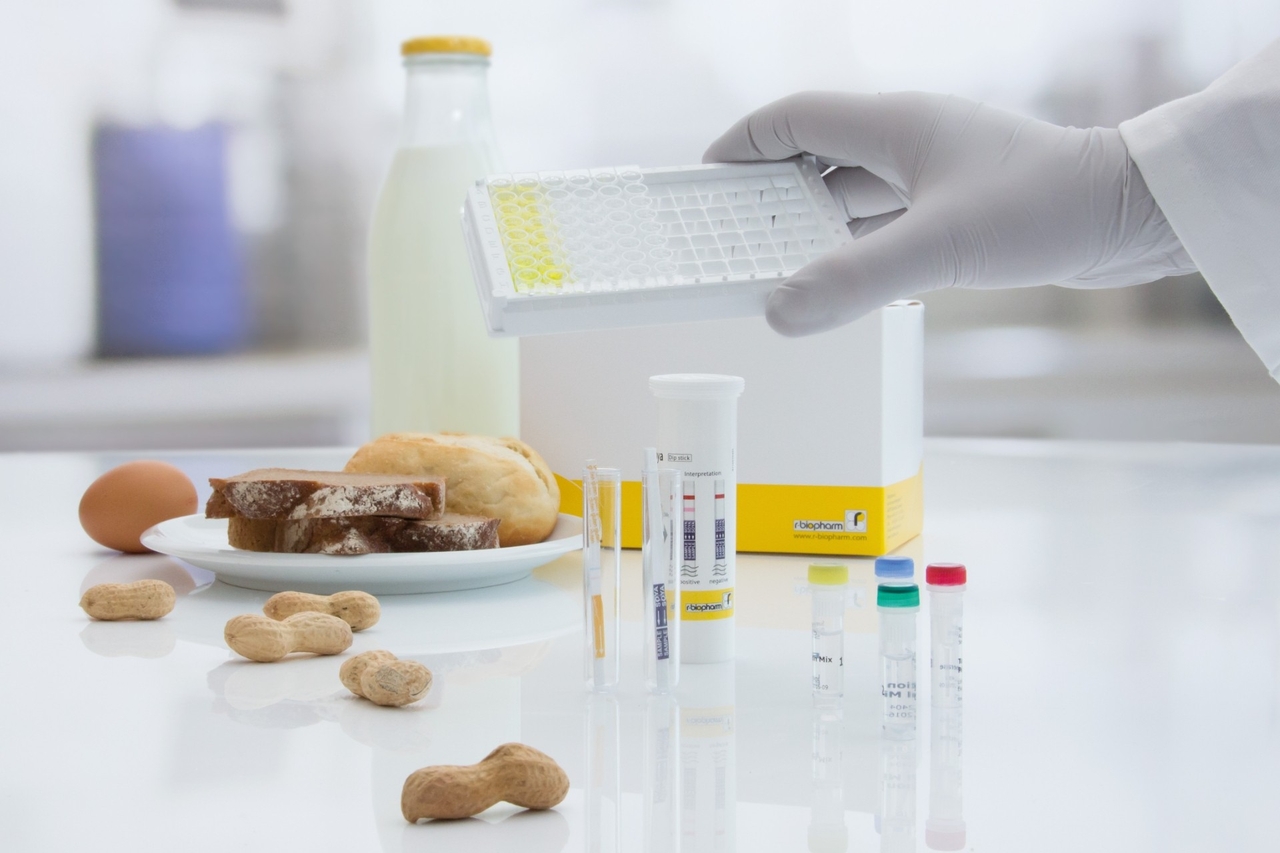
- In the field of food testing, the ELISA method (Enzyme-Linked Immunosorbent Assay) is one of the popular and effective analytical tools for detecting allergens, mycotoxins, veterinary drug residues, growth hormones, or genetically modified organisms (GMO).
- However, how to read ELISA test results is no less important than performing the technique, because it directly affects the reliability of the final assessment.
- The following article will guide you in reading and analysing ELISA test results accurately and scientifically in food testing.
1. Overview of the ELISA method in food testing
ELISA is an immunoassay method based on the antigen-antibody reaction and using an enzyme as the detection reagent. There are several variants of the ELISA technique such as:
- Indirect ELISA (Indirect ELISA)
- Competitive ELISA (Competitive ELISA)
- Sandwich ELISA (Sandwich ELISA)
* In food testing, the ELISA method is commonly used to:
- Detect food allergens (peanuts, soybeans, gluten, milk, eggs, seafood…)
- Detect mycotoxins (aflatoxin, ochratoxin, Zearalenon…)
- Detect veterinary drug residues (chloramphenicol, β-lactam…)
- Detect GMO (usually followed by PCR confirmation)
2. The main steps in ELISA testing
The ELISA procedure usually includes:
- Incubate the sample in the well: containing specific antibodies or antigens.
- Wash the well: to remove unbound substances.
- Add the enzyme conjugated to the antibody.
- Add the substrate: producing a colour reaction (usually yellow or blue).
- Read the results with a spectrophotometer (ELISA Reader): at a specific wavelength (usually 450 nm).
3. How to read ELISA test results
To read and interpret ELISA results correctly, the following principles must be followed:
3.1. Reading the optical density value (OD – Optical Density)
- The ELISA reader gives an OD value corresponding to the colour intensity produced by the enzymatic reaction. This value is directly proportional to the concentration of the substance being detected in the sample.
* Example:
- High OD ⇒ high analyte concentration.
- Low OD or close to the negative control ⇒ negative or negligible concentration.
3.2. Comparison with the standard (Standard Curve)
- For quantitative kits, a standard curve must be built based on standard samples with known concentrations. Based on the standard curve (which is pre-plotted by software or by the instrument), the operator interpolates to determine the concentration of the actual sample.
* Note:
- The standard curve must have a correlation coefficient (R²) > 0,98 to ensure reliability.
- Samples with concentrations outside the linear range of the standard curve must be diluted and re-measured.
3.3. Comparison with the cut-off value (cut-off value)
For qualitative kits (positive/negative), the manufacturer provides the cut-off value (the OD threshold limit):
- Sample with OD ≥ cut-off: positive.
- Sample with OD < cut-off: negative.
Some kits also provide a "grey zone", requiring repetition or checking by another method such as PCR to confirm.
4. Some notes when reading and interpreting ELISA results
- Repeat the sample: to increase reliability, each sample should be run at least twice (replicates).
- Check the blank: No reaction → check the background level and rule out instrument error.
- Check the standard deviation between replicates: If it is too large, the results may not be reliable.
- Note on kit storage conditions: deviations in storage can reduce enzyme activity, affecting the results.
- Compare with regulatory limits: for example, aflatoxin B1 in food must not exceed 5 µg/kg (according to EU or Vietnamese regulations).
Understanding how to read ELISA test results not only helps technicians make a correct assessment of a food sample but also ensures accuracy and reliability in testing. Depending on the testing objective (qualitative or quantitative), the operator must apply the correct procedure for comparing OD with the standard curve or the cut-off value.
Using ELISA kits that meet international standards, following the instructions for use, and evaluating results in the context of current legal regulations is the key to ensuring food safety for the community.
If you need help choosing a suitable ELISA kit for allergen, mycotoxin or antibiotic residue testing in food, do not hesitate to contact us – specialists in providing comprehensive and accurate food testing solutions.
* See also the article Competitive ELISA: principles and applications