
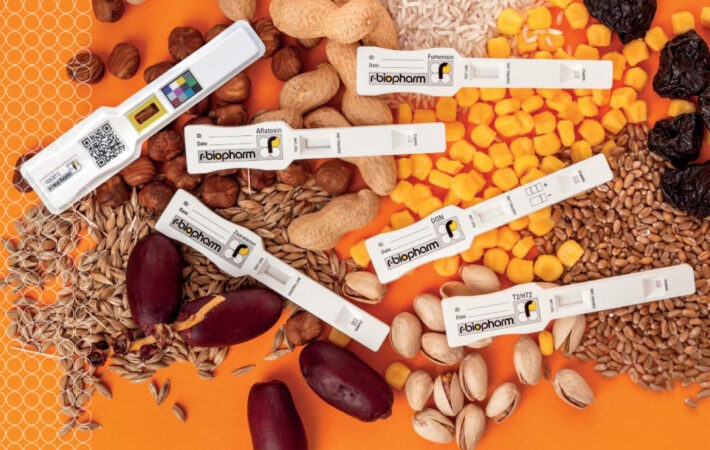
- In this group, Aflatoxin is of particular concern because of its high toxicity and is commonly associated with raw materials such as maize, soybean and other plant-based ingredients.
- For animal feed plants, testing laboratories and raw material buyers, rapid testing for mould toxins in animal feed helps identify at-risk batches early, so that acceptance, grading or in-depth testing decisions can be made.
- One of the most commonly used solutions is the range of Mycotoxin test kits from R-Biopharm, including rapid LFD test strip and ELISA technology.
1. Why test for mould toxins in animal feed?
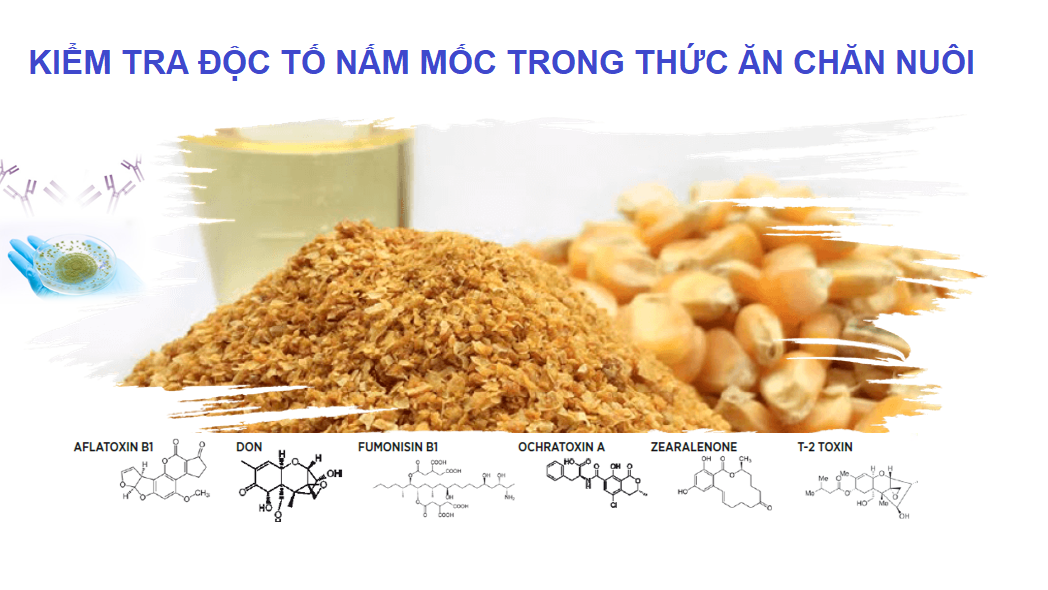
Mould can grow on raw materials during cultivation, harvesting, transport or storage. Some fungal species can produce mycotoxins such as:
- Aflatoxin B1, B2, G1, G2
- Deoxynivalenol (DON)
- Fumonisin
- Ochratoxin A (OTA)
- Zearalenone (ZEN)
- T-2/HT-2 toxin
Of these, Aflatoxin B1 is one of the most closely watched mould toxins.
- For animal feed manufacturers, mycotoxin testing can take place at many points:
Incoming raw materials → testing during production → finished products → batch control before dispatch.
- Early testing helps businesses limit the risk of using unsuitable raw materials and reduces the cost of dealing with problems discovered at the final stage.
2. How to rapidly test for mould toxins in animal feed
The actual testing procedure depends on the kit type, sample matrix and the toxin being analysed. The basic procedure usually includes:
* Step 1: Take a representative sample
- This is a particularly important step.
- Feed or raw material samples must be taken using a suitable sampling procedure, then homogenised to reduce errors caused by uneven distribution of mycotoxins.
* Step 2: Grind and homogenise the sample
- The sample is ground to a suitable particle size as instructed in the kit.
- The aim is to produce a homogeneous sample before extraction.
* Step 3: Extract the toxin
- The sample is extracted with solvent exactly as the manufacturer instructs.
- Sample/solvent ratio, extraction time and the filtration or centrifugation method may differ between kits.
* Step 4: Run the test
Depending on the test objective, businesses can choose:
- Rapid LFD testing (Lateral Flow) for rapid screening.
- Mycotoxin ELISA for quantification.
- HPLC or LC-MS/MS for confirmatory/in-depth purposes.
* Step 5: Evaluate the results
- Results must be compared against the control limits applicable to each feed type, livestock category and current regulations.
Note: do not rely on colour or rapid test results alone while ignoring sampling, sample preparation requirements and the detection limits of each method.
3. What is rapid mycotoxin testing?
- Rapid mycotoxin testing usually uses lateral flow immunoassay technology (Lateral Flow Device – LFD).
- Its greatest advantage is short analysis time, relatively simple handling, and suitability for rapid testing on site or at the raw material receiving area.
- R-Biopharm currently supplies the RIDA®QUICK range for rapid detection of many mycotoxins. According to the manufacturer, RIDA®QUICK kits have an incubation time of about 3 or 5 minutes depending on the product and sample matrix, and do not require calibration as some other quantitative methods do.
Some mycotoxin groups that can be tested with the RIDA®QUICK range include:
- Total Aflatoxin
- DON
- Fumonisin
- Ochratoxin A
- T-2/HT-2 toxin
- Zearalenone
- This allows businesses to build a programme for screening incoming raw materials for mycotoxins more quickly.
4. Comparing rapid mycotoxin testing and ELISA
The two methods businesses most often weigh up are rapid LFD testing and ELISA.
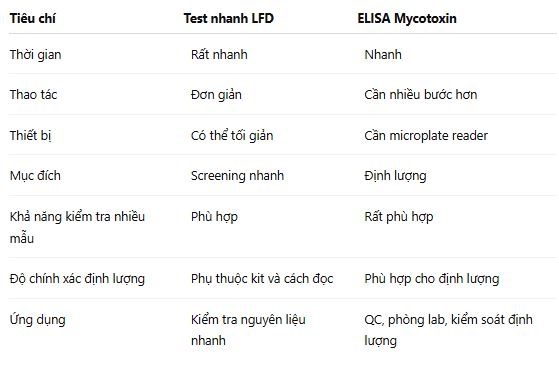
* When should you use a rapid test?
A rapid test suits businesses that need to:
- Quickly check raw materials at intake.
- Screen many batches.
- Quickly identify batches at risk of mycotoxin contamination.
- Make raw material acceptance decisions.
- Test quickly at the factory or in the production area.
* When should you use ELISA?
- Mycotoxin ELISA is more suitable when businesses need quantitative results for a quality control programme.
- For example, RIDASCREEN® Aflatoxin B1 30/15 from R-Biopharm is a competitive ELISA method for quantifying Aflatoxin B1 in cereals and animal feed. For feed matrices, the manufacturer publishes a detection limit of 4 µg/kg and an incubation time of 45 minutes.
- R-Biopharm also has RIDASCREEN®FAST Aflatoxin, used to quantify Aflatoxin in cereals and animal feed, with an assay time of about 15 minutes and a published detection limit below 1.7 µg/kg.
5. Why choose R-Biopharm for mycotoxin testing?
- R-Biopharm supplies many mycotoxin testing solutions, from rapid LFD tests to ELISA, letting businesses choose a method according to the purpose.
- The manufacturer's catalogue covers test groups such as:
- Aflatoxin
- DON
- Fumonisin
- Ochratoxin A
- Zearalenone
- T-2/HT-2
- Citrinin
- RIDASCREEN® and RIDASCREEN®FAST ELISA products are designed for many food and animal feed matrices.
- In particular, for Aflatoxin, businesses can choose from Aflatoxin B1, Total Aflatoxin and rapid test solutions, depending on the control requirement.
6. A suggested mycotoxin control workflow for animal feed plants
Instead of only testing when a problem appears, businesses can build a multi-tier control workflow:
* Tier 1 – Rapid raw material testing
- Use rapid mycotoxin testing for screening when raw materials are received.
↓
* Tier 2 – Quantitative testing
- Risk samples or samples needing quantitative assessment can be tested with R-Biopharm ELISA.
↓
* Tier 3 – In-depth confirmation
- For cases needing confirmatory results or serving in-depth analytical requirements, HPLC or LC-MS/MS can be used depending on the purpose.
- This approach helps businesses allocate resources sensibly: rapid tests for screening – ELISA for quantification – instrumental methods for confirmation when needed.
7. Common mistakes when testing for mycotoxins
7.1. Not taking a representative sample
- Mycotoxins can be unevenly distributed in raw materials, so incorrect sampling can have a big impact on results.
7.2. Ignoring the sample matrix
- A kit can have different detection limits on different matrices.
- For example, with RIDASCREEN® Aflatoxin B1 30/15, R-Biopharm publishes different LODs for cereals, soy, dry cat food and feed.
7.3. Choosing the wrong parameter
- If the regulation requires total Aflatoxin but the business only tests Aflatoxin B1, the two results should not be assumed to be equivalent.
7.4. Not considering the kit's detection limit
- A method is only genuinely useful when its detection limit matches the control level the business needs.
7.5. Testing only the finished product
- Controlling from incoming raw materials onwards usually makes businesses more proactive in managing mycotoxin risk.
8. Which method should you choose for mould toxin testing?
- There is no single method that suits every case. If the goal is to quickly test raw materials, a rapid LFD test is the convenient choice.
- If you need to quantify Aflatoxin/mycotoxins, ELISA is the right choice for testing laboratories and QC programmes.
- If you need in-depth confirmatory analysis, HPLC or LC-MS/MS can be selected according to requirements.
- For animal feed manufacturers, the combined model – rapid test → ELISA → confirmatory method – can help build a more effective and flexible mycotoxin control workflow.
9. R-Biopharm mycotoxin test kits – a mould toxin control solution
- If your business is looking for mould toxin test kits for animal feed, R-Biopharm offers many options for both rapid testing and mycotoxin ELISA.
* Some representative products:
- RIDA®QUICK Aflatoxin → suitable for rapid screening needs.
- RIDASCREEN®FAST Aflatoxin – R5202 → quantitative Aflatoxin ELISA, assay time about 15 minutes.
- RIDASCREEN® Aflatoxin B1 30/15 – R1211 → quantifying Aflatoxin B1 in cereals and feed.
- RIDASCREEN® Aflatoxin Total – R4701 → quantifying total Aflatoxin in cereals and feed.
- Product selection should be based on the mycotoxin type, sample matrix, required limit and testing purpose.
10. Conclusion
- Rapid testing for mould toxins in animal feed is an important step that helps businesses proactively control the quality of raw materials and finished products.
- Especially for Aflatoxin, businesses need to distinguish clearly between Aflatoxin B1 and total Aflatoxin, and check results against the limits applicable under Vietnamese regulations.
- With the R-Biopharm product system, businesses can choose from rapid LFD tests to mycotoxin ELISA, meeting many testing needs from raw material screening to quantification in the QC lab.
- Do you need to test for Aflatoxin B1, Total Aflatoxin or other mycotoxins in maize, bran or animal feed? Choose the kit based on the right sample matrix and testing purpose to ensure suitable results.
See the products for rapid mould toxin test kits here.