
1. Preparing the media
– Prepare agar media: common agar media include Nutrient Agar, Sabouraud Dextrose Agar (SDA), or MacConkey Agar depending on the type of microorganism to be cultured.
– Sterilise the media: the media must be dissolved in water and sterilised in an autoclave at 121°C for about 15-20 minutes. After sterilisation, the media must be left to cool to about 45-50°C before pouring into Petri dishes, avoiding too high a temperature as this can crack the dish and too low a temperature as this will set the media before it is poured.
2. Preparing instruments, consumables and equipment
– Petri dishes: use sterilised Petri dishes (usually sterilised by autoclaving or supplied sterile by the manufacturer).
– Aseptic cabinet: work should be carried out in a laminar flow cabinet to ensure the media and Petri dishes are not contaminated during pouring.
– Alcohol stove or spirit lamp: for disinfecting the neck of the media container when needed.
3. Making the work area aseptic
– Clean and disinfect the work area: wipe the workbench with a disinfectant such as 70% ethanol, making sure no dust or bacteria remain.
– Aseptic hands: wash hands with antiseptic solution or wear sterilised gloves.
– Cabinet: if you work in a laminar flow cabinet, switch on the UV lamp about 15-30 minutes before starting work to kill bacteria in the work area.
4. Procedure for pouring media into Petri dishes
4.1. Preparing the media
– Take the media container (after sterilisation) out of the autoclave. Check whether the media has cooled to 45-50°C by feeling it with your hand or using a thermometer.
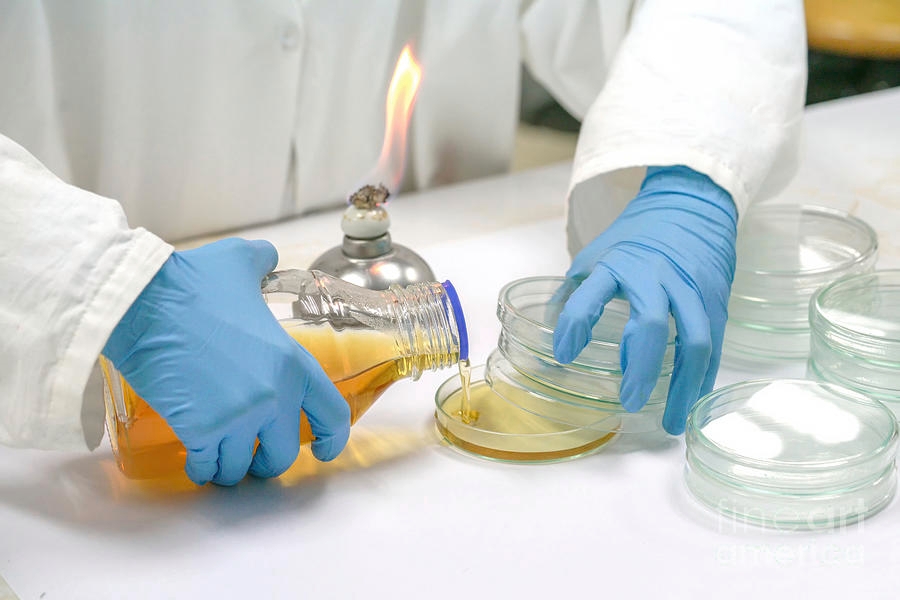
– Disinfect the neck of the media container by passing it over the flame of the spirit lamp before pouring to reduce the risk of contamination from the air.
4.2. How to pour media into Petri dishes
– Open the Petri dish: gently lift the lid, opening it only wide enough to pour in the media in order to avoid too much exposure to the air.
– Pour the media: hold the container slightly tilted and pour about 15-20 ml of media (equivalent to about 1/3 of the height of the Petri dish) into each dish. Pour slowly and carefully to avoid creating air bubbles.
– Replace the lid: after finishing pouring, put the Petri dish lid back on immediately to avoid exposure to bacteria from the air.
4.3. Removing air bubbles (if any)
If air bubbles appear on the surface of the media, you can carefully pass them lightly over the flame to remove them. Take care not to burn the media.
5. Letting the media set
– After pouring the media, leave the Petri dishes on a flat bench and leave them at room temperature (under aseptic conditions) for about 15-30 minutes until the media has completely set.
6. Storage and use
– After the media has set, if it is not used immediately, you can wrap each Petri dish in plastic film or place them in sterile nylon bags and store them in a refrigerator (4°C) for later use.
– Labelling: do not forget to clearly write the media type, the pouring date and any other necessary information on the bottom of the Petri dish.
7. Some notes
– Media temperature: Pouring media when the temperature is too high can damage the Petri dish (especially plastic dishes), while if the temperature is too low, the media will set too early before you finish pouring.
– Volume of media: Make sure the amount of media is enough to create a uniform agar layer, but do not pour it too thickly, avoiding waste and creating uneven conditions for bacteria to grow.
– Asepsis: Maintain aseptic conditions from start to finish to ensure there is no bacterial contamination in the media.
With this procedure, you can ensure that media is poured into Petri dishes accurately and safely for microbiological experiments.